"What Does the Tucker Foundation Do?"
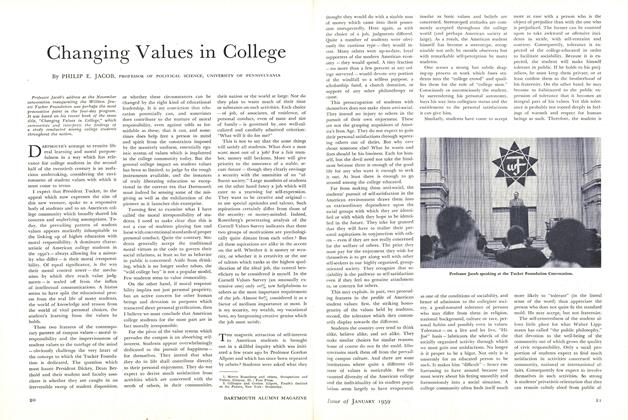
THE formal inauguration of the William Jewett Tucker Foundation in November led several alumni to suggest that the ALUMNI MAGAZINE report something of the program that the Foundation, under Dean Fred Berthold Jr. '45, plans to carry out "to support and further the moral and spiritual work and influence of the College."
A comprehensive summary of the Tucker Foundation's program was written by Dean Berthold for The Dartmouth at the time of the November convocation, and to answer alumni questions we present here the greater part of that excellent statement:
Program development is still in its early stages, open to revision in the light of experience and the suggestions of critics and friends.... A number of programs from the past are being continued or modified. But there are also a number of new ventures, some of them already launched, some still in the planning stage.
1. Visiting Professors. The Foundation hopes to bring at regular intervals, either for a term or a year, distinguished visiting scholars. They would be men who by virtue of their attainments would be welcome in the regular Dartmouth curriculum and who also have something to contribute in the area of the broad concerns of the Foundation. They need not be theologians or even religious men but they would have to be the kind of person who would enliven and deepen our awareness of ethical and/or religious issues.
This program was initiated this fall by Professor Paul Holmer of the University of Minnesota. In addition to teaching Nineteenth Century Philosophy he will give two public lectures on Soren Kierkegaard.
2. Conferences. From time to time the Foundation will arrange a conference on some special theme. This year a Convocation is being held to inaugurate the work of the Foundation. In February a conference will be held on "The Individual and the Organization." Featured will be addresses by Mr. Irwin Miller and Dr. Margaret Mead, as well as the prize-winning essay from a student contest on this same theme.
3. Lectures. This year for example Dr. C. A. Coulson, F.R.S., a noted mathematical physicist, will give two lectures on February 10. One lecture will be technical and the other a public lecture on "Religion and Science - Cooperation or Conflict?"
Also, the Foundation is delighted to announce that Professor Paul Tillich will be on the Dartmouth campus for the entire week of April 27-May 1. He will deliver a series of public lectures and meet various groups informally. His visit is made possible by the generosity of the Jacob Ziskind Charitable Trust.
4. Honor System. Let us now look at something which has not taken definite shape but in which the Foundation is profoundly interested: the honor system. This refers not simply to exams without proctors — or exams with student-instead-of-faculty proctors (which seems to be an implication of the "reporting clause"). It refers to a broader complex of problems which are bound up with student responsibility and honor: - such things as responsibility for self-regulation in dormitory social life, personal initiative and responsibility in academic matters other than examinations.
Few people would deny that Dartmouth, by virtue of her espoused aim of freedom-with-responsibility, is committed to wrestling with the problem of an honor system. We cannot rest with a situation in which virtue is insured by police work. We have to regard it as a measure of our individual and collective failure.
The Tucker Foundation as such has no specific honor system to recommend - at least not yet. But it is eager to explore the question: what are the conditions which make an honor system viable?
5. Social Issues. The Foundation is concerned to relate the moral sensibilities of the campus to broader social issues. This concern is also embodied in other aspects of the Dartmouth scene - such as the Great Issues course. One topic of the November Convocation, for example, is "discrimination on the campus." Professor Gordon Allport will relate this to the broader problem of prejudice in our society. It is hoped that, in the future, resources of the Foundation may be used to supplement the work of others on the campus who are concerned with specific political, economic and social problems.
6. Undergraduate Religious Lite. Two undergraduate organizations are directly concerned with student religious life. Both of these, the Dartmouth Christian Union and the Jewish Life Council, are members of C.0.5.0. Thus, they are independent student groups. Like all groups in C.O.S.O., however, they are expected to develop their programs with the aid of an adult adviser.
The Reverend George Kalbfleisch has served since 1948 as the adviser to the Dartmouth Christian Union. It was with his guidance and encouragement that, in 1950, the Jewish Religious Life Council (now Jewish Life Council) was formed. Since that time he has also acted as its adviser. Thus, in effect, Mr. Kalbfleisch is the coordinator of undergraduate religious activities. He has now been named as a staff member of the newly established Tucker Foundation.
7. The Dartmouth Christian Union. There can be no doubt that the D.C.U. represents the single strongest ally of the Tucker Foundation on the side of the Foundation's concern with the religious life. Over the years the D.C.U. has developed a varied and powerful program. Through the Student Christian Movement it takes part in the world-wide concern of Christian people for building a more just and humane society. It directly aids needy students abroad and keeps us here in touch with their aspirations and problems. The D.C.U., through its program of work trips and hospital visitations, is the primary channel through which many Dartmouth students respond to the human needs around them. Discussion and study groups bring about a dialogue between believers and sceptics, or between the believing and sceptical sides of the same person.
8. Jewish Life Council. The Jewish Life Council has developed a vigorous and extensive program, concerned both with Jewish worship and with the study and discussion of Jewish culture. Through the offices of the Tucker Foundation, an arrangement was completed on an experimental basis with the National Hillel Foundations to bring to the Dartmouth campus semi-weekly an ordained Rabbi to conduct religious services and to advise the Jewish Life Council. Rabbi Julius Kravetz of New York, N. Y., has already begun this work.
Work will shortly be completed in Rollins Chapel which will make available to the Jewish Life Council a center of worship for the Sabbath services as well as for special Holy Days.
9. Liaison with Religious Groups. Many religious bodies touch in one way or another upon the life of the campus. Most obvious is the work of various local churches, all of which reach and serve a segment of the Dartmouth community. Requests for leadership from Dartmouth people come all the time from the churches of this area. For a number of years, for example, Dartmouth people have helped with an "Academy of Parish Practice," a monthly meeting of parish ministers who undertake a course of reading and hear lectures on topics in the field of philosophy, or theology, or social ethics. The Dean of the Tucker Foundation will act as liaison person with all such religious bodies.
10. Counseling. It is expected that the Tucker Foundation will help to coordinate such opportunities as the Dartmouth community has available in the field of religious counseling. Both Dean Berthold and the Reverend George Kalbfleisch are, of course, ready to be of service in this way.
ii. Chapel. Rollins Chapel has been the center of College worship services since it was built in 1885. Until recently a "Chaplain" or "Director of Chapel" presided over Rollins. Now this responsibility passes into the hands of the Dean of the Tucker Foundation. Chapel services are held on four days of the week. Beginning next week, faculty persons or clergymen will conduct two of these services each week, students leading the remaining two.
12. Union Services. Six times a year the College joins with the Church of Christ (Congregational), St. Thomas Church (Episcopal) and Our Savior's Chapel (Lutheran) for worship in Rollins Chapel. On these occasions distinguished preachers are brought to Hanover to deliver the sermon, though this year Dean Berthold preached the first in the series and also will preach the last.
13. Bull Sessions. Dean Berthold's home at 36 North Main Street will be used frequently for informal bull sessions, sometimes with student-faculty groups, sometimes just with students or with faculty.
Finally, one may ask what must be done to liberate us from the special weaknesses that characterize our campus - from the apathy that breaks asunder our ties with human beings in need or suffering injustice, from the toleration of ignorance that threatens the fundamental seriousness of the whole educational process, from the lack of involvement in those democratic processes upon which our way of life depends, from the prejudices that wall us off into competing and "posturing" groups, from the chaos that on occasion threatens our dormitory life? No Foundation, not even one bearing the proud name of William Jewett Tucker, can answer these questions. But it may stand as a witness to the growing awareness of our need to join one another in facing them seriously.
To provide advice on the Tucker Foundation program, the Tucker Council has been formed, consisting of three faculty members, five students and two alumni. At present its members are Prof. Earl R. Sikes, chairman, Prof. Raymond W. Barratt, Prof. Frank G. Ryder, John E. Baldwin '59, Paul K. Clarkin '59, Sigmund G. Ginsburg '59, Richard G. Jaeger '59, Borden Powers '60, Charles E. Griffith '15 and Charles F. Tesreau '38.