1909
Romance of Lucy and Dick
The love affairs of Leander and Hero, Romeo and Juliet, Lil Abner and Daisy Mae have been more widely publicized, but right in our own family circle is a beautiful romance that has never been revealed to the reading public. It is the romance of Dick Lane '07 and Lucy Soper, a luscious darkeyed lass who hailed originally from Bloomington, Ill. Although Dick's courtship of elusive Lucy covered a period of ten years, he finally captured the prize through a little strategy which was suggested by a Dartmouth wife. But let's start at the beginning.
While Dick was in college he worked several summers for the Chicago Club at Charlevoix, Mich., to help pay for his education. It was here that the Sopers had a summer place and eventually Dick met Lucy and was with her on sailing parties. With him it was almost a case of love at first sight, but not with Lucy. She was having too good a time to sign up with any one guy. Dick kept on her trail, however, and after he had graduated from Dartmouth and from Tuck School, he got a job in Chicago with Butler Brothers.
Mr. Butler was a member of the Chicago Club at Charlevoix and had a home there. Dick spent a couple of vacations at the club as a guest. He still maintained contact with Lucy and made some progress with the little lady, but not enough. Then Dick moved to Boston, and although absence from Lucy made his heart grow fonder, his case looked almost hopeless.
It was then that Mrs. E. K. Hall, who had adopted Dick into her family, went to bat. She advised him: "Write to Lucy and tell her to accept my invitation to visit our summer camp at Jackman, Me.; near the Canadian border."
Mrs. Hall further told Dick to add a postscript urging Lucy to come, but if she couldn't to let him know soon so he might invite another girl, much as he preferred her. "If that postscript doesn't bring home the bacon," Mrs. Hall remarked, "you'd better look around."
Lucy accepted the invitation, came on to Boston and up to Maine. One evening Dick and Lucy spent a romantic evening alone on a cabin porch, and this time she accepted his proposal.
The next morning, at breakfast, the other folks asked leading questions, indicating what they expected to hear, and the loving couple gave them the answer. E. K. Hall, who was planning a trip into the woods and was filling a flask at the time, when he got the word, kept on pouring, but on the floor, not in the flask.
That's how Dick finally won his Lucy. They were married on June 17, 1916, and they've lived happily ever since.
E. K. Hall '92 was one of Dartmouth's best known alumni, a top executive in the utilities field, and the one who financed Dick’s House in connection with the Mary Hitchcock Hospital after he had lost his son, Dick. Because of Dick's House, numberless Dartmouth students have made progress in recuperation after hospital confinement, or during ailing periods.
As for Dick, he" made a name for himself in college, and he reached the top in business. As an undergrad, he was manager of the Dramatic Club, a member of the Aegis Board, and played on the basketball team. With all these activities, he qualified for Phi Beta Kappa. Immediately after graduation, he served as graduate athletic manager for two years during which time he completed his work in Tuck School with an MCS degree. He has been class secretary since 1932, has served two terms on the Alumni Council, and, in 1958, he received an Alumni Award for Outstanding Service to Dartmouth.
After serving two years during World War I in the Army Ordnance Department in Washington, retiring as a major, he joined the Kendall Company of Boston. Here he progressed through various positions to become its president, and at the time of his retirement in 1955, its chairman of the Executive committee.
So Lucy did all right for herself with the mate she selected that evening on the porch up in Maine.
Dartmouth Wah-Hoo-Wahers
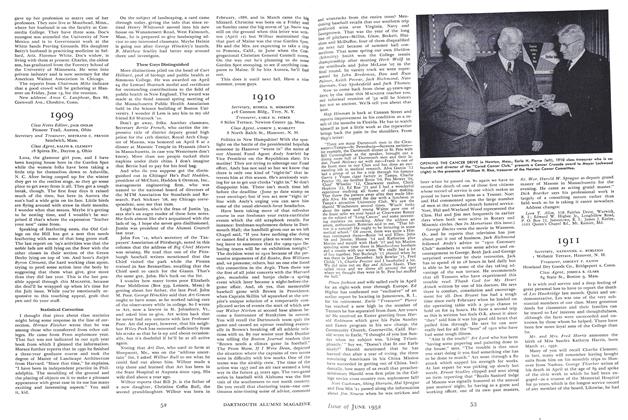
Our esteemed classmate, Nut Root, never had an undergrad picture o£ his older brother Fred '04 until the one accompanying this column was dug up by Tubby Besse '05. The pipe smoking quartet, snapped on Mam Street in Hanover in 1903, includes: Fat Peirce '05, Jonas Hutchinson '05, Pray Wadham '03, and Fred Root '0O4. The German student caps were brought from Germany by Fred's mother. Note the family resemblance between Nut and his brother.
Of this group, only Pray (that's his given name) remains alive, He's presently located in Gettysburg, Penna., where he may have become acquainted with a Dartmouth son adopted through an honorary degree - Ike Eisenhower.
One of the all-time Dartmouth mysteries was the strange disappearance of Jonas Hutchinson, who was nicknamed "Judge" because his father was a prominent judge in Chicago. Not long after his graduation and his return to the Windy City, he disappeared one night and no trace of him has been found since that time. His sisters spent considerable money trying to uncover some clue, but to no avail. Judge was one of the popular Dartmouths of his time. He was a member of Deke and the Sphinx senior society, as were Nut's brother and Nut, himself. College records have kept Judge on the missing list, but recently he is listed as dead.
These are the days when many guys around our time have retired, are semi-retired, or are approaching either state. A Dartmouth friend, who is in the. "semi" class, has taken residence in Arizona, in a town that he says rivals Aurora as the Garden Spot of America. He's a foresighted person who started thinking about retirement years before he pulled up stakes for the southwest. "As I saw it coming," he wrote, "I read things about how to accept it. Retirement is a status, or the status of many Dartmouth contemporaries. If they aren't they should be — you know, through partial, semi, or complete. I think the answer is to avoid this thing called 'complete retirement.' No one, short of an invalid, need accept that condition."
My friend amplifies this thought a little further: "One has to keep thinking that he is important to something or to someone, even if it's only the landscaping, weekly letters to friends, the chairmanship of some committee, the condition of the roof, or the tires. That guy is licked who concludes that, as he is no longer the executive vice-president, he is good for nothing."
Being an observing man, my friend is able to study various retirement conditions in his present location and see what to do and what not to do. "Anyhow, he concludes, "let's not be like the old bankers who don't die - they just lose interest."
February's the birth month of two great Americans: George Harris Hinckley on the 12th, and Harold Cushing Whitmore on the 22nd.
This quartet of "Early Americans" are (l to r) Fat Peirce ’05, Jonas Hutchinson ’05, J. P. Wadham '03, and Fred Root '04. The picture was taken on Main St., Hanover.
Class Notes Editor, 141 Pioneer Trail, Aurora, Ohio
Secretary and Treasurer, Sandwich, Mass.
More From This Issue
-
 Feature
A Dollop of Yankee Talk
February 1961 -
 Feature
Campus Cosmopolitans
February 1961 -
 Feature
Now They're Flicks, Not Movies, But The Nugget Still Carries On
February 1961 -
Feature
Dr. Myron Tribus of UCLA Named Dean of Thayer School
February 1961 -
 Feature
SNOW TIME
February 1961 -
 Article
Problems of Land Development in the New African Nations
February 1961