PROJECT ABC
Dartmouth and independent school group cooperate to offer special program for disadvantaged boys
AN experimental program designed to give socially and educationally disadvantaged secondary-school students "A Better Chance" will be inaugurated at Dartmouth College next summer.
Known as Project ABC (for "A Better Chance"), it will be a collaborative effort by Dartmouth and the independent secondary schools that participate in the National Scholarship Service and Fund for Negro Students Independent Schools Program.
It will bring some fifty Negroes and others from lowincome families to the Dartmouth campus for eight weeks of intensive study in July and August. If they make satis-factory progress during the summer, they will enter one of the participating independent schools in the fall. They will have already received contingent admission and scholarships to these schools.
The aim is to prepare them for admission to the college of their choice on completion of their secondary-school studies.
ROCKEFELLER GRANT AIDS PROGRAM
The Rockefeller Foundation is supporting the three-year experimental program with a $150,000 grant.
Students for the summer 1964 program have been selected from among those in the first two years of high school, primarily from New England and New York. All were chosen for their mental capacity and leadership potential, but they also had to be among those who probably would not qualify for college in their existing circumstances. They are "academic risks" in that they will need special preparation to succeed in an independent secondary school.
At Dartmouth they will receive intensive tutorial instruction in English and mathematics from about ten experienced teachers selected from the Dartmouth faculty and secondary schools. In addition, about ten Dartmouth undergraduates will assist as resident tutors.
President Dickey said that "the primary objective educationally is to determine whether an intensive and highly individualized effort on a campus of higher education can help remedy the academic and cultural deprivation which stands between 'a promising potential' and its educational fulfillment."
He stated that Negroes and other disadvantaged groups face a deepening and dangerous frustration of their aroused desires for equal opportunity unless more individuals from these groups can be qualified for participation in the leadership sector of our society.
"The main barrier to this development in most northern colleges is the lack of qualified applicants for admission and financial aid.
"Progress on the problem requires action at all levels and in various ways, but any swift, substantial improvement will depend upon qualifying more candidates for college from boys and girls now in the early stages of their secondary schooling.
"As with everything else in education this problem cannot stand still; the growing competition for higher education will push the problem back into deeper hopelessness unless at least a start is made on its improvement immediately."
THE PARTICIPATING SCHOOLS
Participating independent schools are Abbott Academy, Andover, Mass.; The Barlow School, Amenia, N. Y.; The Cheshire Academy, Cheshire, Conn.; The Choate School, Wallingford, Conn.; Commonwealth School, Boston; Concord Academy, Concord, Mass.; Dana Hall School, Wellesley, Mass.; Deerfield Academy, Deerfield, Mass.; Emma Willard School, Troy, N. Y.; George School, Bucks County, Pa.; Governor Dummer Academy, South Byfield, Mass.; Groton School, Groton, Mass.; The Gunnery, Washington, Conn.; Hebron Academy, Hebron, Me.; The Hotchkiss School, Lakeville, Conn.; Kent School, Kent, Conn.; Kiskiminetas Springs School, Saltsburg, Pa.; Lenox School, Lenox, Mass.; Mount Hermon School, Mount Hermon, Mass.; Northfield School, East Northfield, Mass.; Phillips Academy, Andover, Mass.; Pomfret School, Pomfret, Conn.; Putney School, Putney, Vt.; St. George's School, Newport, R. I.; St. Mary's in the Mountains, Littleton, N. H.; St. Paul's School, Concord, N. H.; The Taft School, Watertown, Conn.; Tilton School, Tilton, N. H.; Western Reserve Academy, Hudson, Ohio; and Windsor Mountain School, Lenox, Mass. Chairman of the independent schools group is Howard L. Jones, president of Northfield and Mt. Hermon Schools.
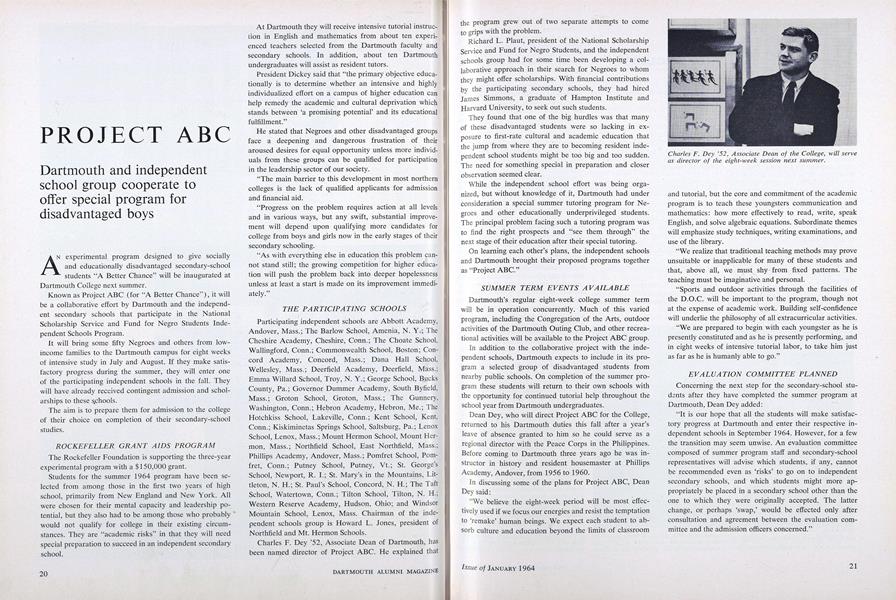
Charles F. Dey '52, Associate Dean of Dartmouth, has been named director of Project ABC. He explained that the program grew out of two separate attempts to come to grips with the problem.
Richard L. Plaut, president of the National Scholarship Service and Fund for Negro Students, and the independent schools group had for some time been developing a collaborative approach in their search for Negroes to whom they might offer scholarships. With financial contributions by the participating secondary schools, they had hired James Simmons, a graduate of Hampton Institute and Harvard University, to seek out such students.
They found that one of the big hurdles was that many of these disadvantaged students were so lacking in exposure to first-rate cultural and academic education that the jump from where they are to becoming resident independent school students might be too big and too sudden. The need for something special in preparation and closer observation seemed clear.
While the independent school effort was being organized, but without knowledge of it, Dartmouth had under consideration a special summer tutoring program for Negroes and other educationally underprivileged students. The principal problem facing such a tutoring program was to find the right prospects and "see them through" the next stage of their education after their special tutoring.
On learning each other's plans, the independent schools and Dartmouth brought their proposed programs together as "Project ABC."
SUMMER TERM EVENTS AVAILABLE
Dartmouth's regular eight-week college summer term will be in operation concurrently. Much of this varied program, including the Congregation of the Arts, outdoor activities of the Dartmouth Outing Club, and other recreational activities will be available to the Project ABC group.
In addition to the collaborative project with the independent schools, Dartmouth expects to include in its program a selected group of disadvantaged students from nearby public schools. On completion of the summer program these students will return to their own schools with the opportunity for continued tutorial help throughout the school year from Dartmouth undergraduates.
Dean Dey, who will direct Project ABC for the College, returned to his Dartmouth duties this fall after a year's leave of absence granted to him so he could serve as a regional director with the Peace Corps in the Philippines. Before coming to Dartmouth three years ago he was instructor in history and resident housemaster at Phillips Academy, Andover, from 1956 to 1960.
In discussing some of the plans for Project ABC, Dean Dey said:
"We believe the eight-week period will be most effectively used if we focus our energies and resist the temptation to 'remake' human beings. We expect each student to absorb culture and education beyond the limits of classroom and tutorial, but the core and commitment of the academic program is to teach these youngsters communication and mathematics: how more effectively to read, write, speak English, and solve algebraic equations. Subordinate themes will emphasize study techniques, writing examinations, and use of the library.
"We realize that traditional teaching methods may prove unsuitable or inapplicable for many of these students and that, above all, we must shy from fixed patterns. The teaching must be imaginative and personal.
"Sports and outdoor activities through the facilities of the D.O.C. will be important to the program, though not at the expense of academic work. Building self-confidence will underlie the philosophy of all extracurricular activities.
"We are prepared to begin with each youngster as he is presently constituted and as he is presently performing, and in eight weeks of intensive tutorial labor, to take him just as far as he is humanly able to go."
EVALUATION COMMITTEE PLANNED
Concerning the next step for the secondary-school students after they have completed the summer program at Dartmouth, Dean Dey added:
"It is our hope that all the students will make satisfactory progress at Dartmouth and enter their respective independent schools in September 1964. However, for a few the transition may seem unwise. An evaluation committee composed of summer program staff and secondary-school representatives will advise which students, if any, cannot be recommended even as 'risks' to go on to independent secondary schools, and which students might more appropriately be placed in a secondary school other than the one to which they were originally accepted. The latter change, or perhaps 'swap,' would be effected only after consultation and agreement between the evaluation committee and the admission officers concerned."
Charles F. Dey '52, Associate Dean of the College, will serveas director of the eight-week session next summer.