THE UNDERGRADUATE CHAIR
Two or three students took charge of the ropes and a thickening crowd stood quietly and respectfully watching the flag flutter down to half mast on that dark Friday, November 22. With this spontaneous gesture of tribute to the man who had in a real and special way been the leader of our generation, Dartmouth College joined the nation in mourning the loss of John Fitzgerald Kennedy.
The team had left for Princeton and the thoughts of all of us had been on the Ivy race, exams, and the vacation ahead when WDCR broke into a recording of "Something's Gotta Give" to tell us that the President had been shot. Across the campus radios were turned on, people crowded before televisions, and many of us went into the newsroom of The Dartmouth to watch the UPI teletype. The crowd there spilled out into the hall and a crew-cut student read out every word the keys printed. He read about the stock market drop and he read about Dallas' Parkland Hospital, and at 2:07 the machine's bulletin bell rang and he read that the President was dead. As we walked out of Robinson Hall the flag was being lowered by the students who had taken the task upon themselves without waiting for official action by the College.
The day was overcast and quiet. Small groups on the sidewalks and walking across the Green stopped and talked. At Lou's the midafternoon coffee-break crowd was listening to the turned-up radio with the details about the bullets and the race to the hospital and wondering what kind of a place Dallas, Texas, is. That night one fraternity spent hours trying to draft a meaningful telegram to Mrs. Kennedy, finally settled on: "Would that we could lighten the burden of your grief." When the news came that the game had been postponed and Saturday classes cancelled none of us really seemed to care, except for a few who wondered if Kennedy would have wanted everything to stop. A jazz and folk concert was called off that night and equipment was set up in Spaulding Auditorium to project the television coverage onto the screen; more than a thousand of us went in to watch during the evening. By 11:00 p.m. The Dartmouth had put out an "extra" which provided area readers with the first printed account of the assassination.
On Saturday a soft rain was falling, a rain, we were thinking, not unlike that which Kennedy had walked through in Dallas Friday. And at Dartmouth, which in matters of student religion can most softly be described as "non-denominational," we went to church on Sunday. A special afternoon memorial service crowded Rollins Chapel for the first time in years, and we listened to John Sloan Dickey say some of the things which needed to be said. Several carloads of Dartmouth men left during the afternoon and evening to be among the thousands who waited through the night to file past the coffin.
There were no classes on Monday either, but by Tuesday there was definite quickening of the pace toward normal. Who is Lyndon Johnson, we wanted to know; how old is Bob Kennedy; what's the story on William Scranton; and how about Nelson Rockefeller? It was time to get moving again, and moving again "with vigor."
With the announcement of a new, improved resolution on racial discrimination early in December, the Interfraternity Council feels it has gone about as far as it can go - for a while, anyway.
Main feature of the resolution is a statement which must be signed by "each and every individual who pledges a Dartmouth College fraternity" asserting that he will not use "race, religion, or national origin as a criterion for voting or influencing others' votes on any matter in my fraternity." Enforcement is to be accomplished by the house presidents.
Also included is a provision that "no eligible rushee shall, be refused admission to any fraternity ... on the first night of rushing." Action on the entire resolution was unanimous.
The new resolution met with apparent approval on all sides and brought at least a temporary halt to the frequent-to-the-point-of-tedium harangues on the subject in the editorial columns of The Dartmouth. That paper's morning editorial gave credit for a "solid, though unspectacular, job," and noted that the IFC had "ridden out a nasty situation while retaining most of its dignity."
At the same meeting, however, a proposal to abolish the blackball was voted down, again unanimously. Opposition to the abolition centered around difficulty of enforcement and the fact that the blackball was not essentially concerned with racial discrimination.
This failure to act could lead to future difficulties, and IFC President Ron Schram '64 has informally suggested that as a final solution the voting procedures of all houses might be standardized.
As first-term finals began, no one seemed aware that the honor system was about to celebrate its second anniversary; indeed, like Hopkins Center, few of us could remember what the College had been like without it.
The introduction of the system, said Dean Seymour recently, has done more than change the method for administering exams. It has, in fact, "had a pervasive effect on the whole academic atmosphere," leading to a "more productive, affirmative" attitude on the part of the faculty toward the students. "No one has even suggested changing it," he said.
A few cases of cheating have been brought to light, the Dean continued, but these seem to point up student responsibility as much as student dishonesty. He illustrated this with the story of one student who had been talked into reporting himself by a friend. In this and other ways the predicted problems involved in one student's "informing" on another have been avoided.
Provost John W. Masland Jr. and several faculty members corroborated Seymour's opinion that the system was working out "very well."
"Equal time" was given to Negro attorney Paul Zuber early last month by the Undergraduate Council to answer the appearance of Alabama Governor George Wallace. Unfortunately, his spirited good talk received brief publicity and conflicted with several other activities and events, so that the crowd of perhaps 150 looked lost in 105 Dartmouth.
His purpose in speaking, he announced, was to dispel the mouldering odor of "three-week-old magnolia" which had clung to the campus following Wallace's "recitation of Alabama folklore." Zuber asserted that whites like Wallace would still be at the "south end of a mule and knee-deep in red clay" if it weren't for the public education programs begun by Negro administrations during Reconstruction, and that "George Wallace would go down in history with 'Wrong-way' Corrigan, goldfish swallowers, and flagpole sitters as one of the great comic figures of our time."
The reaction of the small crowd was enthusiastic and spontaneous, and he received a standing ovation at the conclusion of his speech.
Over hill, over dale, the freshmen hit the 10-mile dusty trail from Hanover to Hanover Center dragging a French 75 mm. cannon in a demonstration of class "gear." Such an effort was required to compensate for the fact that excessive forest fire danger had excused the '67s from building their usual quota of bonfires this fall.
The cannon had been presented to the College at the conclusion of World War I by the French Government and had once stood outside Memorial Field, but for the past several years had been resting comfortably in a Building and Grounds storeroom. It would not be long before the veteran field piece would be wishing for the peaceful nonentity of dry storage again.
Franco-American relations have not been at their best of late, but that was no excuse for a motorist's panic somewhere this side of Etna. In what was apparently a single-handed attempt to halt the advancing French artillery, he crashed into the cannon causing $50 damage to the car but no injuries. The "75," in true "they shall not pass" tradition, kept rolling along.
The cannon, which may not have seen so much action since the drive on Metz, was duly deposited at a cemetery in Hanover Center, but its stay there was brief. Thayer Hall breakfast clubbers found it on the center of campus a few days later with the single word "gear" splashed on its shrapnel plates in white paint.
The identity of those returning the cannon has not been officially disclosed, but the brothers of Phi Gamma Delta, whose flag had allegedly been "borrowed" by the freshmen, had some interesting "theories" about it. They "supposed" that the operation might have been carried out by nine men in two cars between 12:10 and 1:50 that night, Maneuvering over back roads, the group, "whoever they may have been," could have towed the cannon by clamping its hitch inside the trunk of one of the cars and having one man ride the piece to operate its brakes during the downhill stretches.
Building and Grounds has refused to divulge the present resting place of the cannon, which is apparently not scheduled for any front-line action in the near future. Somebody, perhaps, should have explained to it that "gear" is American for "elan."
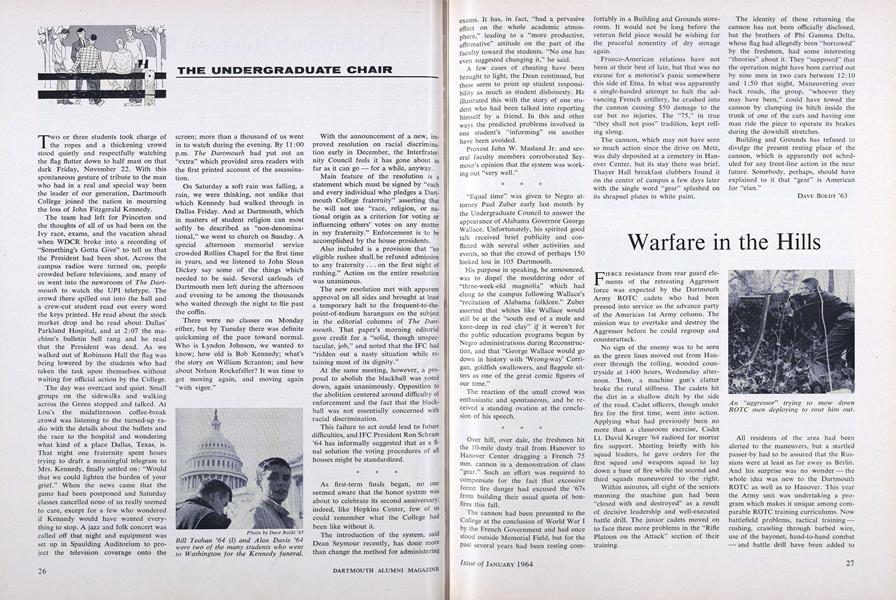
Bill Teahan '64 (1) and Alan Davis '64were two of the many students who wentto Washington for the Kennedy funeral.