ALUMNI COLLEGE 1965
Second 11-Day Session in Hanover Is Scheduled for August 15 to 26
HANOVER hills are white and Occom Pond frozen but summer thoughts push aside wintry visions for members of the small committee charged with making the second Alumni College better than the first. On the basis of praise volunteered by participants last summer and from the College's staff evaluation, this appears a formidable challenge; but with a veteran team doing the planning 1965 Alumni College is quite likely to be both bigger and better.
J. Michael McGean '49, Director of the Alumni College, will again be the man responsible for making the eleven-day "semester," August 15 through August 26, not only comfortable for Dartmouth men and their wives but, more importantly, conducive to the full "recharge of liberal arts batteries." Heading the faculty once again this coming summer will be James F. Cusick, Professor Emeritus of Economics.
Two other members of the 1964 Alumni College faculty will also be returning for the 1965 program: Prof. Harry L. Bond '42 of the English Department and Prof. Timothy J. Duggan of Philosophy. After discussion of individual and shared experiences with the 1964 Alumni College, the three returning members of the faculty chose new directions for exploration and new books for registrants to read and think about before Baker bells ring out the first class call on August 16. Six months of interdisciplinary give-and-take are ahead for Cusick, Bond, and Duggan and for the fourth member of the faculty, Professor of Religion Richard P. Unsworth, Dean of the Tucker Foundation.
In the months between now and the opening of Alumni College the four major members of the faculty will read all the assigned books; then, with each of the four in turn acting as discussion leader for his special area, they will examine together the relationships between the four areas of study. The prepared lectures will reflect these related discussions. Other faculty members serving as discussion leaders will also take part in these preparatory sessions.
The first Alumni College fulfilled the hope that the Dartmouth men and women who returned to Hanover would be seriously striving for intellectual refreshment, prepared for the lectures and discussions by full reading of the assigned texts, and willing to participate in the discussion sessions. Not only were most of the 1964 participants ready and interested in the presentation and defense of their own views, and in challenging others, in the classrooms, but the discussions were carried (as the faculty had expected) to the dining rooms and recreation halls.
Husbands and wives shared a common intellectual experience in reading the same books, listening to the same lecturers, and participating in similar discussions (most husbands and wives chose to be in different discussion groups so that they could compare notes on discussion topics and leaders) and found, according to many questionnaires, that they were still discussing points growing out of Alumni College studies weeks later. Participants stressed the stimulation in sharing this experience with men and women of differing backgrounds, ages, and interests.
Here, in brief, is the essential information on Dartmouth Alumni College 1965:
Housing: Dartmouth dormitories including Massachusetts and South Fayerweather Halls. Maid service provided. Rooms available at no extra charge through balance of the second weekend (August 27 to 29).
Dining: Thayer Hall and special banquets in Alumni Hall, the Bema, and DOC House. Charges: Tuition - $325 per couple - $215 stag - $105 junior. Includes room, board, books, instruction, tickets to evening events, recreation, and numerous other incidentals.
Typical Schedule: Breakfast; two morning lectures; coffee break; seminar discussion group; luncheon; afternoon open for recreation, study, rest, etc.; late afternoon optional course; social hour; dinner; evening event such as play, concert, or film.
Children: Divided into age groups - 3-6. 7-12, 13-18. Youngest are supervised at Hanover Nursery School. Those 7-18 enroll in courses throughout each morning - woodworking, painting, sculpture in Hopkins Center; also science or other class. Recreation program in afternoon. Special evening activities.
Theatre: The Dartmouth Summer Repertory Company will present performances of Shakespeare's Richard II, Moliere's Tartuffe, and Shaw's Doctor's Dilemma in the Hopkins Center Theatre this summer. The Repertory Company is made up of undergraduates, graduate students of drama, and a small number of young professional actors.
Concerts: Several concerts by the Dartmouth Summer Symphony Orchestra are planned.
Exhibits: The Hopkins Center and Baker Library will feature numerous exhibitions of interest to Alumni College participants.
Recreational Opportunities: Participants may wish to take advantage of Dartmouth's two indoor swimming pools, tennis courts, golf courses, the nearby Storrs Pond swimming area, or the mountain and lake resources in New Hampshire and Vermont during afternoon "free periods."
ALUMNI COLLEGE 1965
The program of organized study will consist of four areas:
1. Literature and Contemporary Affairs - Professor Bond.
2. Current Economic Problems - Professor Cusick.
3. The Philosophical Foundations of Communism, Fascism and Democracy - Professor Duggan.
4. Religion in Its Cultural Environment - Dean Unsworth.
1. Literature and Contemporary Affairs
The books to be read are all notable works which offer not only the intellectual and emotional excitement of great literature, but also reveal the efforts of creative spirits to deal imaginatively and symbolically with man's universal concerns. They are on the one hand timeless and on the other timely. The Shakespearean play Richard II with its divided allegiances and loyalties affords an opportunity to examine some of the deeper issues and values which lie behind all of the problems confronting contemporary man, whether in his business or profession or in his personal life. The Brothers Karamazov probes the fundamental problems of human destiny and in its depiction of various concepts of man is an illuminating commentary. The Lyrics of Frost explore man's relationship to the material world and also disclose Frost's own concept of the nature of man.
The books to be read are: (1) Shakespeare, Richard II This play will be produced in the Hopkins Center at the time of its discussion. (2) Dostoevski, The BrothersKaramazov. (3) Frost, Poems. Professor of English Harold L. Bond '42 (Ph.D. Harvard) is an authority on Edward Gibbon, author of The Decline and Fall ofthe Roman Empire. He has recently written a book on his World War II experiences, Return to Cassino, and earlier wrote TheLiterary Art of Edward Gibbon. He received a Faculty Fellowship in 1961-62 to travel to England to prepare a critical biography of Gibbon. He has been at Dartmouth since 1952.
2. Current Economic Problems
This topic will be concerned with the impact of science and technology on man's economic, social and political life. It will offer an introduction to some of the current developments in economic theory and suggest that public policy in the area must be formulated in the light of social, political, and ethical considerations. The main book used in the course is of unusual interest. It is written by a vice-president of the Federal Reserve Bank of Philadelphia. He is a trained economist as well as a banker, having close associations with a wide variety of businessmen and bankers. In dealing with economic problems he is able to analyze as an economist and at the same time make clear the approach of the businessman if there happens to be a difference between them.
The book to be read is: Bunting, TheHidden Face of Free Enterprise.
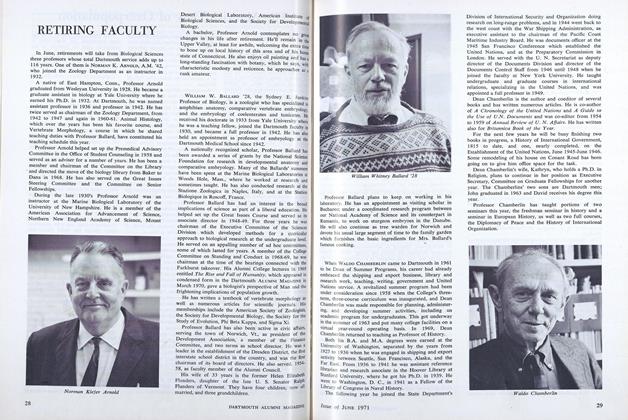
Professor Emeritus of Economics James F. Cusick (Ph.D. Harvard) came to Dartmouth in 1935 after teaching five years at Amherst. Many alumni have taken his "Money and Banking" and "Money and Foreign Exchange" courses, among others. He has served as director of the Great Issues Course, 1957-59, and has been a consultant to the Ford Foundation and many other private and governmental bodies.
3. Philosophic Foundations of Communism,Fascism and Democracy
The world is in ferment with many social and political philosophies competing for man's allegiance. The political philosophies are the substance of the course. It will be concerned not with the institutional structure and the functioning of those institutions but with basic political ideologies regarded as reflections of different concepts of the nature of man and of human values. The concept of man and the concept of society are inextricably bound together. One's view of how society should be organized is a reflection of a basic concept of man.
The course will begin with a consideration of fallacious arguments widely used in discussing various social philosophies. It will then turn to a critical examination of the three political ideologies which dominate this age with particular attention to the divergent concepts of the nature of man embodied in each. Next these ideological positions will be examined within the wider framework of philosophical world views. The over-all aim of the course will be the clarification of the issues which divide East and West and the divisions within the West.
The books to be read are: (1) Cohen (editor), Communism, Fascism and Democracy. (2) White (editor), The Age of Analysis.
Associate Professor Timothy J. Duggan (Ph.D. Brown) is Chairman of the Philosophy Department. He joined the Dartmouth faculty in 1957. In 1961-62 he studied in Edinburgh, Scotland, on a Faculty Fellowship and is currently writing a book on Scottish philosopher Thomas Reid and his work.
4. Religion in Its Cultural Environment
This course will be concerned with the major religions found in the United States, their influence on the American cultural environment, and the reciprocal influence of the environment on religion. Current ferment in these religious movements will receive attention.
The books to be read will be announced later.
Professor Richard P. Unsworth (Th.M. Harvard Divinity School) is the Dean of Dartmouth's William Jewett Tucker Foundation. He joined the faculty full-time in 1964. Formerly chaplain and a member of the Smith College faculty since 1954, he is a member of the advisory committee of Operation Crossroads Africa.
Alumni College Faculty: (Left to right) James F. Cusick, Professor Emeritus ofEconomics; Dean Richard P. Unsworth, Professor of Religion; Timothy J. Duggan,Assistant Professor of Philosophy; Harold L. Bond '42, Professor of English.