New Times, New Courses
MATHEMATICS 16 — "The Role of the Computer Outside the Sciences," one of the many new courses approved by the faculty for this new term, should be a prerequisite for editors attempting to keep up with the ever-changing curriculum.
The wealth of new undergraduate offerings can be traced to three major sources: the introduction of a new program in Comparative Literature, the rapid implementation of the faculty vote for various departmental freshman seminars modeled on the existing English 2 course, and a wide-ranging assortment of changes resulting from individual department re-evaluations and new additions to the faculty. It should also be noted that eighteen courses were dropped from the curriculum, and a dozen or more others, although still tagged with the same catalog number, were updated.
The new program in Comparative Literature with its introduction of 18 new courses - and two others to come - is the biggest area of change. Specifically designed as an interdepartmental program, the new courses draw upon faculty talents from a half-dozen different disciplines as the following sampling of course titles will indicate: "The Christ Figure in Modern Fiction," "The Rise of the Human Imagination," "The Western Impress Upon Modern Japanese Literature," "Utopia and Reality," "The Notion of Summa in East and West," "Classics of the Renaissance," "European Novels of the 19th Century," "Modern Drama," "The Tragic," and "The Lyric."
Some of the courses are similar to those offered by the former Department of Comparative Literature; others replace courses now dropped, such as Humanities 1 and 2. The program, under the chairmanship of Prof. Eugene H. Falk of the Romance Languages Department, seeks to meet the needs of those students whose literary interests are broader than the offerings of any one department. The approach is also comparative, dealing with important works and movements in both East and West, and concerned with relating literature to other fields of knowledge. "This could be taught within a department," Prof. Norman A. Doenges, Associate Dean for the Humanities, remarked, "but it is taught better as a cross-disciplinary offering."
Part of the evolution of this new program grew out of the recent faculty seminars conducted by the Comparative Studies Center. Many of the teachers now offering Comparative Literature courses participated in Prof. Wing-tsit Chan's seminar program sponsored by the Center. The program also evolved to fill the need to deal with literature in translation, preferably in a comparative context.
A great deal of work is also being done for the future in the area of freshman seminars, with many departments, including those in the sciences, preparing to introduce courses similar to the four brought out this term by Religion, Classics, and Romance Languages (separate courses in French and Spanish). These seminars, like English 2, involve the freshman in dealing with a problem, then developing approaches to the problem. The assigned reading is purposefully chosen by the instructor to bring out new dimensions and complications related to the problem and to serve as a basis for discussion - along with the many papers students write.
The Department of Physics and Astronomy has introduced a quartet of interesting new undergraduate courses as well as eight at the graduate level to supplement those previously offered to M.A. and Ph.D. candidates. Astronomy 1 is now "Descriptive Astronomy," and it and its companion course, the new Astronomy 2 - "Elementary Stellar Physics," are designed for those students not majoring in one of the sciences. Another new entry for the outer-space minded is numbered 64 and titled "Particles and Fields in the Solar System."
The impact of science upon our time is not being ignored. The History Department now offers two courses in the History of Science; the first from Copernicus to Newton, the second from Newton to the latest moon probe. Government students now can take "Science and Public Policy," dealing with the political and social significance of technological change. The Government Department is also offering "The Politics and Government in India," certainly a timely area for understanding as daily head- lines reveal, and a revamped Government 6 course concentrating on the American political system.
The Art Department has introduced Art 50, a study of movements and personalities in American art since Colonial days. The former Art 1-2 courses have been combined and completely redesigned as an introduction to art history, taught cooperatively by the department, with more reliance on seminar methods.
More From This Issue
-
 Feature
The Wheelock Dream, Sparsely Realized, Is Still a Force in the Life of the College
October 1965 -
 Feature
A Good Summer Press
October 1965 -
 Feature
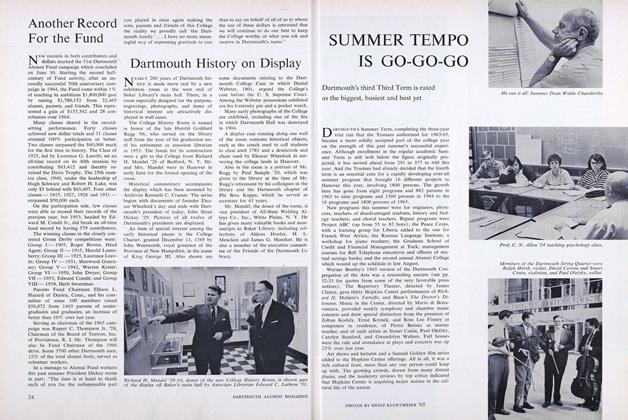
SUMMER TEMPO IS GO-GO-GO
October 1965 -
Feature
Newly Elected Members of the Alumni Council
October 1965 -
 Article
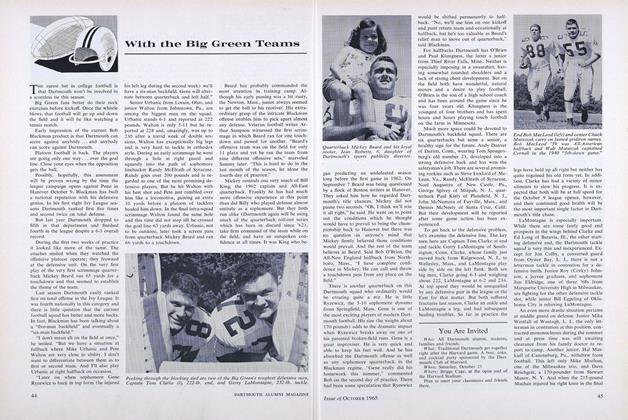
With the Big Green Teams
October 1965 -
 Article
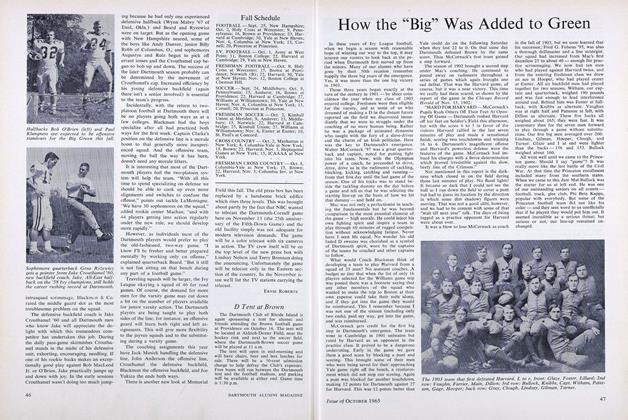
How the "Big" Was Added to Green
October 1965
Article
-
 Article
SCANDINAVIAN FOUNDATION OFFERS FELLOWSHIP
March, 1924 -
 Article
REPORT OF THE ALUMNI FUND—APRIL 20, 1931
MAY 1931 -
 Article
Opening Assembly
November 1960 -
 Article
Trustees Authorize New Ice Arena-Auditorium
FEBRUARY 1973 -
 Article
From the 47th Floor
OCT. 1977 -
 Article
The Commencement Address
July 1953
