U.S. Ambassador
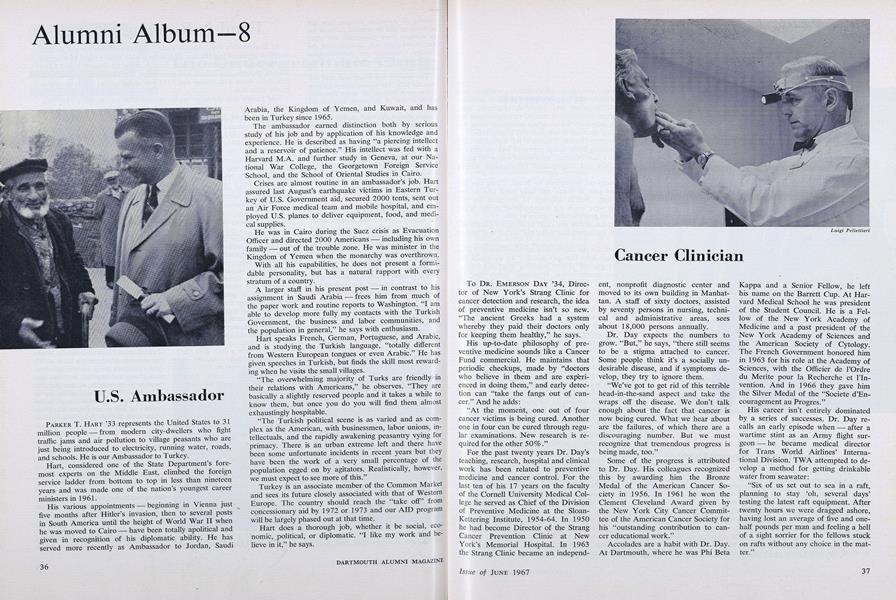
PARKER T. HART '33 represents the United States to 31 million people - from modern city-dwellers who fight traffic jams and air pollution to village peasants who are just being introduced to electricity, running water, roads, and schools. He is our Ambassador to Turkey.
Hart, considered one of the State Department's foremost experts on the Middle East, climbed the foreign service ladder from bottom to top in less than nineteen years and was made one of the nation's youngest career ministers in 1961.
His various appointments - beginning in Vienna just five months after Hitler's invasion, then to several posts in South America until the height of World War II when he was moved to Cairo - have been totally apolitical and given in recognition of his diplomatic ability. He has served more recently as Ambassador to Jordan, Saudi Arabia, the Kingdom of Yemen, and Kuwait, and has been in Turkey since 1965.
The ambassador earned distinction both by serious study of his job and by application of his knowledge and experience. He is described as having "a piercing intellect and a reservoir of patience." His intellect was fed with a Harvard M.A. and further study in Geneva, at our National War College, the Georgetown Foreign Service School, and the School of Oriental Studies in Cairo.
Crises are almost routine in an ambassador's job. Hart assured last August's earthquake victims in Eastern Turkey of U.S. Government aid, secured 2000 tents, sent out an Air Force medical team and mobile hospital, and employed U.S. planes to deliver equipment, food, and medical supplies.
He was in Cairo during the Suez crisis as Evacuation Officer and directed 2000 Americans - including his own family - out of the trouble zone. He was minister in the Kingdom of Yemen when the monarchy was overthrown.
With all his capabilities, he does not present a formidable personality, but has a natural rapport with every stratum of a country.
A larger staff in his present post - in contrast to his assignment in Saudi Arabia - frees him from much of the paper work and routine reports to Washington. "I am able to develop more fully my contacts with the Turkish Government, the business and labor communities, and the population in general," he says with enthusiasm.
Hart speaks French, German, Portuguese, and Arabic, and is studying the Turkish language, "totally different from Western European tongues or even Arabic." He has given speeches in Turkish, but finds the skill most rewarding when he visits the small villages.
"The overwhelming majority of Turks are friendly in their relations with Americans," he observes. "They are basically a slightly reserved people and it takes a while to know them, but once you do you will find them almost exhaustingly hospitable. "The Turkish political scene is as varied and as complex
as the American, with businessmen, labor unions, intellectuals, and the rapidly awakening peasantry vying for primacy. There is an urban extreme left and there have been some unfortunate incidents in recent years but they have been the work of a very small percentage of the population egged on by agitators. Realistically, however, we must expect to see more of this."
Turkey is an associate member of the Common Market and sees its future closely associated with that of Western Europe. The country should reach the "take off" from concessionary aid by 1972 or 1973 and our AID program will be largely phased out at that time.
Hart does a thorough job, whether it be social, economic, political, or diplomatic. "I like my work and believe in it," he says.