1930's 40th
Since our 35th reunion in 1965 we have lived through an action-packed period of change. Certainly no other half decade since 1930 has produced so many alarming incidents or so much to challenge our beliefs and loyalties, our judgment and even our faith. But there is no question that we returned to Hanover this time with a better understanding of what is ailing the world and with a greater sympathy for other problems than our own. We have been educated during this period in the true meaning of the word and we returned in unprecedented numbers to share this learning.
If a college class can be said to have a plan, that of 1930 during the past five years was to reestablish the friendships that were born during our years in Hanover, using as a catalyst the pretty well established premise that there is something about Dartmouth and Hanover that lives in a man long after he has left the College and the town. Happily it appears that much progress was made. Not only did this plan bring renewed and new friendships, but it provided help for classmates and their wives who were sorely in need of communicating with someone who cared. Behind it all was the inspired leadership of Fred Scribner.
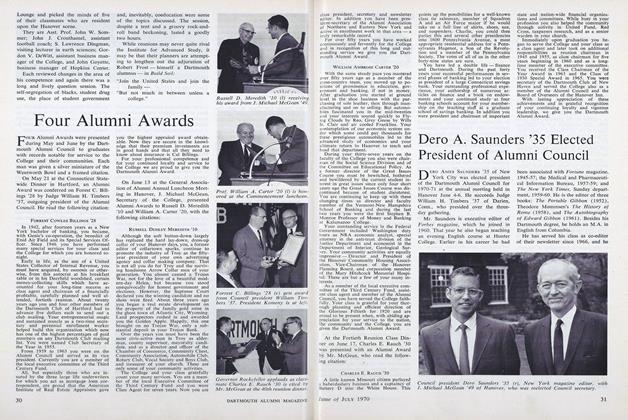
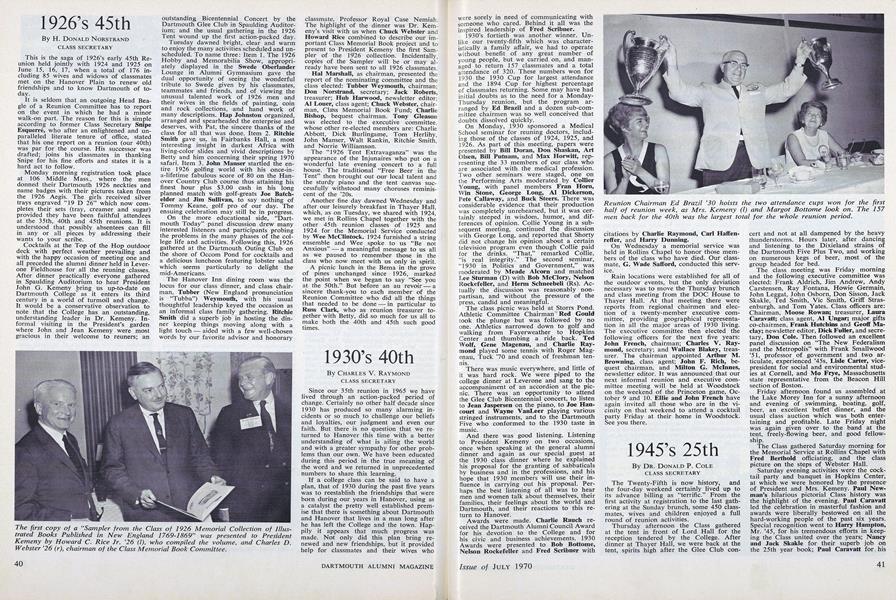
1930's fortieth was another winner. Unlike our twenty-fifth which was characteristically a family affair, we had to operate without benefit of any great number of young people, but we carried on, and managed to return 157 classmates and a total attendance of 320. These numbers won for 1930 the 1930 Cup for largest attendance and the 1894 Cup for highest percentage of classmates returning. Some may have had initial doubts as to the need for a Monday- Thursday reunion, but the program arranged by Ed Brazil and a dozen sub-committee chairmen was so well conceived that doubts dissolved quickly.
On Monday, 1930 sponsored a Medical School seminar for reuning doctors, including those of the classes of 1924, 1925, and 1926. As part of this meeting, papers were presented by Bill Doran, Don Shaskan, ArtOlsen, Bill Putnam, and Max Horwitt, representing the 33 members of our class who are associated with the medical profession. Two other seminars were staged, one on the Performing Arts moderated by CollierYoung, with panel members Fran Horn,Win Stone, George Long, Al Dickerson, Pete Callaway, and Buck Steers. There was considerable evidence that their production was completely unrehearsed, but it was certainly steeped in wisdom, humor, and differences of opinion. Collie Young in a subsequent meeting, continued the discussion with George Long, and reported that Shorty did not change his opinion about a certain television program even though Collie paid for the drinks. "That," remarked Collie, "is real integrity." The second seminar, "1930 in Politics and Government," was moderated by Meade Alcorn and matched Lee Sturman (D) with Bob McClory, NelsonRockefeller, and Herm Schneebeli (Rs). Actually the discussion was reasonably nonpartisan, and without the pressure of the press, candid and meaningful.
The class picnic was held at Storrs Pond. Athletic Committee Chairman Red Gould took the plunge but was followed by no one. Athletics narrowed down to golf and walking from Fayerweather to Hopkins Center and thumbing a ride back. TedWolf, Gene Magenau, and Charlie Raymond played some tennis with Roger Magenau, Tuck '70 and coach of freshman tennis.
There was music everywhere, and little of it was hard rock. We were piped to the college dinner at Leverone and sang to the accompaniment of an accordion at the picnic. There was an opportunity to attend the Glee Club Bicentennial concert, to listen to Jean Jaspersen on the piano, to Joe Hancourt and Wayne "Van Leer playing various stringed instruments, and to the Dartmouth Five who conformed to the 1930 taste in music.
And there was good listening. Listening to President Kemeny on two occasions, once when speaking at the general alumni dinner and again as our special guest at the 1930 class dinner where he explained his proposal for the granting of sabbaticals by business and in the professions, and his hope that 1930 members will use their influence in carrying out his proposal. Perhaps the best listening of all was to hear men and women talk about themselves, their families, their feelings about the world and Dartmouth, and their reactions to this return to Hanover.
Awards were made. Charlie Rauch received the Dartmouth Alumni Council Award for his devotion to the College and for his civic and business achievements. 1930 Awards were presented to Bob Bottome. Nelson Rockefeller and Fred Scribner with citations by Charlie Raymond, Carl Haffen-reffer, and Harry Dunning. On Wednesday a memorial service was held in Rollins Chapel to honor those members of the class who have died. Our classmate, G. Wade Safford, conducted this service.
Rain locations were established for all of the outdoor events, but the only deviation necessary was to move the Thursday brunch and class meeting from the DOC House to Thayer Hall. At that meeting there were reports from regional chairmen and election of a twenty-member executive committee, providing geographical representation in all the major areas of 1930 living. The executive committee then elected the following officers for the next five years: John French, chairman; Charles V. Raymond, secretary; and Wallace Blakey, treasurer. The chairman appointed Arthur M.Browning, class agent; John F. Rich, bequest chairman, and Milton G. McInnes, newsletter editor. It was announced that our next informal reunion and executive committee meeting will be held at Woodstock on the weekend of the Princeton game, October 9 and 10. Ellie and John French have again invited all those who are in the vicinity on that weekend to attend a cocktail party Friday at their home in Woodstock. See you there.
Reunion Chairman Ed Brazil '30 hoists the two attendance cups won for the firsthalf of reunion week, as Mrs. Kemeny (l) and Margot Bottome look on. The 157men back for the 40th was the largest total for the whole reunion period.
CLASS SECRETARY