FINANCIAL POLICY IN A CHANGING ECONOMY.
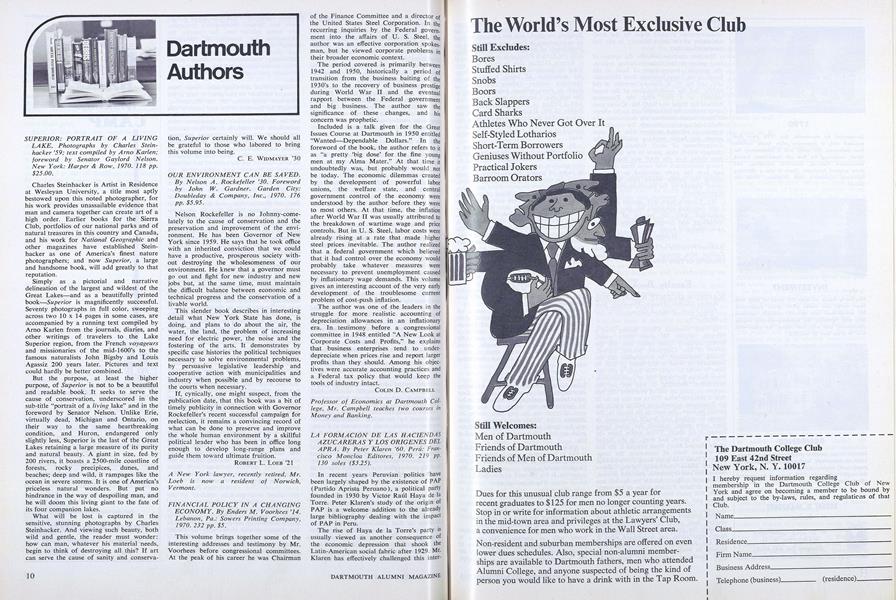
By Enders M. Voorhees '14.Lebanon, Pa.: Sowers Printing Company,1970. 232 pp. $5.
This volume brings together some of the interesting addresses and testimony by Mr. Voorhees before congressional committees. At the peak of his career he was Chairman of the Finance Committee and a director of the United States Steel Corporation. In the recurring inquiries by the Federal government into the affairs of U. S. Steel, the author was an effective corporation spokesman, but he viewed corporate problems in their broader economic context.
The period covered is primarily between 1942 and 1950, historically a period of transition from the business baiting of the 1930's to the recovery of business prestige during World War II and the eventual rapport between the Federal government and big business. The author saw the significance of these changes, and his concern was prophetic.
Included is a talk given for the Great Issues Course at Dartmouth in 1950 entitled "Wanted — Dependable Dollars." In the foreword of the book, the author refers to it as "a pretty 'big dose' for the fine young men at my Alma Mater." At that time it undoubtedly was, but probably would not be today. The economic dilemmas created by the development of powerful labor unions, the welfare state, and central government control of the economy were understood by the author before they were to most others. At that time, the inflation after World War II was usually attributed to the breakdown of wartime wage and price controls. But in U. S. Steel, labor costs were already rising at a rate that made higher steel prices inevitable. The author realized that a federal government which believed that it had control over the economy would probably take whatever measures were necessary to prevent unemployment caused by inflationary wage demands. This volume gives an interesting account of the very early development of the troublesome current problem of cost-push inflation.
The author was one of the leaders in the struggle for more realistic accounting of depreciation allowances in an inflationary era. In testimony before a congressional committee in 1948 entitled "A New Look at Corporate Costs and Profits," he explains that business enterprises tend to under- depreciate when prices rise and report larger profits than they should. Among his objectives were accurate accounting practices and a Federal tax policy that would keep the tools of industry intact.
Professor of Economics at Dartmouth College, Mr. Campbell teaches two courses inMoney and Banking.
More From This Issue
-
 Feature
Trustees and Alumni Council Hear 1970 Called "Great Year for Dartmouth"
February 1971 -
 Feature
The Blackman Era: Sixteen Special Years
February 1971 -
 Feature
Alumni Council Nominates Three for College Trustees
February 1971 -
 Feature
Alumni Awards
February 1971 -
 Article
A Different View of Vietnam
February 1971 -
Article
Faculty
February 1971