Curtain Call for Henry
The following article about Henry B.Williams, Professor of English andDirector of the Experimental Theatre,who ends his long Dartmouth career inJune, appeared in the Boston Herald Traveler of Sunday, January 23. Mr.Hirsch, who has had a professionalinterest in the Dartmouth drama program over the years, is the father ofRobin Hirsch '73, who is spending hisjunior year at the University of Israel.
The red curtains of the Hopkins Center main stage fell on the last notes of the rousing finale of Gilbert and Sullivan's "The Mikado." The hearty applause of the Saturday night audience indicated both pleasure and admiration.
There was also some sadness in that sound—and a feeling of nostalgia. Something more than a show had ended, it seemed to say. An era was coming to an end. A man's career and his prodigious creative achievement were both concluding with that final triumphant performance of a popular operetta.
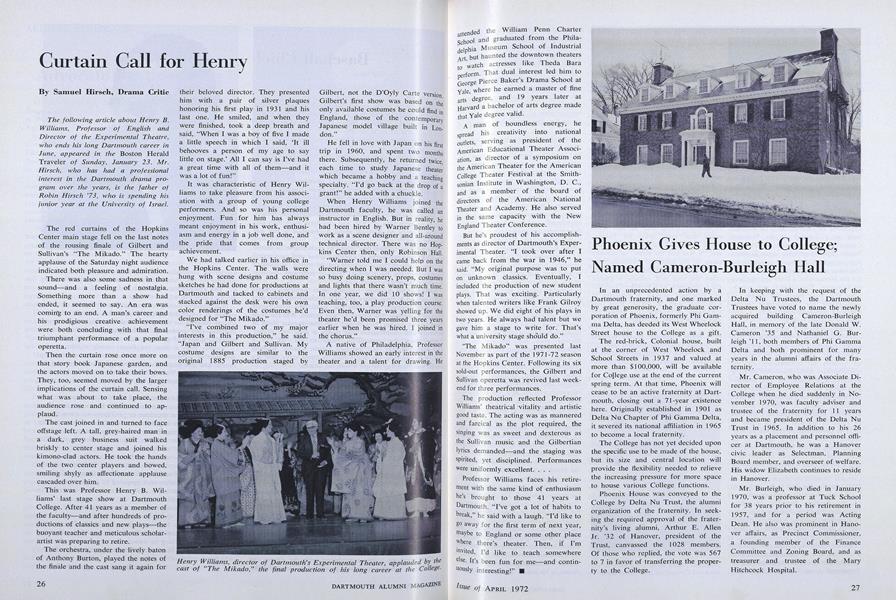
Then the curtain rose once more on that story book Japanese garden, and the actors moved on to take their bows. They, too, seemed moved by the larger implications of the curtain call. Sensing what was about to take place, the audience rose and continued to applaud.
The cast joined in and turned to face offstage left. A tall, grey-haired man in a dark, grey business suit walked briskly to center stage and joined his kimono-clad actors. He took the hands of the two center players and bowed, smiling shyly as affectionate applause cascaded over him.
This was Professor Henry B. Williams' last stage show at Dartmouth College. After 41 years as a member of the faculty—and after hundreds of productions of classics and new plays—the buoyant teacher and meticulous scholar-artist was preparing to retire.
The orchestra, under the lively baton of Anthony Burton, played the notes of the finale and the cast sang it again for their beloved director. They presented him with a pair of silver plaques honoring his first play in 1931 and his last one. He smiled, and when they were finished, took a deep breath and said, "When I was a boy of five I made a little speech in which I said, 'It ill behooves a person of my age to say little on stage.' All I can say is I've had a great time with all of them—and it was a lot of fun!"
It was characteristic of Henry Williams to take pleasure from his association with a group of young college performers. And so was his personal enjoyment. Fun for him has always meant enjoyment in his work, enthusiasm and energy in a job well done, and the pride that comes from group achievement.
We had talked earlier in his office in the Hopkins Center. The walls were hung with scene designs and costume sketches he had done for productions at Dartmouth and tacked to cabinets and stacked against the desk were his own color renderings of the costumes he'd designed for "The Mikado."
"I've combined two of my major interests in this production," he said. "Japan and Gilbert and Sullivan. My costume designs are similar to the original 1885 production staged by Gilbert, not the D'Oyly Carte version. Gilbert's first show was based on the only available costumes he could find in England, those of the contemporary Japanese model village built in London."
He fell in love with Japan on his first trip in 1960, and spent two months there. Subsequently, he returned twice each time to study Japanese theater which became a hobby and a teaching specialty. "I'd go back at the drop of a grant!" he added with a chuckle.
When Henry Williams joined the Dartmouth faculty, he was called an instructor in English. But in reality, he had been hired by Warner Bentley to work as a scene designer and all-around technical director. There was no Hopkins Center then, only Robinson Hall.
"Warner told me I could help on the directing when I was needed. But I was so busy doing scenery, props, costumes and lights that there wasn't much time, In one year, we did 10 shows! I was teaching, too, a play production course, Even then, Warner was yelling for the theater he'd been promised three years earlier when he was hired. I joined in the chorus."
A native of Philadelphia, Professor Williams showed an early interest in the theater and a talent for drawing. He attended the William Penn Charter School and graduated from the Philadelphia Museum School of Industrial Art but haunted the downtown theaters watch actresses like Theda Bara form. That dual interest led him to George Pierce Baker's Drama School at Yale, where he earned a master of fine arts degree, and 19 years later at Harvard a bachelor of arts degree made that Yale degree valid.
A man of boundless energy, he spread his creativity into national outlets, serving as president of the American Educational Theater Association, as director of a symposium on the American Theater for the American College Theater Festival at the Smithsonian Institute in Washington, D. C., and as a member of the board of directors of the American National Theater and Academy. He also served in the same capacity with the New England Theater Conference.
But he's proudest of his accomplishments as director of Dartmouth's Experimental Theater. "I took over after I came back from the war in 1946," he said. "My original purpose was to put on unknown classics. Eventually, I included the production of new student plays. That was exciting. Particularly when talented writers like Frank Gilroy showed up. We did eight of his plays in two years. He always had talent but we gave him a stage to write for. That's what a university stage should do."
"The Mikado" was presented last November as part of the 1971-72 season at the Hopkins Center. Following its six sold-out performances, the Gilbert and Sullivan operetta was revived last weekend for three performances.
The production reflected Professor Williams' theatrical vitality and artistic good taste. The acting was as mannered and farcical as the plot required, the singing was as sweet and dexterous as the Sullivan music and the Gilbertian lyrics demanded—and the staging was spirited, yet disciplined. Performances were uniformly excellent....
Professor Williams faces his retire- ment with the same kind of enthusiasm he's brought to those 41 years at Dartmouth. "I've got a lot of habits to break," he said with a laugh. "I'd like to go away for the first term of next year, maybe to England or some other place where there's theater. Then, if I'm invited, I'd like to teach somewhere else. It's been fun for me—and continuously interesting!"
Henry Williams, director of Dartmouth's Experimental Theater, applauded by thecast of "The Mikado," the final production of his long career at the College.