Two Recent Grads On Himalayan Climb
Two recent Dartmouth graduates are members of an 18-man expedition that is undertaking an assault by a hitherto-unconquered route up one of the highest peaks in the forbidding Himalaya Mountains.
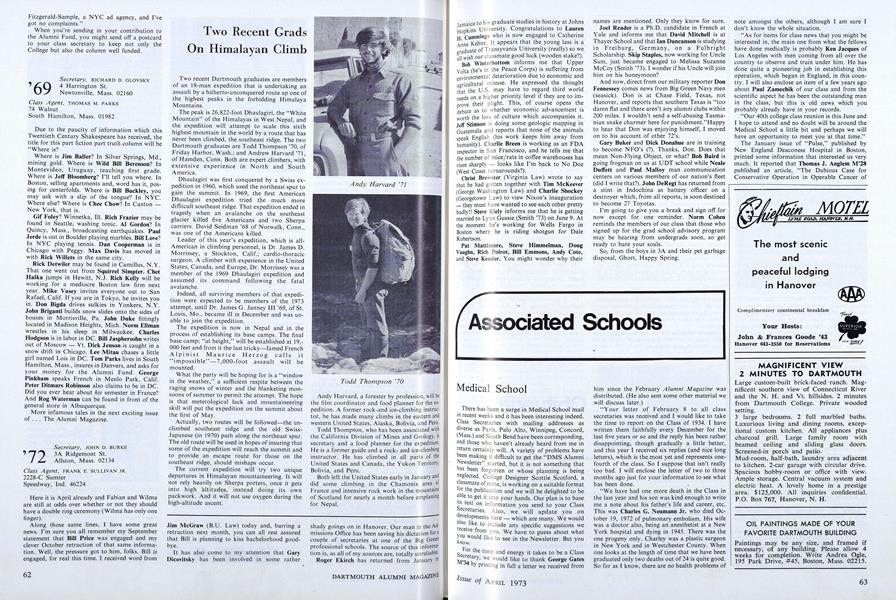
The peak is 26,822-foot Dhaulagiri, the "White Mountain" of the Himalayas in West Nepal, and the expedition will attempt to scale this sixth highest mountain in the world by a route that has never been climbed, the southeast ridge. The two Dartmouth graduates are Todd Thompson '70, of Friday Harbor, Wash.; and Andrew Harvard '71, of Hamden, Conn. Both are expert climbers, with extensive experience in North and South America.
Dhaulagiri was first conquered by a Swiss ex- pedition in 1960, which used the northeast spur to gain the summit. In 1969, the first American Dhaulagiri expedition tried the much more difficult southeast ridge. That expedition erided in tragedy when an avalanche on the southeast glacier killed five Americans and two Sherpa carriers. David Seidman '6B of Norwalk, Conn., was one of the Americans killed.
Leader of this year's expedition, which is all-American in climbing personnel, is Dr. James D. Morrissey, a Stockton, Calif.; cardio-thoracic surgeon. A climber with experience in the United States, Canada, and Europe, Dr. Morrissey was a member of the 1969 Dhaulagiri expedition and assumed its command following the fatal avalanche.
Indeed, all surviving members of that expedition were expected to be members of the 1973 attempt, until Dr. James G. Janney III '69, of St. Louis, Mo., became ill in December and was unable to join the expedition.
The expedition is now in Nepal and in the process of establishing its base camps. The final base camp; "at height," will be established at 19,- 000 feet and from it the last tricky—famed French Alpinist Maurice Herzog calls it "impossible"—7,000-foot assault will be mounted.
What the party will be hoping for is a "window in the weather," a sufficient respite between the raging snows of winter and the blanketing mon- soons of summer to permit the attempt. The hope is that meterological luck and mountaineering skill will put the expedition on the summit about the first of May.
Actually, two routes will be followed—the unclimbed southeast ridge and the old Swiss- Japanese (in 1970) path along the northeast spur. The old route will be used in hopes of insuring that some of the expedition will reach the summit and to provide an escape route for those on the southeast ridge, should mishaps occur.
The current expedition will try two unique departures in Himalayan mountaineering. It will not rely heavily on Sherpa porters, once it gets into high altitudes, instead doing its own packwork. And it will not use oxygen during the high-altitude ascent.
Andy Harvard, a forester by profession, will be the film coordinator and food planner for the expedition. A former rock-and ice-climbing instructor, he has made many climbs in the eastern and western United States, Alaska, Bolivia, and Peru.
Todd Thompson, who has been associated with the California Division of Mines and Geology, is secretary and a food planner for the expedition. He is a former guide and a rock- and ice-climbing instructor. He has climbed in all parts of the United States and Canada, the Yukon Territory, Bolivia, and Peru.
Both left the United States early in January and did some climbing in the Chamonix area of France and intensive rock work in the mountains of Scotland for nearly a month before emplaning for Nepal.
Andy Harvard '71
Todd Thompson '70