Big Green Teams
IT wasn't seven days in May or thirteen days in October. The balance of international power wasn't involved. It was two days in December and what was involved was of definite meaning to the mini-world of Ivy League athletics.
Two events in New York City on the 10th and 11th of December provided focal points for the quiet period that occurs annually between the end of the fall season and the brief flurry of winter competition before the exam break.
The first day in our special events calendar marked the turnover of the Ivy League Football Trophy, including all the pine scent that has grown on the big silver bowl during five years of residence in Hanover, to Harvard and Yale. The occasion was the first Ivy football luncheon sponsored by The Touchdown Club of New York and it made sense, in a negative sort of way, that it wasn't simply a case of toting the bauble to New York and back to Hanover.
The second day will rank with the historic dates in the annals of Ivy League athletics. Meeting in New York, the eight Ivy presidents reached decisions that will have far-reaching impact on the games that Ivy teams play. Freshman eligibility, which made inroads into Ivy athletics in 1971, gained a bigger foothold as the presidents approved participation at the varsity level by first-year undergraduates in three team sports - baseball, lacrosse, and soccer.
The decision is based largely on the concerns that the presidents - as well as many others - have for the increased cost of intercollegiate athletic programs in the league. This wasn't the only area where the presidents sought solution. They also accepted a recommendation from their athletic directors to limit the number of full-time coaches in football to seven, with an amendment that will permit each college to budget a maximum of $4,000 for up to four part-time assistant coaches. Also approved was the addition of two games to the hockey schedules (bringing the total to 26, the same as in basketball), with the proviso that these added games be scheduled during holiday periods.
Since 1971, the Ivy League has permitted freshman eligibility in the so-called "individual" sports - cross country, track, fencing, golf, swimming, tennis, wrestling. Now, the eight colleges may, at their individual discretion (though it's 1,000-1 that any will choose not to), use freshmen in three team sports. At the same time, the presidents voted against permitting freshmen to compete in varsity football; a final vote on freshman eligibility in basketball and hockey was put off until a special meeting scheduled in February.
In a report to President Kemeny, Director of Athletics Seaver Peters indicated a change in his position concerning freshman eligibility in the winter and spring team sports. "I'm opposed to freshman eligibility in the fall sports because I think the first experience of freshmen should not be two weeks of double sessions," said Peters. (Still, it's likely that soccer will use freshmen at the varsity level and the mechanics of how things will develop in this sport remain to be resolved.)
"Almost all institutions on our intercollegiate schedules, with the exception of the Ivy League schools, are using freshmen," Peters continued. "This has become particularly evident during the first week of the current winter season where our hockey and basketball teams have been defeated decisively by teams using freshmen [at this writing, both hockey and basketball are winless in four games]. A case in point would be Holy Cross in basketball where two freshmen were in their starting five and one of the freshmen was the leading scorer and rebounder. We penalize the Dartmouth teams by not being able to use freshmen and thus subject them to unfair competition. In addition, we are losing top flight young men from our applicant pool because they won't consider Dartmouth due to the ineligibility of freshmen for the varsity teams. A Bill Bradley, a Rudy LaRusso, or a Jim McMillian would not apply to an Ivy college with our present regulation."
Participation has been the primary argument in the past for retaining a full freshman program but the development of sub-varsity teams in the individual sports during the past three seasons has not shown a decrease in either participation or enthusiasm. From the academic stand-point, Peters said, "We notice no difference in academic achievement of athletes in-season versus out-of-season. Our coaches are a group of professional sophisticated, sensitive men and women. They wouldn't subject an athlete to the pressures of varsity competition unless in their opinion the athlete is ready both physically and mentally."
The long, hard look at athletic budgets in the Ivy League has been in progress for several years and will continue during the coming months. At their meeting in February, the Ivy presidents are expected to consider such items as limits on the number of coaches in sports other than football, recruiting expenses, training table costs, and team travel budgets.
FOOTBALL - the frustrating season is over and the final record of 3-6, capped by a 27-20 loss at Penn, is hardly the measure of Dartmouth's performance. "Those of us in athletics realize perhaps more than others the narrow margin separating success and failure," said Jake Crouthamel. "In 1973, we lost one Ivy game by a ' touchdown and won three others by less than a touchdown or on a big play late in the game. This year we lost four Ivy games - two by a touchdown and two others by less than a touchdown."
"The record in 1974 is not what we expected or hoped for but it wasn't the result of lack of effort. This group of young men deserved a better season but if we put it into perspective, if we consider the quality of the Ivy teams that barely beat us, then you realize how much really was accomplished by this team," Crouthamel continued. "I'm sure both Yale and Harvard would agree that they knew they were playing a team that was defending its title with pride and determination. The total difference in those two games was seven points."
The individual honors that have come to members of this team measure the respect that was gained. Reggie Williams, the junior linebacker from Flint, Michigan, who has been elected co-captain of the 1975 team with offensive tackle Tom Parnon from Syosset, New York, is the mosthonored player and is building a reputation that could rank him as the finest linebacker the Ivy League has ever seen. Williams was a unanimous pick on the Coaches' All-Ivy team, made every All-Ivy squad that was picked, was tapped for three All-East teams and two All-New England teams picked by the wire services, and gained All-America mention. When a player averages 15 tackles per game, which is what Williams did, he's doing just about everything right. Said a member of Yale's coaching staff, "I never saw a player handle blocking the way he does. I doubt that anyone actually took him down all season.
Joining Williams on the Coaches' All- Ivy first team was junior rover back Skip Cummins. Making the second team were four other defenders - tackle Brian Wroczynski, end Alan Markman, linebacker Jim Conterato, and halfback Frank Turner - plus tight end Alex Kandabarow.
THE soccer team finished with a 3-7-1 record, tied for fourth place in the Ivy race (3-3-1), and lost six of seven games by the margin of a single goal.
Steve Papai and Bruce Bokor, who was runnerup in the league scoring race, earned first-team All-Ivy selection, forward Steve Alford made the second team, and goalie Mark Porto and junior Jim Tierney gained honorable mention.
THE WINTER SEASON
Clearly, things have not gotten off on the right foot. In basketball, hockey, and swimming, Dartmouth still stands in search of the first victory. In squash, Dartmouth has split a pair of matches and only in gymnastics, (unbeaten in two outings) have things gone to the Green's advantage.
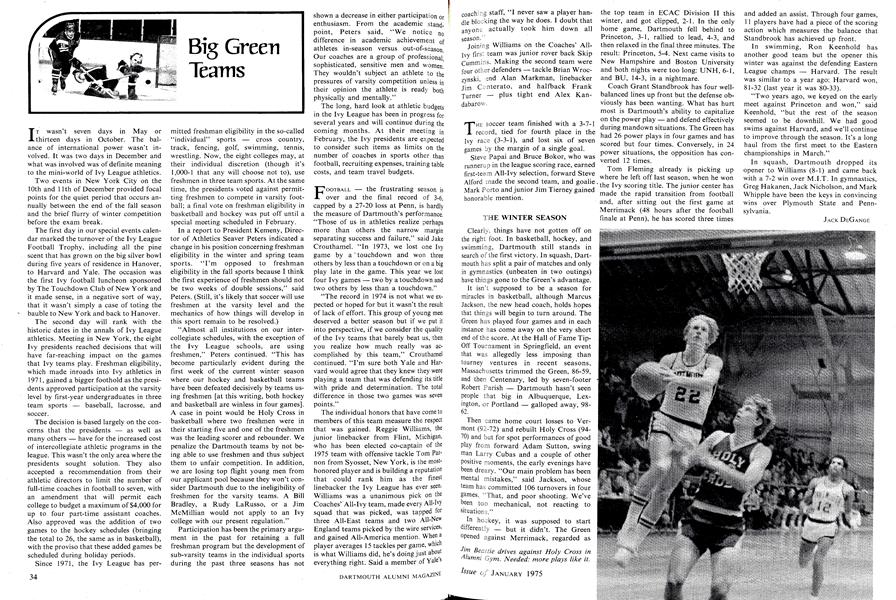
It isn't supposed to be a season for miracles in basketball, although Marcus Jackson, the new head coach, holds hopes that things will begin to turn around. The Green has played four games and in each instance has come away on the very short end of the score. At the Hall of Fame Tip- Off Tournament in Springfield, an event that was allegedly less imposing than tourney ventures in recent seasons, Massachusetts trimmed the Green, 86-59, and then Centenary, led by seven-footer Robert Parish - Dartmouth hasn't seen people that big in Albuquerque, Lexington, or Portland - galloped away, 98-62.
Then came home court losses to Vermont (92-72) and rebuilt Holy Cross (94-70) and but for spot performances of good play from forward Adam Sutton, swing man Larry Cubas and a couple of other positive moments, the early evenings have been dreary. "Our main problem has been mental mistakes," said Jackson, whose team has committed 106 turnovers in four games. "That, and poor shooting. We've been too mechanical, not reacting to situations."
In hockey, it was supposed to start differently - but it didn't. The Green opened against Merrimack, regarded as the top team in ECAC Division II this winter, and got clipped, 2-1. In the only home game, Dartmouth fell behind to Princeton, 3-1, rallied to lead, 4-3, and then relaxed in the final three minutes. The result: Princeton, 5-4. Next came visits to New Hampshire and Boston University and both nights were too long: UNH, 6-1, and BU, 14-3, in a nightmare.
Coach Grant Standbrook has four well- balanced lines up front but the defense obviously has been wanting. What has hurt most is Dartmouth's ability to capitalize on the power play - and defend effectively during mandown situations. The Green has had 26 power plays in four games and has scored but four times. Conversely, in 24 power situations, the opposition has converted 12 times.
Tom Fleming already is picking up where he left off last season, when he won the Ivy scoring title. The junior center has made the rapid transition from football and, after sitting out the first game at Merrimack (48 hours after the football finale at Penn), he has scored three times and added an assist. Through four games, 11 players have had a piece of the scoring action which measures the balance that Standbrook has achieved up front.
In swimming, Ron Keenhold has another good team but the opener this winter was against the defending Eastern League champs - Harvard. The result was similar to a year ago:. Harvard won, 81-32 (last year it was 80-33).
"Two years ago, we keyed on the early meet against Princeton and won," said Keenhold, "but the rest of the season seemed to be downhill. We had good swims against Harvard, and we'll continue to improve through the season. It's a long haul from the first meet to the Eastern championships in March."
In squash, Dartmouth dropped its opener to Williams (8-1) and came back with a 7-2 win over M.I.T. In gymnastics, Greg Hakanen, Jack Nicholson, and Mark Whipple have been the keys in convincing wins over Plymouth State and Pennsylvania.
More From This Issue
-
 Feature
THE HUNTERS, OR THE SUFFERINGS OF HUGH AND FRANCIS, IN THE WILDERNESS.
January 1975 -
 Feature
A Place In the Country
January 1975 -
 Feature
A MEMORANDUM
January 1975 -
Feature
Jeffrey Hart Professor of English 20 million readers in a single column
January 1975 -
 Feature
Noel Perrin Professor of English 2 pigs on a single form
January 1975 -
 Feature
Carole Berger Professor of English 2 wolves in a single run
January 1975