Guardian of the Oasis
No wreck is so frequent, No waste so wild, as the wreck and waste of the minds of men Devoted to the Arts. John Ruskin
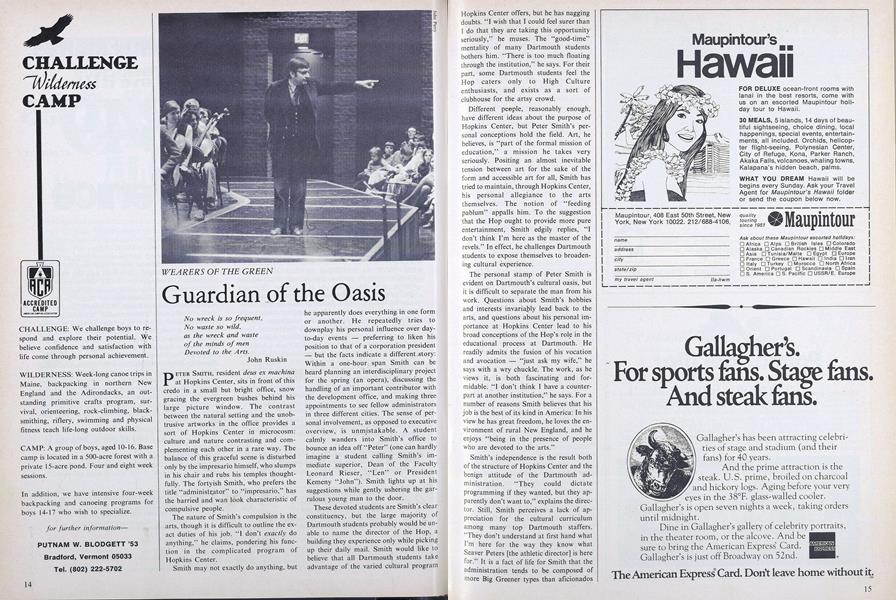
PETER SMITH, resident deus ex machina at Hopkins Center, sits in front of this credo in a small but bright office, snow gracing the evergreen bushes behind his large picture window. The contrast between the natural setting and the unobtrusive artworks in the office provides a sort of Hopkins Center in microcosm: culture and nature contrasting and complementing each other in a rare way. The balance of this graceful scene is disturbed only by the impresario himself, who slumps in his chair and rubs his temples thoughtfully. The fortyish Smith, who prefers the title "administrator" to "impresario," has the harried and wan look characteristic of compulsive people.
The nature of Smith's compulsion is the arts, though it is difficult to outline the exact duties of his job. "I don't exactly do anything," he claims, pondering his function in the complicated program of Hopkins Center.
Smith may not exactly do anything, but he apparently does everything in one form or another. He repeatedly tries to downplay his personal influence over day-to-day events - preferring to liken his position to that of a corporation president - but the facts indicate a different story: Within a one-hour span Smith can be heard planning an interdisciplinary project for the spring (an opera), discussing the handling of an important contributor with the development office, and making three appointments to see fellow administrators in three different cities. The sense of personal involvement, as opposed to executive overview, is unmistakable. A student calmly wanders into Smith's office to bounce an idea off "Peter" (one can hardly imagine a student calling Smith's immediate superior, Dean of the Faculty Leonard Rieser, "Len" or President Kemeny "John"). Smith lights up at his suggestions while gently ushering the garrulous young man to the door.
These devoted students are Smith's clear constituency, but the large majority of Dartmouth students probably would be unable to name the director of the Hop, a building they experience only while picking up their daily mail. Smith would like to believe that all Dartmouth students take advantage of the varied cultural program Hopkins Center offers, but he has nagging doubts. "I wish that I could feel surer than I do that they are taking this opportunity seriously," he muses. The "good-time" mentality of many Dartmouth students bothers him. "There is too much floating through the institution," he says. For their part, some Dartmouth students feel the Hop caters only to High Culture enthusiasts, and exists as a sort of clubhouse for the artsy crowd.
Different people, reasonably enough, have different ideas about the purpose of Hopkins Center, but Peter Smith's personal conceptions hold the field. Art, he believes, is "part of the formal mission of education," a mission he takes very seriously. Positing an almost inevitable tension between art for the sake of the form and accessible art for all, Smith has tried to maintain, through Hopkins Center, his personal allegiance to the arts themselves. The notion of "feeding pablum" appalls him. To the suggestion that the Hop ought to provide more pure entertainment, Smith edgily replies, "I don't think I'm here as the master of the revels." In effect, he challenges Dartmouth students to expose themselves to broadening cultural experience.
The personal stamp of Peter Smith is evident on Dartmouth's cultural oasis, but it is difficult to separate the man from his work. Questions about Smith's hobbies and interests invariably lead back to the arts, and questions about his personal importance at Hopkins Center lead to his broad conceptions of the Hop's role in the educational process at Dartmouth. He readily admits the fusion of his vocation and avocation - "just ask my wife," he says with a wry chuckle. The work, as he views it, is both fascinating and formidable. "I don't think I have a counterpart at another institution," he says. For a number of reasons Smith believes that his job is the best of its kind in America: In his view he has great freedom, he loves the environment of rural New England, and he enjoys "being in the presence of people who are devoted to the arts."
Smith's independence is the result both of the structure of Hopkins Center and the benign attitude of the Dartmouth administration. "They could dictate programming if they wanted, but they apparently don't want to," explains the director. Still, Smith perceives a lack of appreciation for the cultural curriculum among many top Dartmouth staffers. "They don't understand at first hand what I'm here for the way they know what Seaver Peters [the athletic director] is here for." It is a fact of life for Smith that the administration tends to be composed of more Big Greener types than aficionados of the arts. (Tastes can always change.)
Born and educated in England - he received his B.A. with honors from the University of Birmingham - Smith sees an advantage to his status as something of an outsider among the career Dartmouth men: "If a man has never worked at an outside institution, he may fail to develop or even accept new ideas." Living in Strafford, Vermont, has provided Smith with a certain distance from the Dartmouth community, "which I get enough of at work." Strafford is more than a half-hour drive from Hanover, and such distance "leads to a redefinition of the word 'emergency.' "
Perspective is something Smith's career might provide a great deal of. After college, he crossed the Atlantic to begin his career as an administrator at McMaster University in Ontario, where he worked in admissions, in the office of the registrar, and finally as the director of an extension program for part-time students. While at McMaster he organized a series of seminars together with the Stratford Shakespeare festival and founded a film society. Leaving McMaster in 1965, Smith moved to the Santa Cruz campus of the University of California, where he was assistant to the chancellor and chairman of the campus committee on arts and lectures. At Santa Cruz he helped develop a drama program and participated in the planning of their performing arts center.
At Dartmouth since 1969, Smith performs a variety of functions at the Hop (besides overall direction). Since virtually all major events must be subsidized, fund raising is crucial to the cultural program at Dartmouth. "We can get almost anything if the money is available," claims Smith, who also feels that he can get all the money he needs if he has the time. He believes Hopkins Center's uniqueness makes it very easy to sell to potential contributors, many of whom are not Dartmouth graduates. The problem is that Smith can only devote a certain amount of his time to fundraising, given the other demands of his job and the strain placed on his family life by constant travel. "People want to get a sense of just who is going to be spending their money," he says by way of explaining why the director of an arts center can raise money more effectively than professional fund raisers.
Contacting and contracting first-line performers for the Hop is not the director's total responsibility, as Smith quickly points out, but the stature of a director often facilitates the booking of quality events. The rest comes with luck and meticulous attention to the needs of the performers, according to Smith. When Sir Georg Sold and the Chicago Symphony planned their eastern tour in 1971, they ineluded Hanover because they believed they would find an appreciative audience, and they made a significant concession in terms of their fee. Smith quotes Solti as saying "being up here [in Hanover] is as good as a rest cure." In reference to the geographical isolation frequently cited as a barrier to obtaining metropolitan-based groups, Smith is dubious. "Hanover has a worse reputation than it deserves for being difficult to get in and out of."
The man who runs the show likes to be personally involved. Smith used to attend virtually every event at the Hop, which meant day and night duty almost 365 days of the year. This is no longer strictly true, but circumstances require his presence at most performances. With performers he has personally brought to Hanover, Smith feels compelled to attend so he can see "how it goes." But the feelings of in-house artists are ruffled if he shows interest only in imported talents, and in any case he truly wants to be on hand for their performances. As a result of these time demands on top of his fund-raising duties and administrative chores ("regulating traffic"), the director has been forced to forego his old passion: the movies. Celluloid is impersonal and enduring. He can always catch up with movies, but the performances of actors, musicians, and some other artists exist only for the present.
Smith's involvement with the arts extends beyond his administrative responsibilities. He acts, sings, designs posters and seeks out paintings and sculpture for his personal collection. But he does not want to be known as a dabbler: His identity hinges on his administrative role, and this is where he hopes to leave his mark. He even claims to have no real preferences among the arts, "which is perhaps why I got the job and why I'm not doing too badly in it."
"I was very fortunate to get the perfect job for me in my thirties," says Smith. "It is the best job of its kind in the world." Away from work, Smith treasures a "Hobbit-like existence" with his wife and son. He pursues few hobbies and no sports, but speaks longingly of time spent before a roaring fire with his family.
These days Smith has little time to stoke the home fire. Hopkins Center continues its varied program and Smith has a personal goal of raising $11 million for the center as part of the Campaign for Dartmouth. Once this exhausting undertaking is finished, Smith hopes to take a leave of absence from his position as Dartmouth's custodian of culture to replenish his energy reserves. It takes a great deal of stamina to "let our students know . . . that the arts are very multifarious."
Article
-
 Article
SONGS, CHEERS AND ENTHUSIASM
November, 1911 -
 Article
Political Science Portraits
August, 1912 -
 Article
New boat house under construction
SEPTEMBER 1985 -
 Article
Somebody Should Warn The Fish
NOVEMBER 1990 -
 Article
BOSTON ASSOCIATION
March, 1924 -
 Article
Vacation on the Dartmouth Mountain
June 1934


