Of Sun-Gazers and Seal-Hunters
And the men who study them
Query: When is an archaeologist not anarchaeologist?Ans.: When he's an anthropologist or ageographer.
REGARD then Professor Elmer Harp Jr., Dartmouth anthropologist, and Professor Vincent H. MalmstrÖm, Dartmouth geographer. Both have archaeology in their academic quivers (indeed, Harp, a practical expert in the field, teaches a course in Field Methods in Archaeology) in addition to other ammunition more directly related to their disciplines.
Both, too, are interested in time (as what archaeologist isn't?), although MalmstrÖm is perhaps more literally interested in it than Haarp. They are, in fact, both in- terested in the origins of prehistoric American peoples, although the fields of their interests lie nearly a half a globe apart, latitudinally speaking.
Harp is the senior of the two men. He has been a member of the Dartmouth faculty for 30 years and, now 64, he will he retiring on July 1. He is a trim, compact man with a full head of white hair above a surprisingly youthful face. For almost all of those 30 years his field research has concerned the Dorset Eskimo culture of the central and eastern North American Arctic. The Dorsets, a pelagic hunting people (seals and whales and occasionally caribou), existed for about 2,000 years from 600 B.C. to about 1400 A.D., at which time they were probably assimilated by the Thule Eskimos who came out of the western Arctic about 1000 A.D.
An inveterate pipe-smoker, Harp has the calm, unflappable air that novelists invariably associate with the briar-bearing set. One can easily picture him imperturbably shooting an Arctic rapids with pipe firmly but insouciantly in mouth.
MalmstrÖm, as his name might suggest, is an expert on Scandanavian land use, but his archaeological bent, of much more recent origin than Harp's, has taken him about as far away, geographically, from Norden as even a Viking would wish to go. A man with dark, curly hair, tall and slender, he has aquiline good looks and an air of quiet boyishness. He is 51.
He is a relative newcomer to the Dartmouth faculty, having moved to it from Middlebury in 1975 as a full professor. He, too, is investigating tribal origins, but his particular research centers upon the Olmec civilization, the oldest in Central America. The Olmec time span goes further back than that of the Dorsets, to about 1400 8.C., and runs forward to about the end of the first millenium, A.D. These Mexican Indians were skilled agriculturists and were probably assimilated by Nahuan Indians, of whom the Aztecs represent the highest (and last) culture.
Whereas Harp has been pursuing his quarry for nearly 30 years on 11 separate expeditions to the north, MalmstrÖm has been embarked on his particular argosy southward only for the past four years. MalmstrÖm's special interest in the Olmecs has centered around a strange, 260-day sacred calendar that these people and others throughout Mesoamerica used in pre-Columbian times and which has continued in use virtually to date among remote Indian tribes in Guatemala.
THE Olmecs, traditional wisdom had it, originated on the Gulf coastal plain of Mexico. But MalmstrÖm, using a combination of geographic and calendric deduction, bolstered by a pinch of computer technology, came up with a hypothesis in 1973-74 that the Olmecs originated on the Pacific coastal plain near the present-day Guatemala-Mexico border. This hypothesis has interesting ramifications, for it could suggest (shades of Thor Heyderdahl) that the Olmecs had even earlier ties with Peru and/or Polynesia.
In brief, MalmstrÖm theorized that a 60-day calendar used by a prehistoric people would have had to been devised by a culture situated at, or near, the 15th parallel of latitude. It is at this parallel, he points out that 260 days elapse between the occasions that the sun is overhead. He put forward his hypothesis in an article in Science in September 1973. In searching for a known prehistoric site which fitted the 15th-parallel theory, he zeroed in on the ancient lowland village of Izapa on the Pacific coastal plain of Chiapas, Mexico's southernmost state. Not only is Izapa very close to the 15th parallel (it is only a few minutes south of it), thus fulfilling the 260-day vertical sun position interval, but it is so situated as to suggest that a 365-day secular calendar could have been figured there by the Olmecs.
The main Olmec pyramid there, MalmstrÖm found when he visited Izapa in 1974, is oriented in such a way that the sun appears to rise out of the crater of the highest volcano in Central America, Tajumulco, some 20 miles distant, on the summer solstice. Thus, he reasons, by counting the number of days which elapsed between two successive sunrises at the summer solstice over this volcano, the priests at Izapa could determine the true length of the year.
MalmstrÖm returned to Mexico in the winter of 1977 to test further his theories about the Olmecs, a people already known to have developed an astronomic science, a beginning of hieroglyphic writing, and to have discovered the mathematical concept of zero. His 1977 trip was aimed at checking other sites to see if they were solsticially oriented to volcanoes or mountains. West of Mexico City on the Pacific coast his results were "essentially negative, but we were not too surprised, for this was known to be a cultural backwater, archaeologically speaking."
The first evidence he found on this trip of pyramid-mountain .orientation was at Cholula, 60 miles southeast of Mexico City. At Cholula is a pyramid known to have served as a great pilgrimage site, the largest man-made structure of pre-Colum-bian times in the Western Hemisphere. This pyramid is oriented to the mountain Ixtaccihuatl, which means "white women" in Nahuatl, the language of the Aztecs. It got its name because its profile looks like that of a reclining women and, at the summer solstice, the sun sets over the woman's "breasts."
Similar solsticial orientations were found at sites in the Pacific coastal plain of Guatemala, where, due to poor visibility, some of the alignments had to be reconstructed from detailed topographic maps. "However," MalmstrÖm recalls, "in eastern Mexico, where we hoped to find the link between the Guatemalan and Mexican plateau sites, the weather really threw us a curve. Extremely rainy weather set in and we simply could not take visual sightings of the mountains."
He remedied this lack of field data by using cartographic aids in the Geography and Map Division of the Library of Congress on his return to the United States. With them, he was able to determine that every one of the major Olmec sites on the Gulf coastal plain was oriented to a sunrise or sunset position at the summer or winter solstice.
His field and Library of Congress data gave him an S-shaped pattern of calendrical diffusion running from Guatemala in the south to the Mexican plateau in the north. He believes the pattern starts in Izapa and stretches both eastward into Guatemala and northward into Mexico, rather than the other way around, as previous theory would have it. With some logic, he points out that it is more reasonable to assume that the principle of solsticial orientation was hit upon where the peak in question was only 20 miles away - as at Izapa - than in the Gulf coastal plain where the distances between pyramid and peak were sometimes greater than 90 miles - as, for example, between San Lorenzo and Zempoaltepec. Such distances, he adduces, suggest that Olmecs who already knew the solsticial principle had to search for a mountain upon which to orient their pyramid. Radio-carbon dating tends to support this theory, for readings of 1700 B.C. have been obtained at Izapa, while ones of only 1400 B.C. have been gotten at San Lorenzo.
One more scientific back-up bolsters the MalmstrÖm hypothesis. He used the computer at Kiewit to run the two Olmec calendars - sacred and secular - back to their respective starting dates. The results suggest a mid-14th century B.C. origin for both.
This time-frame has proven specially interesting to Mexican archaeologists working in the coastal plain of Chiapas. In their digs near Izapa there, they found many obsidian chips which were clearly not arrow or spear points. They have theorized that these chips were set in boards and used to shred manioc, a root crop. However, in the levels since 1400 8.C., the obsidian chips are totally absent, and this is taken as evidence that the Olmecs at that time shifted from a manioc culture to corn cultivation. Such a shift, MalmstrÖm points out, might explain the need for a calendar, for corn-growers would have to know when the rainy season sets in in order to plant, a calendrical observation not needed by manioc harvesters.
MalmstrÖm is once again in Mexico, having departed Hanover just before Christmas, and will spend the winter term trying to gather further data on this elusive but vastly talented pre-Columbian people.
THE archaeological will-'o-the-wisp followed by Harp involves a people perhaps less cerebral, but not the less admirable for their carebral out a considerable culture in a vastly more severe climate. On the total human scale, the Dorset Eskimos are relative Johnny-come-latelies. It is generally accepted that the first North Americans (at least the northernmost ones) crossed a land bridge that once existed between Siberia and Alaska 20,000 to 40,000 years ago.
These, in the traditional anthropological view, were the ancestors of the modern American Indian. The Eskimos were a much later Mongoloid invasion - perhaps 5,000 years ago - and the Dorsets were the first to settle the eastern and central Arctic of North America. Eventually, the Dorsets were superseded by the Thule Eskimos, "very likely," Harp says, "because the Thule people were better whale hunters."
While Malmstrom's reconnaissance has been more speculative, Harp's has been almost pure archaeology, with carefully controlled digs at points ranging from Newfoundland and Labrador to the Dismal Lake area of the Northwest Territories and the Belcher Islands of Hud- son Bay. As might be expected, his oeuvre is greater (after all, he's been at it far longer) than MalmstrÖm's, but each of them, in his own way, is seeking out the same thing - the birth, beginnings, and history of two sturdy cultures.
Some hint of the energy expended and the scholarly research done by Harp was given in an exhibition, "The Search for an Ancient Arctic Past," in the Wilson Museum, home of Harp's Anthropology Department, during-the fall term at Dartmouth. The exhibition gave the broad outlines of those 11 expeditions, plus many shorter trips to flesh out his knowledge of this vast northern area.
Harp's first indoctrination to the Arctic was in 1948, when he was a member of a Harvard (his alma mater, undergraduate and graduate) -Andover Yukon (a symbol for his alba mater) expedition. This trek was in search of Paleo-Indian traces along the migration routes from Alaska to central Canada, and really had nothing to do with his career-work with the Dorsets, except that it aroused his appetite for the Arctic. Since then he has trudged, canoed and overflown the more easterly Arctic pursuing his particular quarry, and some of his field work has lengthened both the ancient and modern chronological limits once accepted for this culture.
The Dorsets were a more mobile people than the Olmecs. Because their economy rested upon hunting, they had to move where the prey was and because the environment would not support more than one or two families in a given area, they had to move if a locality became "over-populated." They were far less "sedentary," in a fine anthropological term, then the agricultural Olmecs.
Fittingly enough, Harp himself is far from sedentary. He has traveled on his hegiras by boat, car, train, airplane (he learned to fly one himself in the 19405) and freighter canoes. His trips typically have been eight-person groups, which have usually included a Dartmouth anthropology major, a Harp son (or daughter), a Hanover teenager for company for same, and a couple of graduate students from other universities, in addition to the leader and other Arctic experts. They have been funded by a variety of sources, ranging from the Arctic Institute of North America through the National Science Foundation to the American Philosophical Society.
After the Yukon expedition, on which he was an assistant, all the other trips have been Harp-staged shows. They are, chronologically: 1949, northern New-foundland, coast of Labrador; 1950, Port Aux Choix, Newfoundland; 1955, Coronation Gulf, Northwest Territories; 1958, Baker Lake and Thelon River, Northwest Territories; 1961 and 1963, Port Aux Choix; 1967 and 1971, Richmond Gulf, east coast of Hudson Bay; and 1974 and 1975, Belcher Islands, Hudson Bay.
The Belcher Islands, which were made famous by the great documentary film-maker, the late Robert Flaherty (one of the islands is named Flaherty Island and it was here that he filmed part of the classic, Nanook of the North), are a remote, windswept archipelago, 100 miles into Hudson Bay from its southeastern shore. So windswept are they ("sometimes," Harp says, "you could fly a mattress") that archaeologic investigations at times have to be postponed. However, this very wind- iness was put to use by Harp, who is never averse to technological advances. He had aerial photographs taken by a motor-driven camera hoisted aloft by an airfoil and triggered from the ground by pneumatic and electrical releases.
Indeed, throughout his Arctic career, Harp has used aerial reconnaissance to backstop his more terrestial digs. In fact, he is an acknowledged expert in the field of aerial photography to pinpoint archaeological sites and he has written learned papers on the subject. Teaming with the U.S. Army's Cold Regions Research and Experimental Laboratory in Hanover, he worked out a method of taking aerial photos using four different film emulsions - black-and-white, infra-red, true color, and camouflage color - which, when examined in contrast by skilled eyes, give very strong clues as to promising sites for digs.
The Belcher trips give some idea of the logistics involved in this research. The group each time took off from Hanover in rented vans and drove to Montreal. There, they stayed overnight at Dorval Airport and flew out the next day to Great Whale River, P.Q., on the eastern shore of Hudson Bay. A 40-foot boat and two 23-foot freighter canoes with outboard motors and an Eskimo pilot were hired to take much of their supplies over the 100 miles of the bay to the Belchers, while the personnel made it, relatively more comfortably, air-borne in Twin Otters. There, they typically spent two months both ranging the islands and settling down to semi-permanent digs.
While much of Harp's Arctic work has been of a pioneering exploratory nature, he has also done some work as a consultant hired by the Arctic Institute of North America with the aim of protecting archaeological sites from the incursions of modern technology. The first of these jobs was to advise the Bureau of Land Management whether field archaeology along the Alaska pipeline was being done properly by the University of Alaska. To this end, he traveled the length of the pipeline from Prudhoe Bay to Valdez in the summer of 1972.
In 1976, he became a consultant on the proposed Polar Gas Pipeline project which will bring gas from the field in the far Arctic North in the Queen Elizabeth Islands by one of two routes to settled Canada either along the west coast of Hudson Bay or down the Mackenzie River to the Alcan Highway. This past year he spent two weeks with a group at Resolute Bay on Cornwallis Island and then was flown 100 miles farther north to the true polar desert country on Karluk Island to investigate 30 prehistoric sites. While there, his camp was ravaged by marauding polar bears and "we signalled Cornwallis to get us out of there quick."
Looking back on it recently, Harp, who gives the impression of never having had to move quickly (or at least precipitously), said he could go back to the Belcher Islands in two or three years for further research. Physically, he certainly seems capable of it.
But, he says, "I've made a good cross-section of what's there and I'm inclined to let it sit and let a younger generation take a crack at it." He also says he is looking forward to "retirement," for he thinks it will "give me some time to learn how to glide."
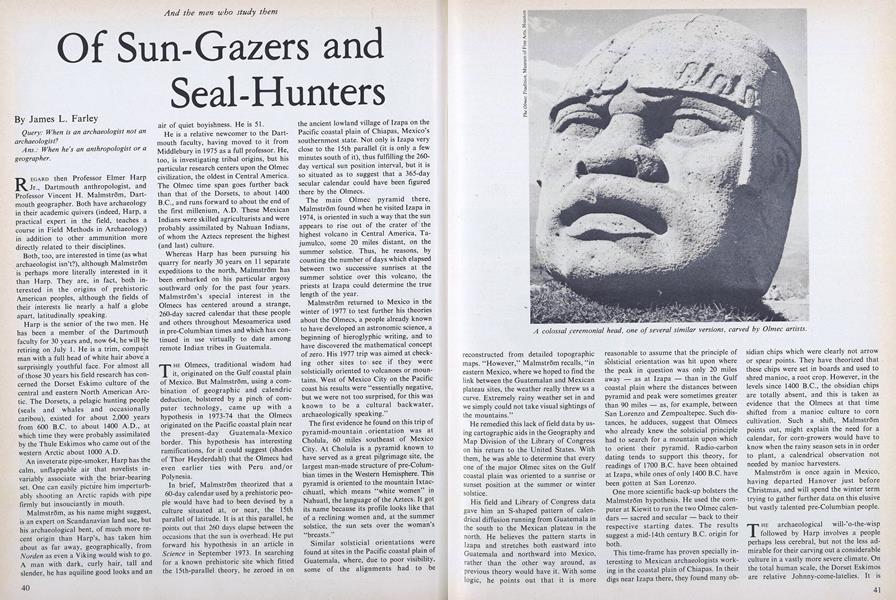
A colossal ceremonial head, one of several similar versions, carved by Olmec artists.
Opposite: On his 1974 Belcher Islands expedition,Harp tests a camera bipod usedin obtaining true vertical pictures (the lenspoints downward) of archaeological sites.
James L. Farley '42 has written many articlesfor the A LUMNI MAGAZINE, includingmost recently "The Elm and the Beetle."