Scions of Rhodes
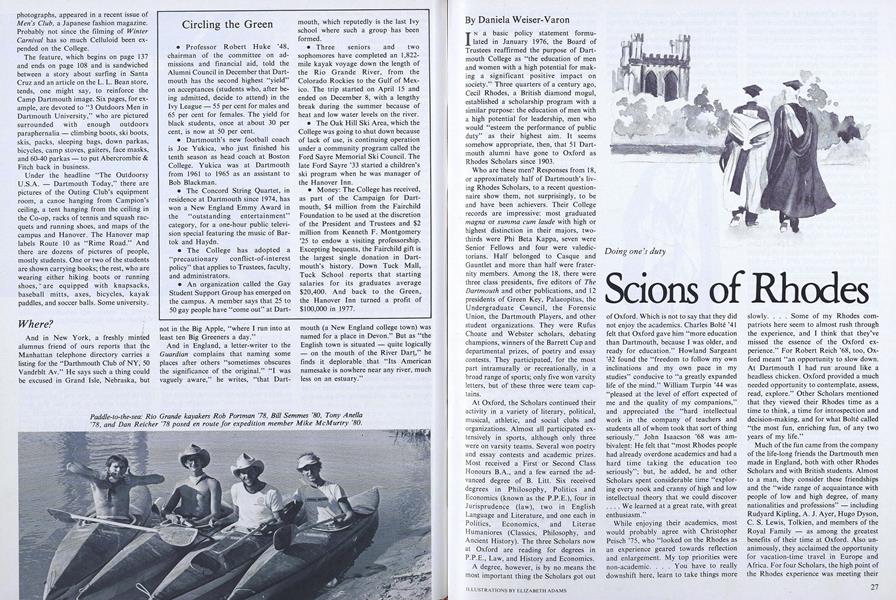
Doing one's duty
IN a basic policy statement formulated in January 1976, the Board of Trustees reaffirmed the purpose of Dartmouth College as "the education of men and women with a high potential for making a significant positive impact on society." Three quarters of a century ago, Cecil Rhodes, a British diamond mogul, established a scholarship program with a similar purpose: the education of men with a high potential for leadership, men who would "esteem the performance of public duty" as their highest aim. It seems somehow appropriate, then, that 51 Dartmouth alumni have gone to Oxford as Rhodes Scholars since 1903.
Who are these men? Responses from 18, or approximately half of Dartmouth's living Rhodes Scholars, to a recent questionnaire show them, not surprisingly, to be and have been achievers. Their College records are impressive: most graduated magna or summa cum laude with high or highest distinction in their majors, twothirds were Phi Beta Kappa, seven were Senior Fellows and four were valedictorians. Half belonged to Casque and Gauntlet and more than half were fraternity members. Among the 18, there were three class presidents, five editors of TheDartmouth and other publications, and 12 presidents of Green Key, Palaeopitus, the Undergraduate Council, the Forensic Union, the Dartmouth Players, and other student organizations. They were Rufus Choate and Webster scholars, debating champions, winners of the Barrett Cup and departmental prizes, of poetry and essay contests. They participated, for the most part intramurally or recreationally, in a broad range of sports; only five won varsity letters, but of these three were team captains.
At Oxford, the Scholars continued their activity in a variety of literary, political, musical, athletic, and social clubs and organizations. Almost all participated extensively in sports, although only three were on varsity teams. Several won poetry and essay contests and academic prizes. Most received a First or Second Class Honours 8.A., and a few earned the advanced degree of B. Litt. Six received degrees in Philosophy, Politics and Economics (known as the P.P.E.), four in Jurisprudence (law), two in English Language and Literature, and one each in Politics, Economics, and Literae Humaniores (Classics, Philosophy, and Ancient History). The three Scholars now at Oxford are reading for degrees in P.P.E., Law, and History and Economics.
A degree, however, is by no means the most important thing the Scholars got out of Oxford. Which is not to say that they did not enjoy the academics. Charles Bolté '41 felt that Oxford gave him "more education than Dartmouth, because I was older, and ready for education." Howland Sargeant '32 found the "freedom to follow my own inclinations and my own pace in my studies" conducive to "a greatly expanded life of the mind." William Turpin '44 was "pleased at the level of effort expected of me and the quality of my companions," and appreciated the "hard intellectual work in the company of teachers and students all of whom took that sort of thing seriously." John Isaacson '68 was ambivalent: He felt that "most Rhodes people had already overdone academics and had a hard time taking the education too seriously"; but, he added, he and other Scholars spent considerable time "exploring every nook and cranny of high and low intellectual theory that we could discover . . . . We learned at a great rate, with great enthusiasm."
While enjoying their academics, most would probably agree with Christopher Peisch '75, who "looked on the Rhodes as an experience geared towards reflection and enlargement. My top priorities were non-academic. . . .You have to really downshift here, learn to take things more slowly. . . . Some of my Rhodes compatriots here seem to almost rush through the experience, and I think that they've missed the essence of the Oxford experience." For Robert Reich '68, too, Oxford meant "an opportunity to slow down. At Dartmouth I had run' around like a headless chicken. Oxford provided a much needed opportunity to contemplate, assess, read, explore." Other Scholars mentioned that they viewed their Rhodes time as a time to think, a time for introspection and decision-making, and for what Bolté called "the most fun, enriching fun, of any two years of my life."
Much of the fun came from the company of the life-long friends the Dartmouth men made in England, both with other Rhodes Scholars and with British students. Almost to a man, they consider these friendships and the "wide range of acquaintance with people of low and high degree, of many nationalities and professions" - including Rudyard Kipling, A. J. Ayer, Hugo Dyson, C. S. Lewis, Tolkien, and members of the Royal Family - as among the greatest benefits of their time at Oxford. Also unanimously, they acclaimed the opportunity for vacation-time travel in Europe and Africa. For four Scholars, the high point of the Rhodes experience was meeting their future wives at Oxford; for another, high points were "the occasional brilliant essays which suddenly made something make sense or tutorials when something got off the ground."
Perhaps more than any one particular thing, the Scholars enjoyed the history and beauty and life of Oxford itself: tea in the afternoon when friends dropped in to smoke their pipes and share experiences or to discuss the work that they were doing and the events of the day; late-night discussions of practically everything; bells in the rain; lawn-bowling in the 9:00 p.m. twilight; a glass of bitter with the other side after a wet and bloody rugby match; cricket against village teams in May with tankards of mild ale on the field; standing at attention in the dining hall at the evening meal as the robed fellows of the college ceremoniously proceeded to high table and the Latin grace was intoned by one of the college members; Eight's Week, a five-day crew competition on the Isis River in the spring, which Christopher Hall '76 calls "a terrific time - beer flows like it will never end and the races are incredibly exciting - a five-day party." (Except for the crew races, "Eight's Week" sounds remarkably like a Winter Carnival or a Green Key weekend at Dartmouth.) And perhaps a Dartmouth background accounts for more than half of the Scholars listing English beer as one of the high points of their stay at Oxford.
While the Scholars liked the beer, they unanimously condemned English food and English weather as the low points of their Oxford experience. Other problems included occasional loneliness, occasional frustration with tutors, and, for David Bergamini '49, "falls incurred climbing over walls into Merton and New College." Gordon Bjork '57 also spent time "climbing over barbed wire and broken glass at two a.m. after the college gates were shut for curfew," a curfew that, in the day of Richmond Lattimore '26, was shortly after midnight. Few Scholars mentioned any disappointments, although Sargeant noted "the frequent evidence that my English classmates lacked knowledge of the real world and often displayed a rather touching naivete as compared with young men of their age in America," and John Martin '31 was "disappointed to find that people are the same everywhere to the extent that some are intent upon benefiting from their experience but that many intend to get by with as little effort as possible."
DARTMOUTH'S Rhodes Scholars, at any rate, seem to have been among those intent upon benefiting from their experience, an experience that Lattimore called "almost perfect." For Turpin, the Rhodes experience, "at the time . . . meant that I had something on the ball and the world was open to me. In retrospect, it opened my eyes to a number of things." It opened Martin's eyes by giving him an "increased interest in world politics and world affairs, as distinguished from a more parochial approach to activities in my own country." For those who went to Oxford during the period of the Vietnam War, Oxford provided a certain perspective. According to Reich, "those years gave us an opportunity to assess our liberalism and view America's agony in perspective. I left America with some cynicism about liberal values. I returned in 1970 with, I think, a renewed and more understanding commitment to those values." Harris Wagenseil '67, in England during the same period, said, "My eyes were very much turned westward, to the U.S. I came away from Oxford feeling more uniquely American than ever before in my life and cherishing that identity." And Neil MacFarlane '76, a Canadian, found that Oxford "gave me a different and perhaps more realistic perspective on North America."
What, besides perspective, does Oxford offer Rhodes Scholars as a group? "A chance to get to know themselves." "An opportunity to gain intellectual maturity." "Familiarity with and knowledge of the best aspects of British culture." Speaking for his fellows, Turpin commented, "We have been to the intellectual mountain-tops, and if we have found, most of us, that the air is too rare for us, still we have breathed it." But, he added, "We may have become intellectual snobs." According to John Isaacson, however, Rhodes Scholars gain "a certain cultural tolerance." That, and "the Seal of Good Housekeeping."
If there is any one thing the Scholars agree that Oxford has given them, it is breadth, or - as Charles Bolté put it - "broader horizons than any of us got from earlier education in our own countries; hence, presumably, better and heavier equipment to take into 'the world's fight.' " The Rhodes Scholars feel that they, in turn, have brought to Oxford a breadth, international perspective and flavor, not to mention "the ability to beat up Cambridge in American-type sports." In addition, their zest, sparkle, enthusiasm, and energy, according to one Scholar, were generally appreciated. Bolte, for one, has his doubts on this point: "I often felt that many of the English secretly agreed with the Duke of Dorset, in Zuleika Dobson [one of the classic books about Oxford], who didn't object to the right of Rhodes Scholars to exist, only to their exercising the right in his presence." Bolté's thesis supervisor clearly agreed: "While polite to me, he was unremittingly anti-American. On learning that he'd never visited, I suggested he do so, and see for himself. 'No,' he replied. 'I don't want to risk weakening my prejudices.' "
If Rhodes Scholars bring a certain perspective to Oxford, they also come away with a new' one. Experiencing a different system of higher education, they achieve a basis of comparison from which to view their own education. What are the basic differences between the Oxford system of education and our own? For starters, an Oxford education is highly specialized and centers around the tutorial system. A student is responsible for mastering one subject or combination of subjects over a two- or sometimes three-year period. To this end, the student has a "tutor," or faculty member, who guides him, suggests readings, and listens to and comments on a weekly essay the student writes. There is little or no emphasis on required readings or attendance at lectures, which are given on an optional basis for the student who feels they may be useful to the particular course of inquiry he is following. One Rhodes Scholar remembers being told by his first don at his first tutorial, "Don't be like lots of Americans and waste your time attending lectures. The necessity for giving lectures was obviated 500 years ago by the invention of the printing press." Nor is there any periodic testing: the entire degree depends upon a series of exams administered usually at the end of two years, exams which are set and corrected by external examiners rather than by the student's tutor. With the exception of two or three who were disappointed by the quality of tutors or tutorials, the response of the Scholars was overwhelmingly favorable toward the tutorial system, with its "apparent freedom from coerced studying and thinking"; some called it the highlight of the Oxford experience. It is a system which, they say, "taught me to write and think clearly," "made me semiliterate," "promotes self-discipline," and is "just right for anyone highly motivated."
Most of the Scholars found Oxford's educational philosophy, as characterized by the tutorial system, much more individualized, student-oriented, flexible, permissive, and relaxed than that of American institutions. According to John Martin, it leaves to the individual "more fully the determination of whether he is going to make something of his opportunities." Some felt that Oxford, and British schools in general, put far greater emphasis on articulate expression of intelligent opinions, on exchange of ideas, and on original thought and interpretation than do Dartmouth and other American schools, which emphasize memorization of facts and "the student giving back to the professor what the professor specified on papers and examinations." Harris Wagenseil felt that, in England, "the scope and extent of the work done depends entirely on you, and that leads to an intellectual maturity which our system of scheduled readings and examinations does not, in my judgment, usually create." Thomas Brewer '68 commented that "Dartmouth, and American colleges and universities generally, encourage the student to view progress as something measured vis-a-vis the group. Learning at Oxford is a more solitary, independent venture. . . . The on-going experience is a relatively pure one between the student, subject, and tutor. The benchmarks [of progress] are less attainable but far more meaningful."
Nathan Parker '26 noted the "almost complete freedom of study methods of the English system compared to the American classroom discipline," although "the freedom of the student's social life was regulated far more" in England. Albert Colton '47 also found that English students had far better academic preparation but were socially far less mature than their American counterparts. Turpin, a college professor, underscored the difference in assumptions: "Oxford presupposes first-class secondary education and we presuppose none, and Oxford presupposes that students want to learn and we know ours mostly don't. Oxford may be overspecialized; our system seems to me diffuse and on the part of academic administrators, irresponsible (we don't know what we want to teach, or why, much less how). On the whole, our post-graduate education and much of our undergraduate education is excessively pre-professional, training rather than education. Oxford does some training, but I submit that it also and always tries to educate." For Reich, the single most salient difference is that "at Oxford, you and your tutor are allies . . . you form a deep, personal, richly intellectual partnership. In American universities, too often you and your professors are on opposite sides. Who will martyr whom? The academic and intellectual process is a means rather than an end in itself." Gordon Bjork expressed the same feelings in suggesting that Dartmouth institute the Oxford tutorial system: "One of its prime virtues is that the tutor becomes an ally in preparation for the evaluations performed by the examiners. This relieves the student and professor from the tension which arises because the latter is also responsible for assigning grades which have become so terribly important to American students because of their importance to graduate and professional schools and employers."
Other Scholars, however, did not see this kind of rift between American students and professors. Harold Glendening '18, for instance, found that "the friendly relations between faculty and students" are similar at Oxford and Dartmouth. And Christopher Peisch, now at Oxford, misses his Dartmouth professors, whom he calls "unusually personable and dedicated to the student's well-being." By way of contrast, he described one of his first tutors at Oxford, who "would never look at me, and while I read my essay, he would sometimes bury his head in his hands and murmur to himself in a way that almost sounded like groans. The first time this happened I had difficulty finishing the essay, as I thought I had done an unusually thorough job of butchering the essay topic and that my interpretation was almost painful to the tutor." But most tutors, he admitted, are quite friendly.
Do DARTMOUTH and Oxford have anything in common other than friendly professors? Hall and Bergamini both mentioned that the Honors work 'they did at Dartmouth was quite similar to their studies at Oxford. Sargeant suggested that other Senior Fellows in his class "would have found in the Oxford of my day a philosophy of education and a climate that in many ways would have made us say - 'But everyone here is in the status of a Senior Fellow.' " What this suggests is that at least a small number of motivated Dartmouth students do have the opportunity to have an academic experience similar to that at Oxford. In fact, some of Dartmouth's Rhodes Scholars said that they found little or no difference in the philosophies of education of the two schools. Turpin expressed his view rather cautiously: "I hope Dartmouth is trying to do the same thing as Oxford, and the official statements can be read that way. What the real purpose of the administrative brass is, I don't know; to raise money seems to be the main, and constant, and possibly necessary primary objective. But if Dartmouth has a purpose apart from keeping the shop running, then surely it is to do what Oxford is there to do." A majority of the Scholars responding, however, were critical of Dartmouth. MacFarlane, for example, said he was "not sure if Dartmouth has, or, more importantly, applies" an educational philosophy. And one rather recent Scholar had the following perspective to offer:
My time [at Oxford] has led me to be somewhat critical of Dartmouth's seeming lack of concern with academic standards (c.f. guts, antiintellectualism, summer-camp atmosphere, etc.). Everybody (i.e. administration, faculty, and students) seems to be far too concerned with leading a painless, secure, and conforming existence. There are of course exceptions to this in all three categories. However, as a general rule, it seems to me that serious thought and intellectual development tend to get lost in the shuffle of balancing the budget., tenure wrangles, generating alumni support, football games, frat parties, T.V.-room sit-ins, punting, screwing, booting, etc. Dartmouth is supposed to be an academic institution. It should keep that in mind.
A lack of concern with academics is what another Rhodes Scholar sees as the reason why Dartmouth students don't win more of the Scholarships. Maybe, he suggested, "we just need more 'brains' at the college." Albert Colton, who has been involved with Rhodes selection committees for 15 years, offered a different possibility: "The College doesn't give applicants enough support. Harvard, for example, gives each applicant extensive briefing, and the faculty references do not hesitate to write masterful and very detailed letters which obviously reflect a substantial investment of time."
Apart from the elimination of qualifying exams and of Greek and Latin requirements early in the century, the criteria for the selection of Rhodes Scholars have remained virtually unchanged since their establishment in 1903. The one requirement that has been eliminated is the "qualities of manhood." In 1976, an act of Parliament opened the Rhodes Scholarships to women, a move which Dartmouth's Scholars applauded unanimously with such comments as "About time!" and "Thank God!" - although, as Glendening pointed out, Cecil Rhodes would certainly not have approved. Christopher Hall remembered that "we gave a standing ovation when it was announced at a Rhodes dinner that the first female Rhodes Scholar had been elected." With the exception of one alumnus who admitted "some early prejudice" and of another who admitted to "some lingering doubts about the value of single-sex education," all of the Scholars questioned were unreservedly in favor of coeducation at Dartmouth.
As for the selection criteria, the Scholars unanimously agreed that, given a choice, they would not change any of them. Quite a few, however, said they would like to see certain criteria emphasized over others. Only three Scholars felt athletic achievement is over-emphasized; most agreed that the Rhodes Scholars who had been outstanding athletes, such as Supreme Court Justice Byron (Whizzer) White and Princeton's Bill Bradley, also had the other academic credentials and qualifications. Many characterized themselves as athletic failures or commented that there had been very few outstanding athletes in their Rhodes classes. The importance of athletic achievement may be exaggerated, according to one Scholar, because it is easy to account for.
Much harder to judge are such qualities as sympathy, kindliness, unselfishness, truth, and moral force. MacFarlane suggested that "it would be enough to ask that the committees apply the criteria as presently defined. In that manner, one could perhaps reduce the number of amoral, unprincipled, opportunistic, selfsatisfied hypocrites" who ' win Scholarships. Brewer felt that "the Scholarship too often goes to well-spoken student-government types, who fail to appreciate the very real educational opportunities available at Oxford." To avoid this, he suggested that the committees put more emphasis on specific educational objectives. Most of the younger Scholars agreed that today's Scholarships usually go to people with high scholastic achievements, one outstanding non-academic achievement, and ability to handle themselves well in public, and a little leadership potential.
It is precisely the quality of leadership potential that a large group of the Scholars felt should be emphasized more strongly by the selection committees. As John Martin put it, "the primary purpose of sending Rhodes Scholars to Oxford is to enable them to develop further there the power, which they might be presumed to have from the nature of their selection, to lead their fellow men in moral and beneficial directions." Nathan Parker felt strongly that "the importance of our political and economic life demands . . . the improvement of our leaders, and I think the Rhodes Scholars should have much that is needed to produce them." Edward Campion '67 took a different view. "I don't think anyone takes Cecil Rhodes's phrases too seriously," he wrote. "It's apparent Rhodes tried to purchase moral righteousness in his will after a life of amoral aggrandizement. Thence most see the scholarship as a marvelous opportunity, but not one [for which] to march to old Cecil's tune. The very few Rhodes Scholars who did seem to think they were selected to lead the world were unbearable bores."
THERE is disagreement among the Scholars on whether most of them have taken Rhodes's phrases - or, at any rate, his purpose - seriously and on how they have fulfilled his will. One noted that "many Rhodes Scholars have gone into public service"; another felt that the Scholars have not "been the sort of leaders in public life that Cecil intended." Asked whether he felt that he had lived up to Rhodes's expectation that Scholars "esteem the performance of public duty as their highest aim," Thomas Brewer, a lawyer, replied, "I esteem it. It's just that identifying it is so difficult! Most of us have probably fallen well short of this ideal, unless 'public duty' be equated with government positions, which Scholars have held a lot of. But the equation is too dubious." Two of the Scholars who do make this equation, and who do not feel they have fulfilled Rhodes's expectations, are Glendening, a lawyer for 30 years on Wall Street and for four years with the Department of Justice, and Parker, a lawyer and corporation vice-chairman who served for two years in the U.S. Army Civil Affairs division. According to Glendening, only a few Scholars can be "senators, governors, U.S. Supreme Court Justices, etc. The rest of us have to be satisfied with a more private life." Parker, however, feels that if he could do it over again, he would direct his "efforts to the possibilities of service in the political arena, for I feel that is one of the ways in which our experience [as Rhodes Scholars] could contribute to the education and welfare of all peoples who must adjust to the changing ways of the world in which we live."
But the majority of Dartmouth's Scholars had broader definitions of public duty than did Glendening or Parker. Lattimore, a classics professor for 35 years, suggested that "perhaps any teacher and lecturer is performing a public duty as well as earning a living.." Bergamini, for ten years a writer and writer-editor for Life magazine, and the author of two published novels, four science popularizations, and a controversial 1,200-page book on Japan, felt that he has performed a public duty, particularly in that he has "made my views public. I have suffered for my frankness. The fact that I was once a Rhodes Scholar has enabled me to continue expressing dis-sidence totally unaffiliated, yet retaining an audience."
In general, Dartmouth's Scholars have disproved Lattimore's Depression-time definition of a Rhodes Scholar as "a young man with a good future behind him." Martin has combined private law practice with an extensive list of government positions on both federal and state levels. Sargeant has spent most of his working life in public service, mostly for the federal government, particularly the State Department. Bolté's checkered career includes positions on the American staff to the United Nations, the Natural Resources Council of Maine, the Carnegie Endowment for International Peace, and the American Veterans Committee, as well as work in publishing, public relations, and freelance writing and consulting. Turpin, for 25 years a foreign service officer and economic adviser, is now an economics professor. Colton has combined law practice with active Episcopal ministry. Bjork, an economics professor and consultant, served for six years as a college president. Campion is a rheumatology fellow at Massachusetts General Hospital and his classmate Wagenseil is a private lawyer who has worked with Defenders Inc., defending indigents accused of crimes. Isaacson and Reich are classmates and also lawyers; Isaacson is assistant commissioner of the Massachusetts Department of Youth Services, and Reich, after working as assistant to the U.S. Solicitor General, is director of policy planning for the Federal Trade Commission. Peisch, Hall, and MacFarlane are still at Oxford, but all indicate an interest in public service. If Cecil Rhodes were around, he would probably approve of Peisch's statement that "intelligence and achievement mean nothing unless they enlarge qualities of the spirit that lead to constructive and enlightened social action. This is an ideal that is important to me. . . . When society gives you good things, you should take advantage of them, but if you don't give something back your life is vapid and hollow."
Isaacson calls Rhodes Scholars a peculiar, interesting, and often admirable group of "compulsive, self-driven, academic achiever-athletes whom we anoint for public duty." If any generalization can be made about Dartmouth's Rhodes Scholars, or at least about the 18 responding to the questionnaire, it is that they are, by most standards, "achievers." "Public duty" is a rather vague term, but in a broad sense most of Dartmouth's Scholars probably have performed or are performing or will perform it. Most probably have displayed or are displaying or will display the ability for leadership which Dartmouth, and the Rhodes selection committees, saw in them. How much of the Scholars' success is due to the benefits of a Dartmouth and an Oxford education, and how much to the fact that they are the kind of people Dartmouth and the Rhodes committees select, is a debatable point. Certainly, both a Dartmouth degree and an Oxford degree can boost a career considerably.
Dartmouth aside, there are two ways in which Scholars assess their Oxford experience. One is as preparation for a life which is changed considerably by the contact with Oxford. As Reich put it,
Oxford is an elitist institution, and the Rhodes Scholarship is an elitist program. The public duty Cecil Rhodes had in mind was modeled on the noblesse oblige of pre-war, imperialist Britain. Then how is it that so many Rhodes Scholars have gone into public service, and have viewed the two years at Oxford - as I view them - as an ideal preparation for public life, and perfect opportunity for understanding liberal, democratic institutions? Perhaps it's the contrast with America, and the cloistered timelessness of the environment at Oxford, which enables one to see the bare outlines of the American whale; a view which, to one who would live most of his life in the beast's belly, is forever memorable.
The other way is as an enjoyable experience which changes very little for, according to Isaacson, "short of war, torture, prison, disease, re-birth, psychoanalysis, marriage, children, or an act of God, very little happens in two years that really alters people's lives." Either way, all of Dartmouth's Scholars view their time at Oxford as a special gift, one which they would not hesitate to take again. In Reich's words: "I was nostalgic about Oxford before I arrived there. It comprised, so far, the best years of my life."
Daniela Weiser-Varon is a sophomorefrom Brookline, Massachusetts. She isspending the winter term as a TuckerFoundation intern in Jersey City.

More From This Issue
-
 Feature
Of Sun-Gazers and Seal-Hunters
January | February 1978 -
 Feature
WINTER
January | February 1978 -
 Feature
Here's Looking At It
January | February 1978 -
 Article
Guardian of the Oasis
January | February 1978 -
 Class Notes
1923
January | February 1978 -
 Article
A Solution to Our Woes
January | February 1978