1913
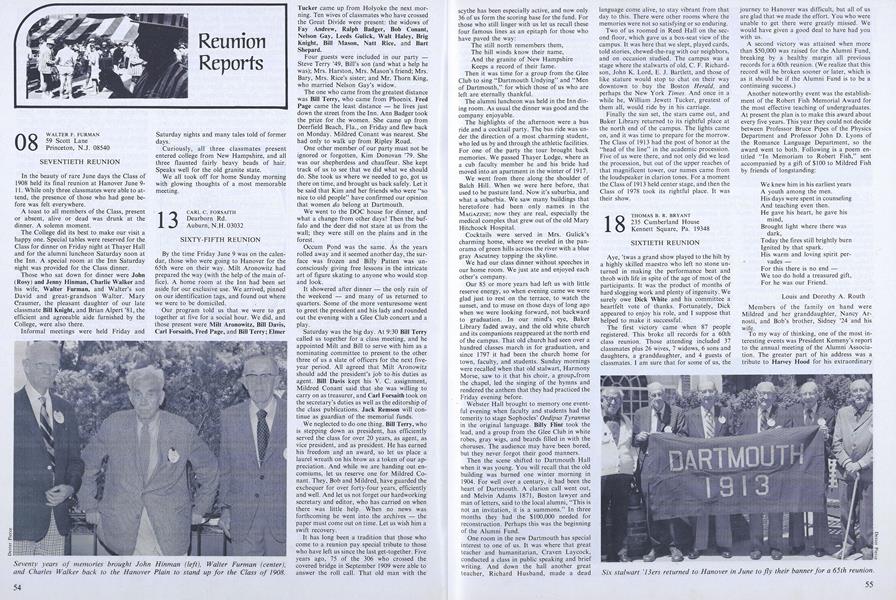
SIXTY-FIFTH REUNION
By the time Friday June 9 was on the calendar, those who were going to Hanover for the 65th were on their way. Milt Aronowitz had prepared the way (with the help of the main office). A home room at the Inn had been set aside for our exclusive use. We arrived, pinned on our identification tags, and found out where we were to be domiciled.
Our program told us that we were to get together at five for a social hour. We did, and those present were Milt Aronowitz, Bill Davis,Carl Forsaith, Fred Page, and Bill Terry; ElmerTucker came up from Holyoke the next morning. Ten wives of classmates who have crossed the Great Divide were present: the widows of Fay Andrew, Ralph Badger, Bob Conant,Nelson Gay, Leeds Gulick, Walt Haley, BrigKnight, Bill Mason, Natt Rice, and BartShepard.
Four guests were included in our party - Steve Terry '49, Bill's son (and what a help he was); Mrs. Harston, Mrs. Mason's friend; Mrs. Bary, Mrs. Rice's sister; and Mr. Thorn King, who married Nelson Gay's widow.
The one who came from the greatest distance was Bill Terry, who came from Phoenix. FredPage came the least distance - he lives just down the street from the Inn. Ann Badger took the prize for the women. She came up from Deerfield Beach, Fla., on Friday and flew back on Monday. Mildred Conant was nearest. She had only to walk up from Ripley Road.
One other member of our party must not be ignored or forgotten, Kim Donovan '79. She was our shepherdess and chauffeur. She kept track of us to see that we did what we should do. She took us where we needed to go, got us there on time, and brought us back safely. Let it be said that Kim and her friends who were "so nice to old people" have confirmed our opinion that women do belong at Dartmouth.
We went to the DOC house for dinner, and what a change from other days! Then the buffalo and the deer did not stare at us from the wall; they were still on the plains and in the forest.
Occum Pond was the same. As the years rolled away and it seemed another day, the surface was frozen and Billy Patten was un- consciously giving free lessons in the intricate art of figure skating to anyone who would stop and look.
It showered after dinner - the only rain of the weekend - and many of us returned to quarters. Some of the more venturesome went to greet the president and his lady and rounded out the evening with a Glee Club concert and a play.
Saturday was the big day. At 9:30 Bill Terry called us together for a class meeting, and he appointed Milt and Bill to serve with him as a nominating committee to present to the other three of us a slate of officers for the next five- year period. All agreed that Milt Aronowitz should add the president's job to his duties as agent. Bill Davis kept his V. C. assignment, Mildred Conant said that she was willing to carry on as treasurer, and Carl Forsaith took on the secretary's duties as well as the editorship of the class publications. Jack Remson will continue as guardian of the memorial funds.
We neglected to do one thing. Bill Terry, who is stepping down as president, has efficiently served the class for over 20 years, as agent, as vice president, and as president. He has earned his freedom and an award, so let us place a laurel wreath on his brow as a token of our appreciation. And while we are handing out encomiums, let us reserve one for Mildred Conant. They, Bob and Mildred, have guarded the exchequer for over forty-four years, efficiently and well. And let us not forget our hardworking secretary and editor, who has carried on when there was little help. When no news was forthcoming he went into the archives - the paper must come out on time. Let us wish him a swift recovery.
It has long been a tradition that those who come to a reunion pay special tribute to those who have left us since the last get-together. Five years ago, 75 of the 306 who crossed the covered bridge in September 1909 were able to answer the roll call. That old man with the scythe has been especially active, and now only 36 of us form the scoring base for the fund. For those who still linger with us let us recall these four famous lines as an epitaph for those who have paved the way:
The still north remembers them, The hill winds know their name, And the granite of New Hampshire Keeps a record of their fame.
Then it was time for a group from the Glee Club to sing "Dartmouth Undying" and "Men of Dartmouth," for which those of us who are left are eternally thankful.
The alumni luncheon was held in the Inn dining room. As usual the dinner was good and the company enjoyable.
The highlights of the afternoon were a bus ride and a cocktail party. The bus ride was under the direction of a most charming student, who led us by and through the athletic facilities. For one of the party the tour brought back memories. We passed Thayer Lodge, where as a cub faculty member he and his bride had moved into an apartment in the winter of 1917.
We went from there along the shoulder of Balch Hill. When we were here before, that used to be pasture land. Now it's suburbia, and what a suburbia. We saw many buildings that heretofore had been only names in the MAGAZINE; now they are real, especially the medical complex that grew out of the old Mary Hitchcock Hospital.
Cocktails were served in Mrs. Gulick's charming home, where we reveled in the panorama of green hills across the river with a blue gray Ascutney topping the skyline.
We had our class dinner without speeches in our home room. We just ate and enjoyed each other's company.
Our 85 or more years had left us with little reserve energy, so when evening came we were glad just to rest on the terrace, to watch the sunset, and to muse on those days of long ago when we were looking forward, not backward to graduation. In our mind's eye, Baker Library faded away, and the old white church and its companions reappeared at the north end of the campus. That old church had seen over a hundred classes march in for graduation, and since 1797 it had been the church home for town, faculty, and students. Sunday mornings were recalled when that old stalwart, Harmony Morse, saw to it that his choir, a group.from the chapel, led the singing of the hymns and rendered the anthem that they had practiced the Friday evening before.
Webster Hall brought to memory one eventful evening when faculty and students had the temerity to stage Sophocles' Oedipus Tyrannus in the original language. Billy Flint took the lead, and a group from the Glee Club in white robes, gray wigs, and beards filled in with the choruses. The audience may have been bored, but they never forgot their good manners.
Then the scene shifted to Dartmouth Hall when it was young. You will recall that the old building was burned one winter morning in 1904. For well over a century, it had been the heart of Dartmouth. A clarion call went out, and Melvin Adams 1871, Boston lawyer and man of letters, said to the local alumni, "This is not an invitation, it is a summons." In three months they had the $100,000 needed for reconstruction. Perhaps this was the beginning of the Alumni Fund.
One room in the new Dartmouth has special interest to one of us. It was where that great teacher and humanitarian, Craven Laycock, conducted a class in public speaking and brief writing. And down the hall another great teacher, Richard Husband, made a dead language come alive, to stay vibrant from that day to this. There were other rooms where the memories were not so satisfying or so enduring.
Two of us roomed in Reed Hall on the second floor, which gave us a box-seat view of the campus. It was here that we slept, played cards, told stories, chewed-the-rag with our neighbors, and on occasion studied. The campus was a stage where the stalwarts of old, C. F. Richardson, John K. Lord, E. J. Bartlett, and those of like stature would stop to chat on their way downtown to buy the Boston Herald, and perhaps the New York Times. And once in a while he, William Jewett Tucker, greatest of them all, would ride by in his carriage.
Finally the sun set, the stars came out, and Baker Library returned to its rightful place at the north end of the campus. The lights came on, and it was time to prepare for the morrow. The Class of 1913 had the post of honor at the "head of the line" in the academic procession. Five of us were there, and not only did we lead the procession, but out of the upper reaches of that magnificent tower, our names came from the loudspeaker in clarion tones. For a moment the Class of 1913 held center stage, and then the Class of 1978 took its rightful place. It was their show.
Dearborn Rd. Auburn, N.H. 03032
More From This Issue
-
 Feature
A Company of Stretchers
September 1978 -
 Feature
Poet at Full Ahead
September 1978 -
 Feature
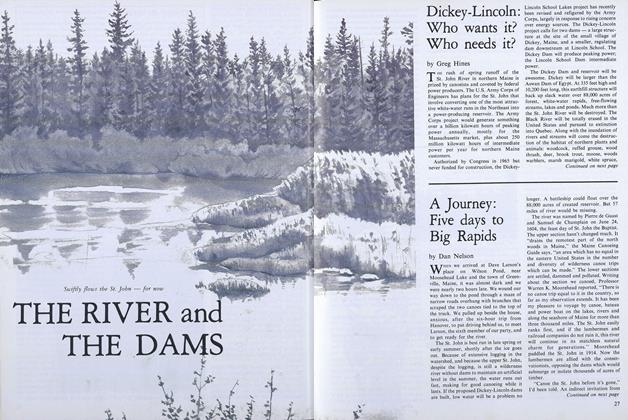
THE RIVER and THE DAMS
September 1978 -
Article
A Journey: Five days to Big Rapids
September 1978 -
Article
Dickey-Lincoln: Who wants it? Who needs it?
September 1978 -
 Article
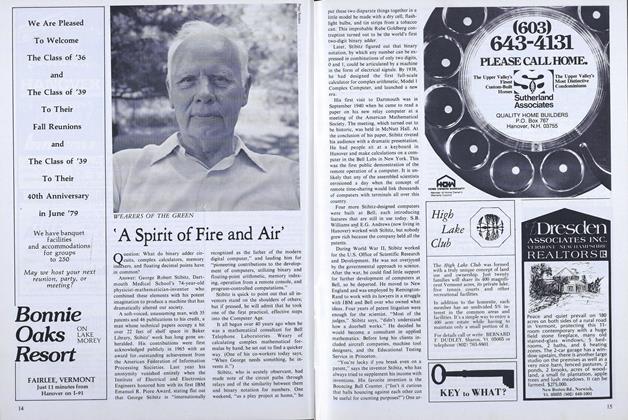
'A Spirit of Fire and Air'
September 1978