1913
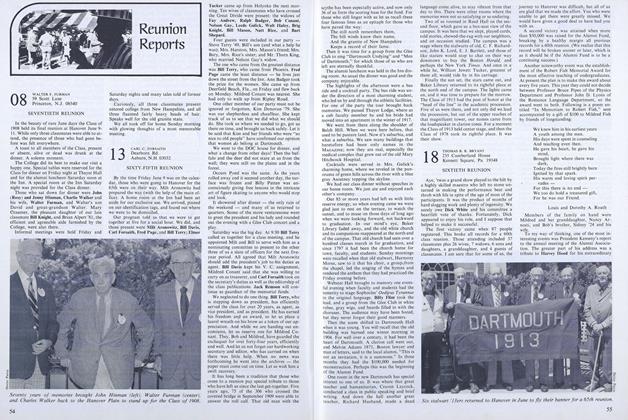
Once again it is necessary to report a death. Our class orator, Clarence G. Maloney died on February 21. His obituary has appeared or soon will appear in the MAGAZINE. His passing leaves our Class with only 30 still able to come down to breakfast.
By September of 1909, 336 had paid their matriculation fees, and the Class of 1913 was a reality. Four years later, President Nichols handed out 232 diplomas; 104 were no longer with us. Four had died, and 100 had left for various reasons. Twenty transferred to other colleges; five became lawyers, two doctors; one graduated Phi Beta Kappa; and several went into teaching, the business office, or the factory.
One letter dropped into my mailbox. It was from Bill Gumbart, and it says that almost all of his contempories are gone or installed in nursing homes, which in his opinion is not the lesser of two evils. In a final paragraph he asks this question, "Why is it, that there is never any reference in Dartmouth publications to Ernest F. Nichols? I used to see him quite often after he came to Yale as a research scientist." It is our duty as a class to keep his light shining. He was our president. He came with us to Hanover, where, like Jacob of old, he worked seven years for Rachael, and at the end they gave him Leah, a professorship at Yale.
He was not. one of Dartmouth's greatest residents, and what is more he had the misfortune to be sandwiched between two of the greatest. Tucker and Hopkins. As he himself said, he was miscast as an administrator; his place was in the laboratory. Also, he shifted positions too often. His career began in Kansas Agricultural College, where he served as assistant chemist in 1886. He was Brooks Fellow at Cornell in 1891, and went from Ithaca to Colgate as professor of physics in 1892. He came to Dartmouth in 1898 and went on to Columbia in 1903, then back to Dartmouth as president in 1909, and then on to the professorship at Yale in 1916, with time out to serve in the Bureau of Ordnance during World War I. Then back to administration as president of M.I.T. in 1921. Ill health intervened, and he died in 1924. He was only 55.
The high point in his career came while he was serving as professor of physics and collaborating with G. F. Hull in measuring the pressure of light. This was an outstanding contribution, as one who was able to judge wrote: "It was the first experimental proof of the detailed validity of the Clark-Maxwell theory of light, and it was to have importance in the development of the quantum theory."
However, he did not do too badly as our president. During .his term in office the gymnasium was built, also Robinson and North and South Massachusetts. And that which is of equal importance, several outstanding professors came to Hanover at his invitation.
Dearborn Rd. Auburn, N.H. 03032