Love and War Among the Ivies
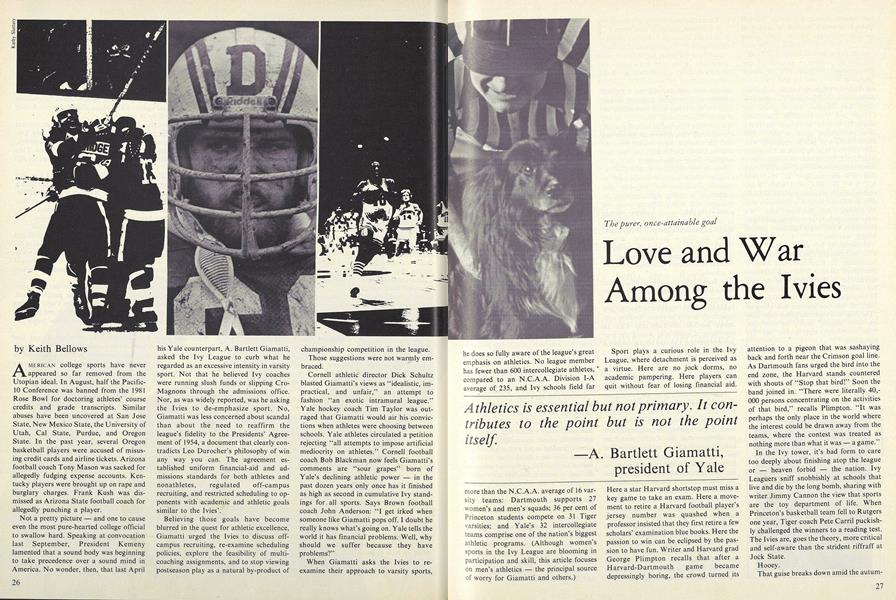
The purer, once-attainable goal
AMERICAN college sports have never appeared so far removed from the Utopian ideal. In August, half the Pacific-10 Conference was banned from the 1981 Rose Bowl for doctoring athletes' course credits and grade transcripts. Similar abuses have been uncovered at San Jose State, New Mexico State, the University of Utah, Cal State, Purdue, and Oregon State. In the past year, several Oregon basketball players were accused of misusing credit cards and airline tickets. Arizona football coach Tony Mason was sacked for allegedly fudging expense accounts. Kentucky players were brought up on rape and burglary charges. Frank Kush was dismissed as Arizona State football coach for allegedly punching a player.
Not a pretty picture and one to cause even the most pure-hearted college official to swallow hard. Speaking at convocation last September, President Kemeny lamented that a sound body was beginning to take precedence over a sound mind in America. No wonder, then, that last April his Yale counterpart, A. Bartlett Giamatti, asked the Ivy League to curb what he regarded as an excessive intensity in varsity sport. Not that he believed Ivy coaches were running slush funds or slipping CroMagnons through the admissions office. Nor, as was widely reported, was he asking the Ivies to de-emphasize sport. No, Giamatti was less concerned about scandal than about the need to reaffirm the league's fidelity to the Presidents' Agreement of 1954, a document that clearly contradicts Leo Durocher's philosophy of win any way you can. The agreement established uniform financial-aid and admissions standards for both athletes and nonathletes, regulated off-campus recruiting, and restricted scheduling to opponents with academic and athletic goals similar to the Ivies'.
Believing those goals have become blurred in the quest for athletic excellence, Giamatti urged the Ivies to discuss offcampus recruiting, re-examine scheduling policies, explore the feasibility of multicoaching assignments, and to stop viewing postseason play as a natural by-product of championship competition in the league.
Those suggestions were not warmly embraced.
Cornell athletic director Dick Schultz blasted Giamatti's views as "idealistic, impractical, and unfair," an attempt to fashion "an exotic intramural league." Yale hockey coach Tim Taylor was outraged that Giamatti would air his convictions when athletes were choosing between schools. Yale athletes circulated a petition rejecting "all attempts to impose artificial mediocrity on athletes." Cornell football coach Bob Blackman now feels Giamatti's comments are "sour grapes" born of Yale's declining athletic power in the past dozen years only once has it finished as high as second in cumulative Ivy standings for all sports. Says Brown football coach John Anderson: "I get irked when someone like Giamatti pops off. I doubt he really knows what's going on. Yale tells the world it has financial problems. Well, why should we suffer because they have problems?"
When Giamatti asks the Ivies to reexamine their approach to varsity sports, he does so fully aware of the league's great emphasis on athletics. No league member has fewer than 600 intercollegiate athletes, compared to an N.C.A.A. Division I-A average of 235, and Ivy schools field far more than the N.C.A.A. average of 16 varsity teams: Dartmouth supports 27 women's and men's squads; 36 per cent of Princeton students compete on 31 Tiger varsities; and Yale's 32 intercollegiate teams comprise one of the nation's biggest athletic programs. (Although women's sports in the Ivy League are blooming in participation and skill, this article focuses on men's athletics the principal source of worry for Giamatti and others.)
Sport plays a curious role in the Ivy League, where detachment is perceived as a virtue. Here are no jock dorms, no academic pampering. Here players can quit without fear of losing financial aid. Here a star Harvard shortstop must miss a key game to take an exam. Here a movement to retire a Harvard football player's jersey number was quashed when a professor insisted that they first retire a few scholars' examination blue books. Here the passion to win can be eclipsed by the passion to have fun. Writer and Harvard grad George Plimpton recalls that after a Harvard-Dartmouth game became depressingly boring, the crowd turned its attention to a pigeon that was sashaying back and forth near the Crimson goal line. As Dartmouth fans urged the bird into the end zone, the Harvard stands countered with shouts of "Stop that bird!" Soon the band joined in. "There were literally 40,000 persons concentrating on the activities of that bird," recalls Plimpton. "It was perhaps the only place in the world where the interest could be drawn away from the teams, where the contest was treated as nothing more than what it was a game."
In the Ivy tower, it's bad form to care too deeply about finishing atop the league or - heaven forbid the nation. Ivy Leaguers sniff snobbishly at schools that live and die by the long bomb, sharing with writer Jimmy Cannon the view that sports are the toy department of life. When Princeton's basketball team fell to Rutgers one year, Tiger coach Pete Carril puckishly challenged the winners to a reading test. The Ivies are, goes the theory, more critical and self-aware than the strident riffraff at Jock State.
Hooey.
That guise breaks down amid the autumnal revelry of tailgating and the boisterous intensity of hockey games. Ivy League gentility? Ken Dryden, former goalie for Cornell and the Montreal Canadiens, recalls Davis Rink as "a zoo, the East's most intimidating place to play." The Davis tradition of pelting opponents with dead chickens may be passe at Thompson Arena, but Dartmouth fanaticism isn't: Green supporters boorishly heckled North Dakota's cheerleaders at the 1980 N.C.A.A. playoffs. And while many students openly dismiss sports as declasse, deep down most revel in a hometown win. As Cornell's Bob Blackman says, "We want winners here as much as elsewhere. Everybody wants one students, alumni, faculty, everybody."
Moreover, if Ivy coaches aren't fired with enthusiasm, they'll be fired with enthusiasm. In Blackman's den hangs a photograph taken in 1956 Blackman's second year at Dartmouth of the eight Ivy fpotball coaches seated around a table. In a companion picture, taken four years later, all but two coaches had changed. "The Ivies don't tolerate losers more than any other league," says John Anderson, "but we must win within the Ivy philosophy."
Worries are that the Ivies are adrift from that philosophy, a concern partially prompted by that subtle Ivy suspicion that as athletic success increases then, by golly, academic standards must be in decline. Inside Sports magazine nurtured such skewed logic by noting that in the early fifties Harvard admitted only the 1,200-odd students with the finest academic credentials, but that it has since "broadened admissions requirements" ostensibly to slip in a few more able-bodied football players. Harvard and Yale, says Inside Sports, still have the toughest requirements, Penn the weakest, with Dartmouth and the rest bunched closely in between.
Not to be forgotten is that the Ivy League, while publicly committed to mutual excellence in athletics and academics, is really eight separate institutions with widely differing needs and goals the chief reason a scholar rejected by one of the Ivies turns up at another. Princeton basketball coach Pete Carril likens the league to General Motors. "How," he asks, "can everyone adhere to the general purpose, yet maintain individual personality within departments or schools?"
In basketball-crazy Philadelphia, Penn feels a need to be competitive on the court. Dartmouth is especially committed to football and hockey; Princeton to football and basketball; Brown to soccer, hockey, and, lately, football; Harvard and Yale to everything. Cornell gets wound up over lacrosse and has a storied hockey tradition to uphold. "If we ceased to be ranked in the national top ten," says Cornell hockey coach Dick Bertrand, "a few eyebrows would be raised around here. People would start looking at me and at my program."
This individualism gives rise to apparent academic and athletic anomalies in the Ivies and, in turn, to cries that member schools are "cheating" on the 1954 agreement. A recent survey conducted by the Ivy presidents reveals that Cornell and Yale had the fewest athletes in the bottom five per cent of entering classes and that Princeton had five times the average leading one coach to carp that "Princeton has made no bones about doing whatever it needs to make its athletic teams the best."
Princeton athletic director Robert Myslik concedes that after nine grim football seasons "there's an unconcealed effort to improve." Similar reasoning prevails over Princeton's hockey team, a long-time disgrace with only three winning seasons in 20 years. Princeton has begun a drive to raise $3 million to renovate its antiquated rink, and in 1977 it hired as coach former Dartmouth assistant Jim Higgins, who according to one source is "a real pusher the school must have promised to support to the hilt." Last season, the team had its best record since 1968 and this year is a bona fide contender for the Ivy title. In other sports, too, Princeton has pulled up its socks dramatically: After seven straight third-place finishes in overall Ivy standings for all sports, it has wound up first the last five seasons.
Pennsylvania, it is suggested, has become a basketball power because it reserves 15 per cent of entering classes for students who under normal conditions wouldn't qualify academically. Penn has indeed prospered. After never finishing higher than fourth in the overall Ivy ranking, Penn has been near the top in the last dozen years and has four firsts. But, ah, the rub. College-board verbal scores of 97 specially admitted athletes in the class of 'Bl were 100 points below the university average. Math scores were 70 points lower.
Cornell's hockey team is often slandered as a bunch of slick-playing, puck-brained Canadians the school hides in its state-run agriculture school. This infuriates Dick Bertrand, who vehemently denies the agriculture-school accusations, though he admits "we used to put a lot of kids in there because they were fuzzy about what they wanted to do." The agriculture school has declined in importance, but state schools still play a major role in Cornell hockey. Of 30 starters last season, two underclassmen have left the team, 18 are enrolled in the New York State School of Industrial and Labor Relations and seven in the New York State College of Agriculture and Life Sciences. (Further, the Canadian connection flourishes: Two-thirds of the players are from Canada.) Bertrand counters by saying that with half of an entering class reserved for women and with a recent surge in qualified applicants Cornell has "no room for ringers." Bridling over smirks about the agricultural school, Bertrand adds, "We had kids turned down with 740 verbals. Hockey players. You won't find many of them. When a kid from South Porcupine, Ontario, is asked [by a rival recruiter] 'Wanna be a farmer, wanna shovel horse manure all your life?' he thinks twice about coming here. It's not fair.
Such tacky mudslinging disturbs Ivy administrators, as do whispers that the league is going "big time." Big time is when Penn finishes among the Final Four in basketball (1978) or Dartmouth among the Final Four in hockey (1979, 1980). Big time in football is when Yale meets Boston College (1980) or Brown schedules Penn State (1981). Big time is when Dartmouth's football team finishes 14th in the nation and wins the Lambert Trophy as the East's best team (1970). Gone are the days when the Dartmouth football team spurned a berth in the 1937 Rose Bowl or when the hockey team won the Ivy title, then rejected a 1964 N.C.A.A. tournament bid.
Today's athletic climate is more complex, more competitive, more heavily influenced by finance than when the Ivy presidents drew up their 1954 guidelines. So while Giamatti's concerns may be overstated, they do, says Ralph Manuel '5B, dean of the College at Dartmouth and chairman of the Ivy Group Policy Committee, "help us assess our performance, so we can remain true to the 1954 ideals without suggesting that we've strayed from those ideals. I don't think we have."
FORMER Dartmouth baseball coach Tony Lupien once dismissed recruiting as a "whore's business." Giamatti likens it to "hustling in the hustings." "Student enrollment work" is the polite Ivy euphemism. No matter, it's hard work, undeniably detracting from time a coach devotes to teaching. While most Ivy football coaches spend only three weeks recruiting on the road, their hockey and basketball counterparts spend considerably more. Dartmouth hockey coach George Crowe, who scours the U.S. from Minnesota to Massachusetts, Canada from coast to coast, estimates that 50 per cent of his job is recruiting. Princeton assistant coach Brian McCloskey (class of '77 at Dartmouth) was six weeks on the road last year, Cornell's Dick Bertrand two months.
Without recruiting, say most coaches, the Ivy League would plunge into athletic mediocrity. "It would be impossible to field a competitive team without it," says Bob Blackman, who fathered Ivy recruiting when he came to Dartmouth in 1955, breaking the alumni-aided football stranglehold enjoyed by Harvard, Yale, and Princeton.
Indeed, for years Harvard barred its coaches from off-campus recruiting, preferring instead to rely on a powerful alumni network. But after finishing firstplace overall 13 times between 1956 and 1971, Harvard faded, picking up only one first to go with five seconds, two thirds, and a fourth. And it had but four football titles in 25 years, compared to Dartmouth's 11. "We figured we'd get our share," says Harvard sports information director Joe Bertagna, a former Crimson hockey goalie. "We weren't aggressive and we were getting killed."
In 1977, Harvard decided to halt the carnage by allowing its coaches one visit per recruit. In 1979 and 1980, hockey coach Bill Cleary had his best pair of recruiting years ever and last season started 11 freshmen. Harvard's football team, after its wretched 3-6 record in 1979 - worst in 30 years opened this season with four straight wins, including a 15-10 decision over Army.
According to a former Ivy assistant coach, the pressure to turn a program around or to remain competitive has led to an "erosion of decorum and respect for the rules in the Ivy League." Four years ago, one Ivy hockey coach grandly offered to take a prospect's entire high-school line if he would decide for his team, an offer the coach had no right making considering the admissions office has final say. Other Ivy hockey coaches have entered Canadian players' dressing rooms to talk to prospects a breech of N.C.A.A. rules. Several coaches this year jumped on Princeton when it accepted Scott Billeadeau, a promising Minnesota hockey defenseman who as a high-school sophomore had spent some time in a summer reform camp. "We didn't know about that," claims Brian McCloskey. "They're pretty closemouthed out west in those mining towns." The coaches stuck to their evaluation of Billeadeau as sound academically and athletically. Princeton's admissions officers apparently agreed, for no matter how effective an Ivy recruiter is, he must contend with the admissions roadblock.
It's for this reason that Rogers E. M. Whitaker, The New Yorker's college football writer, believes that, while "the Ivies have their occasional letdowns, for the most part the coaches are gentleman recruiters." An informal survey of league coaches suggests that few resort to hardsell tactics, though there are the inevitable black sheep. "The word recruiting has a nasty connotation," says Dartmouth football coach Joe Yukica. "Hard sell, giving gifts, loans, credit cards. But you can recruit tastefully. We're not pushy. We don't have to be. In the Ivy League, recruiting means telling, not selling."
Ivy administrators still fear that if a coach unearths a receiver whose grasp of the ball exceeds his grasp of studies, then admissions officers may find themselves subtly pressured to bend the rules. No Ivy school pretends that every varsity athlete boasts combined boards of 1,200 or better. "It would be unnatural if that were the case," says Pennsylvania basketball coach Bob Weinhauer.
The Ivy League prides itself on building classes with academic, geographical, and extracurricular balance. But concessions are made for the sons and daughters of alumni, for relatives of past or potential donors, for the kid with the horrendous verbals but a genius for computer electronics, and, yes, for the player with the 1,000 boards and a dunk shot to rival Darryl Dawkins'. "Half the football team doesn't have 1,200 boards," says Dartmouth athletic director Seaver Peters '54 pointedly, "but then neither does half the student body."
Majoring in eligibility isn't an Ivy pastime, and cinch courses are rare. Yet there "are cases at Harvard," says Joe Bertagna, "that would raise a few eyebrows. I have strong doubts about the academic acumen of some players. But those cases are rare." Bertagna's observation is applicable to all the Ivies, and because such examples exist the Ivy Group Policy Committee recently completed a report of Ivy athletics so confidential not even the Harvard sports office could get a copy. It cites no violations, says Ralph Manuel, its author, but it's not for public consumption, either. "We're just making sure that what happened in the Pac-10 doesn't happen here," he says. "There's increased pressure on the admissions people to stretch a little to take the guy who'll make all the difference. We've got to short-circuit that pressure." This they appear to be doing.
"There are so many checks and balances, we don't dare try anything," says Dick Bertrand. "Cornell may not have as many national and eastern titles in the seventies as we would like, but if we step out of line, look out." Penn's Bob Weinhauer turned down a choice coaching offer from a big-time basketball power because he feared the consequences. "Deep down I knew what the pressures might force me to do. Here I don't have those pressures to the same degree. I've got a wife and kids. I like what I'm paid. I like my job. You won't find me cheating."
George Crowe, who scouts Hockey Night in Boston, a tournament showcase of some 180 top Boston-area high-school hockey players, claims that in his six years at Dartmouth never has the admissions office been so demanding. "Not ten of those tournament kids would get in." It's no surprise, then, that Crowe capitalized on his prep school coaching background to place 25 prep-school graduates on the Dartmouth varsity last year more than at any other Ivy school.
Today, says Princeton economics professor James Litvak, director of the Council of Ivy Group Presidents, more than 90 per cent of league athletes graduate, a rate comparable to the general student body. Three Yale football players last year majored in molecular physics, and Yale's hockey captain in 1979-80 was a Rhodes Scholar, as was Dartmouth football star Willie Bogan '7l, Harvard's 1978-79 basketball captain Glenn Fine, and Princeton basketball great Bill Bradley. (Stack that against the Utah basketballer who requested "highway aid you know, one of them Rhodes Scholarships.")
Burdening Ivy coaches in their quest to be competitive is the league's strict policy of granting scholarships only because of financial need. Few athletes want to swap a free ride for the Ivies' academic rigors, for possible debt and the drudgery of a parttime job. "We're two strikes down when we recruit against the scholarship schools," says Crowe, whose team faces 11 such schools this season. "For us to come up with five or six quality players we must spend twice the time recruiting as the scholarship schools. We really do follow the rules here, but we get so few kids in, and many we do accept take a free ride somewhere else."
This recruiting handicap breeds frustration and prompts some Ivy coaches to take a bifocal view of their position. "There's a natural tendency in the Ivies to keep education first, athletics second," says Bertrand. "I believe in that as an individual and as a Cornell grad, but not as a coach. I'd like a few things relaxed. Our sport contributes to the excellence of campus life. I'd like to be guaranteed a few spots for players. Bring in the qualified athlete, sure, but don't turn him down when he agrees to come and has 1,150 boards just because there are 200 other students with 1,2505."
Ivy coaches may be handcuffed in a world where twelve 50s sometimes is the amount slipped under the table, but they benefit handsomely from alumni support. When Bob Blackman came to Hanover, he established an alumni recruiting network that vaulted Dartmouth to an Ivy football title within three years and set the foundation for the early-seventies string of five straight Ivy crowns. John Anderson, a former Blackman aide, set up a similar program when he went to Brown in 1972, and the Bruins, so long Ivy doormats, have finished no worse than third in the past five seasons. Meanwhile, Anderson has a 48-22-2 record compared to his predecessor's combined 27-94 effort.
Most colleges march out their famous sons or daughters to woo talented prospects, but the Ivies have more of them. In 1968, Robert Kennedy took James Brown, a top basketball prospect, and his high-school coach to lunch in the Senate dining room, then followed up with dinner a few weeks later. Brown played at Harvard.
More important than informal alumni support'is each Ivy school's alumni sponsors program, not to be confused with the rabid booster clubs that serve as a conduit for favors and kickbacks at some places. Dartmouth's Alumni Sponsors Program, begun in 1963 by Blackman and run for 18 years by Larry Leavitt '25, permits alumni to foot the cost of a prospect's travel to and from Dartmouth. The program, limited to football in 1963, has grown from 31 sponsors and 21 athletes to this year's 235 sponsors and 94 athletes, in eight sports. Despite mushrooming costs $20,915 this year the program has flown in more than a thousand players since its inception. Fly-ins include hockey all-America Ross Brownridge 'BO and Minnesota high-school hockey star John Donnelly '83, kicker Nick Lowery '7B (now of the Kansas City Chiefs), Reggie Williams '76 (now of the Cincinnati Bengals), and current football standouts Jeff Kemp and Dave Shula, both '81s.
The program's success prompted the other Ivies to follow suit, and in 1976-77 the only year for which there are comparative records the eight schools spent almost $119,000 flying in 866 players. Now, league members combatively snare each other's fly-ins; 16 players flown in by Dartmouth started in the 1978 DartmouthYale game eight for each team.
Former Yale football coach Herman Hickman once said his chief problem was to win enough to keep the alumni sullen but not mutinous. Because alumni interest often leads to alumni giving, there's even more pressure on coaches to win. Robert Myslik echoes prevailing logic when he states, "I'd say alumni giving drops when we begin to lose," but a recent PsychologyToday report disputes this. An analysis of the financial records of 138 Division I colleges shows that schools with winning records in 1974-75 reported fewer donors than in the previous year, and in 1970 colleges making football-bowl appearances reported a decline in donations.
Even so, coddling alumni won't diminish, especially now that the cost of the Ivies' athletic programs is becoming frighteningly steep. Built into Dartmouth's athletic budget is an annual nine per cent inflation boost. But in an era of 13 per cent inflation, that's inadequate, and already steaks are being snatched from the training tables. The average Division I athletic program loses $91,000 annually. Dartmouth spent some $2.8 million last year and took in about $800,000. Given the College's commitment to the value of athletics, it's difficult to interpret the difference as a "loss" the Classics Department doesn't "make" money, either.
Even Dartmouth's most popular spectator sports hockey and football fail to clear a profit. Last year, the Eastern Collegiate Athletic Conference ruled that each of its 17 Division I hockey members play each other at least once, a decision that means Dartmouth's hockey team will spend $16,000 to travel 2,398 miles on the road this season. "It's beyond me how Division I can continue in the face of those costs," says Manuel. Such considerations forced the Ivy League to abandon costly freshman teams (except in football) after years of refusing to do so and to sanction freshman varsity eligibility.
The economic crunch has hit other sports, too. Yale has lopped almost $500,000 from its athletic budget in the past two years. Despite their Ivy championship last season, the Elis drew only 28,000 fans a game to the 70,874-seat Yale Bowl, enough to cover the facility's upkeep and little else. (To raise more money, this summer Yale opened the Bowl to 400,000 rock fans.) Last season, Columbia averaged more than 26,000 empty seats at home games. Princeton's football attendance has declined steadily for two decades, a trend that may render Palmer Stadium a white elephant. Overall, the average 1979 Ivy football attendance dipped by 1,193 to 12,172. The addition of a tenth game became a survival tactic. "We added that when we finally realized we couldn't play just for fun," says Brown's John Anderson.
Tight money also led to Giamatti's suggestion that the Ivies shift to multiple coaching assignments (a head football coach can command over $40,000 annually), a policy that makes economic sense in some sports but is hara-kiri in others. Dartmouth's Dud Hendrick coaches men's lacrosse and women's soccer. A single coach handles Harvard cross-country and indoor and outdoor track. Another oversees tennis and squash. But in the Big Three sports football, basketball, and hockey that won't work. Carmen Cozza was approached to add baseball to his football coaching duties, but he begged off because the workload would force him to ease up in one or both programs. Dartmouth's Joe Yukica attends 30 to 35 alumni meetings annually, works with alumni sponsors, is often on the road for up to 20 days at a stretch, yet still oversees the football team, a formidable task even with the help of five full-time assistants and a full-time freshman coach. "If I coached another sport," he says, "I couldn't do justice to my job."
In football, that job is clearly defined: win the Ivy League title. Not so in basketball, hockey, track, crew, skiing, and other sports in which national championships are possible. That worries Giamatti and others who believe the league should not enter the national sports arena. He didn't suggest an outright ban on postseason play, but urged that the Ivies not so readily feed that hunger for "the sequel, the bigger league look and feel that violates the essence of what we believe."
Outside football there isn't an Ivy coach who doesn't yearn for a playoff spot. The Ivy hockey champion automatically earns one. "It's more important to win the E.C.A.C.s than the Ivy League," says George Crowe, who nonetheless wants his players to aim for the top without getting "hung up on the big time, the N.C.A.A.s." Joe Bertagna claims that no matter how good your season, "If you miss the playoffs you've failed."
Because there are only 34 Division I hockey teams, the Ivy League has been extremely competitive; historically it's the best hockey league in the nation, sending a representative to the national championship in 19 of 33 years and placing 83 players on national and Olympic teams (Dartmouth accounts for 25). Last year's E.C.A.C. final was all-Ivy Cornell and Dartmouth. But this national excellence, some believe, obscures the chief goal: to be the best in our own league. "That's the focus," says Ralph Manuel. "We're not in business to send two or three teams to these championships."
Some find that hard to reconcile. Says Dick Bertrand: "I believe in the Ivy philosophy, but it's inconsistent with what we're doing. We subconsciously hunger to be the best in the country." To deny athletes the opportunity to prove they're the best would be inconsistent with the character of. the Ivy League. In truth, the Ivy institutions perpetually compete with the nation's best in other arenas for faculty, for research grants, for graduate students, for overall prestige. Dartmouth sophomore John Donnelly, a hockey player majoring in political science with a minor in Russian, picked Dartmouth over traditional hockey powers Wisconsin and Minnesota "because I could blend top academics with national-caliber hockey. I wouldn't have come, though, if we weren't allowed to compete nationally." Says Princeton's Pete Carril: "The nationals aren't always a realistic goal, but if I wasn't allowed to go I'd be upset."
The Ivy League is no stranger to postseason play. Harvard has been to baseball's playoffs six times and Dartmouth four. Cornell has reached the national lacrosse final eight times, winning in 1971, 1976, and 1977. Columbia has won the N.C.A.A. team fencing title eight times and boasts 16 individual N.C.A.A. fencing champions. Brown has been to the N.C.A.A. soccer playoffs 13 times, Cornell six, Harvard five, and Dartmouth four. In 1977, five Ivy teams qualified for the playoffs. Princeton and Penn have each made ten trips to the N.C.A.A. basketball playoffs, and in 1978 Penn beat North Carolina, Syracuse, and St. John's to become only the second Ivy basketball team, after Princeton's '65 squad, to reach the Final Four.
Bob Weinhauer, the coach of the Penn team, regards anything beyond the Ivy title as "candy," but believes a team must always retain the right to realize its potential. "And never overlook what that kind of success does for the school," he says. "It was the healthiest thing to happen to Penn in decades. It instilled pride. And now when I call someone they don't go, 'Oh, are you from Penn State?' "
Furthermore, postseason exposure generates a financial windfall for the league. Dartmouth's N.C.A.A. hockey appearance last year generated $20,000 and Penn's basketball team brought in $250,000. Surprisingly, recruiting benefits are less impressive. Crowe claims he lost three or four players last year due to the Final Four showing. "So many kids get scared when they look at our depth and strength," he says. "They figure they have a better shot of cracking the line-up of a weaker school."
In recent years the Ivies have begun to schedule schools which don't share with them "similar academic and athletic philosophies." It's a trend, says Princeton's Myslik, designed to "put a little sex appeal into the season." The Big Green hockey squad traveled to play Michigan last year and early this season met the Minnesota* Gophers, which placed eight players on the 1980 Olympic Team and are probably the country's best team. Last fall, Yale's football team lost 26-9 to Boston College which played Pitt, a preseason favorite for the national title. Tangling with powerful Rutgers, Cornell was bombed 44-7. Brown will face Penn State in 1981, an ill-received development that arose because Penn State coach and Brown alumnus Joe Paterno obviously not above using his alma mater as cannon fodder came to the school's aid when a tenth game was approved and no respectable team would schedule the thenwretched Bruins. Dartmouth has Army and Navy coming up. "I'm concerned about that," says Manuel. "Navy will kill us. We must schedule teams compatible with our ideals."
Giamatti's worries about the "swollen" regular season may be valid. A 26-game hockey schedule doesn't appear overlong, but it can be taxing for athletes with a heavy workload. Says Joe Bertagna, who started every game as a senior and junior: "We had time to study, but I was so emotionally drained, it wasn't quality time." Off-ice training, practices, and regular and postseason play kept last year's Dartmouth hockey players in uniform for almost three terms, and the team ended up playing 31 games. "It was more than I expected," concedes John Donnelly.
According to Yale athletic director Frank Ryan, the E.C.A.C.'s current schedule is "just crazy." During one stretch last winter, the Big Green played seven games in 22 days, four in midweek and five on the road in Boston, New Hampshire, New Haven, Ithaca, and Providence. Players log ten hours busing to and from Cornell, ten hours roundtrip when playing Yale. The pace takes its toll.
Moreover, because Ivy hockey teams are forbidden to hold formal practices until a month before the close of football season, they often open their seasons against wellprimed opponents which explains in part why Dartmouth lost five of its first six games last year. Colgate and Clarkson, Dartmouth's first two opponents this season, had already played 20 games between them.
Some Ivy schools have slyly sidestepped regulations, extending seasons even further. Ivy rules dictate that lacrosse practices can't begin until February 1, yet at least one school has a physical-education class in lacrosse largely attended by varsity players. Enterprising Harvard hockey coach Bill Cleary tried to set up powerskating classes for his players prior to this season's October 22 practice start but was stonewalled by Harvard president Derek Bok, who had caught wind of Ivy coaches' adroit navigation of the rules. In October, the Ivy athletic directors moved to close this loophole, voting to ban students from varsity play should they take a physicaleducation class in their sport.
ONLY in the Ivies is the acceptance of a pro contract deemed a step down in social, if not financial, status. Power, not sports, is the prevailing Ivy postcollegiate religion. Statistically, the greatest number of players seeking pro careers come from disadvantaged backgrounds, hence the gentry from Fairfield County or Shaker Heights are usually disinclined to toil for the Pittsburgh Steelers.
Nevertheless, the professionalism that has so long been a part of sports on other campuses has not bypassed the Ivy League. The Ivies have seritt their share of players to the pros. From Cornell came Ed Marinaro (Minnesota Vikings) and Ken Dryden (Montreal Canadiens); from Yale, Calvin Hill (now with the Cleveland Browns); from Princeton, Bill Bradley (New York Knicks); from Harvard, Pat Mclnally (Cincinnati Bengals); from Dartmouth, Jim Beattie (Seattle Mariners) and Reggie Williams (Cincinnati Bengals); from Brown, Bill Almon (New York Mets) and Curt Bennett (formerly of the Atlanta Flames). Dartmouth's 1980 all-American Ross Brownridge 'BO signed with the Quebec Nordiques of the N.H.L. In fact, in the past four years, 19 Ivy League players were drafted by the N.H.L., and Dartmouth's Carey Wilson '83 and Yale's Bobby Brooke were among the top ten college players selected last June.
Colleges have long served as a talent pool for pro basketball, football, and, more recently, hockey teams although not always willingly. Dartmouth's potential all-Ivy basketballer Larry Lawrence 'BO, who sat out last season with an injury, was illegally drafted by the Atlanta Hawks. Senior goalie Bob Gaudet rejected a bid by the Quebec Nordiques - which didn't consult Dartmouth officials first to skip his final year and sign for a package potentially worth almost $50,000.
This activity annoys the Ivy League athletic fraternity. "They go behind our backs, use colleges as a farm system," fumes Seaver Peters. "It's selfish and it concerns me." "What makes me nervous," says Ralph Manuel, "is if kids start saying, 'lf I come here I'll make the pros.' Well, the Ivy League is not the road to the pros."
Most Ivy administrators agree that the league will remain above the cesspool of athletic skullduggery that has crippled other conferences. But, say many, look for even tougher Ivy standards in the future a trend that will be reflected nationwide. "I think we've got things pretty close to the way we want them," says Dick Bertrand. "So what you'll see is the rest of the country coming around to our way of thinking."
Indeed, the University of Southern California recently issued a critical report on the relationship of athletics and academics there and suggested it was time to crack down (it also admitted that in the past decade 303 U.S.C. athletes had grades below minimum standards). Other schools seem determined to follow suit. Changes under consideration include greater regulation of recruiting, elimination of freshman varsity eligibility, stricter monitoring of academic performance, and the granting of aid according to financial need.
If passed, this last measure should make the Ivies even more competitive. Princeton's Pete Carril reflects the majority view when he observes that the recent rash of college scandals has soured athletes on big-time college sports, making carteblanche financial aid less attractive. "The value of an education, even when it costs a lot, is more important than ever," says Carril. "If all things became equal and others eliminated grants-in-aid, we'd benefit. Kids will want to come to the best."
If need-based scholarships don't become standard nationwide, the Ivies ability to be competitive may slip. If so, the league might retreat to its own division in some sports, notably in hockey and basketball. "That wouldn't bother me a bit," says George Crowe. "We'd be competing with the Bowdoins and Middleburys, which are more compatible with our ideals."
Academic considerations aside, budget cutting may force the Ivies to convert some varsities to club status, a blow that befell the University of Tulsa's baseball team shortly after it won the 1979 College World Series. In the past year 356 schools have axed 523 women's and men's sports. Even Notre Dame was ready to drop hockey to the club level before it switched conferences to save money.
Within two years, say observers, skyrocketing costs will demolish the E.C.A.C.'s play-everyone hockey format, a move favored by the Ivies, which will then turn to greater intraleague play. In all sports, increased emphasis will fall on the Ivy championship, as it now does in football. "If we can have intercollegiate athletics without going broke, and still derive the lessons and values from athletics, that will be enough," says Ralph Manuel. Manuel also concedes that postseason play may be curtailed or restricted, and that the length of some sports' seasons may be cut. So much for Carmen Cozza's wish to have spring football and permission to play a postseason game every four years.
The manacles may also be put on recruiters which, Manuel believes, will permit the Ivies to "free coaches to use their time more creatively." He recalls how the late Eddie Jeremiah '30, a member of the N.H.L. Hall of Fame, coached basketball, football, and freshman and varsity hockey. "Those were simpler times," Manuel admits, "but the ideal, the purer goal, stands as having once been attainable."
The Battle of Waterloo may not have been won on the playing fields of Eton, but the vigor of an institution is mirrored by the success of its athletes and by the elements of teamwork, resourcefulness, and courage fostered by sport. That's the ideal, the purer goal, as well as the focus of Giamatti's proposals. "But I'm sure there won't be agreement on them," he wrote recently, "and unless these and other matters are discussed, candidly and cordially, a situation now in some disrepair will only get worse."
Worse is relative. The Ivies remain dedicated to subordinating athletic victory to the broader concerns of education. Transgressions are trivial; the Ivy League fields student-athletes, not athletestudents. "Ball scores are only part of the story," says Carmen Cozza. "What must remain important is: Are the kids having a worthwhile time? Is it meaningful? Will it help them later in life? Hopefully, we'll be able to control our emotions and not let things get out of hand. Whenever you're hurting the boy or girl and you hurt them when you become corrupt then it's wrong. We can't tolerate that. For that reason, perhaps it's a good thing that we take a hard look at ourselves. It can't hurt."
Athletics is essential but not primary. It contributes to the point but is not the pointitself. —A. Bartlett Giamatti, president of Yale
Recruiting is not coaching, and ... the present practice of the recruitment of studentswho are athletes cannot encroach upon thetime and effort that must be devoted toworking with students who are here. . . .Coaches are teachers and they must not bemade into something else by the multiplepressures brought about by present recruitment practices, postseason opportunities,and swollen schedules. A gifted coach, andthere are many, can and ought to work withstudents in various contexts. —A. Bartlett Giamatti
The Ivy League ideal means that we nomore encourage a professionalism of spiritin athletics in our undergraduates than weencourage a professional view of the purposeof an undergraduate education. —A. Bartlett Giamatti
Keith Bellows '74, editor of Hockey magazine, has written profiles ofprofessional athletes Jim Beattie andReggie Williams and actor MichaelMoriarty for the ALUMNI MAGAZINE.
Keith Bellows
Features
-
 Feature
More Honors for Good Teaching
FEBRUARY 1966 -
 Feature
Third Century Fund Launches General Campaign Among Alumni
OCTOBER 1969 -
 Cover Story
Jean Baptiste
OCTOBER 1997 -
 Cover Story
How to Find Your Inner Santa
Sept/Oct 2001 -
 Feature
"Red" Rolfe '31 to Return As Director of Athletics
January 1954 -
 Feature
Once King and Future President
May 1981


