1966
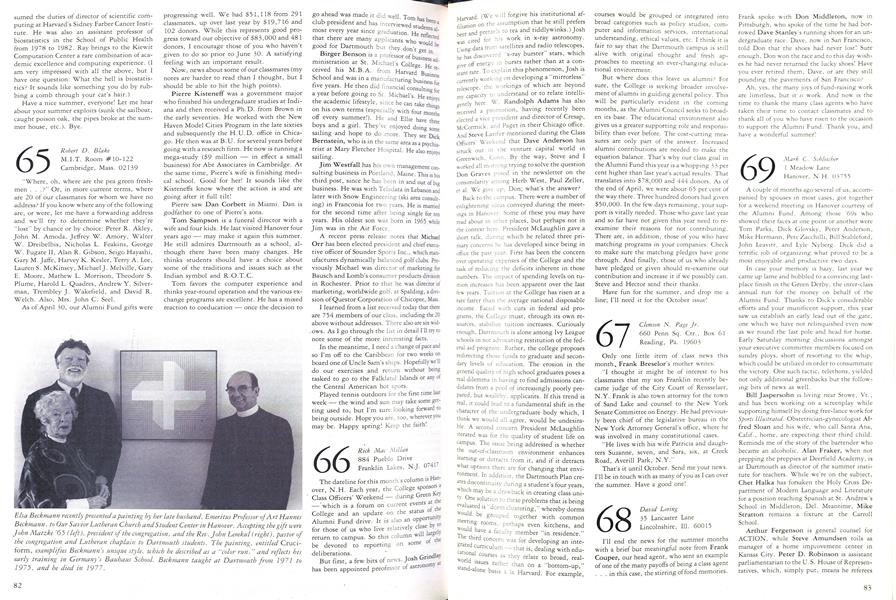
The dateline for this month's column is Hanover, N.H. Each year, the College sponsors a Class Officers' Weekend during Green Key which is a forum on current events at the College and an update on the status of the Alumni Fund drive. It is also an opportunity for those of us who live relatively close by to return to campus. So this column will largely be devoted to reporting on some of the deliberations.
But first, a few bits of news, josh Grindlay has been appointed preofessor of astronomy at
Harvard. (We will forgive his institutional affiliation on the assumption that he still prefers -and pretzels to tea and tiddlywinks.) Josh cited for his work in x-ray astronomy, Using data from satellites and radio telescopes, he has as discovered "x-ray burster" stars, which give off energy in bursts rather than at a conrate. To explain this phenomenon, Josh is currently working on developing a "mirrorless" telescope, the workings of which are beyond my capacity to understand or to relate intellihere. W. Randolph Adams has also received a promotion, having recently been elected a vice president and director of Cresap, McCormick, and Paget in their Chicago office. And Steve Lanfer mentioned during the Class Officers' Weekend that Dave Anderson has struck out in the venture capital world in Greenwich, Conn. By the way, Steve and I worked all morning trying to solve the question Don Graves posed in the newsletter on the nsimilarity among Herb West, Paul Zeller, et al. We give up, Don; what's the answer?
Back to the campus. There were a number of enlightening ideas conveyed during the meetings in Hanover. Some of these you may have read about in other places, but perhaps not in the context here. President McLaughlin gave a short talk, during which he related three primary concerns he has developed since being in office the past year. First has been the concern over operating expenses of the College and the task of reducing the deficits inherent in those numbers. The- impact of spending levels on tuition increases has been apparent over the last few years. Tuition at the College has risen at a rate faster than the average national disposable income. Faced with cuts in federal aid programs, the College must, through, its own resources, stabilize tuition increases. Curiously enough, Dartmouth is alone among Ivy League v hools in not advocating restitution of the federal aid program. Rather, the college proposes redirecting those funds to graduate and seconlary levels of education. The erosion in the general quality of high school graduates poses a real dilemma in having to find admissions candidates from a pool of increasingly poorly prepared, but wealthy, applicants. If this trend is real, it could lead to a fundamental shift in the -racter of the undergraduate body which, I hink we would all agree, would be undesirable A second concern President McLaughlin iterated was for the quality of student life on campus. The issue being addressed is whether the out-of-classroom environment enhances learning or detracts from it, and if it detracts what options there are for changing that environment. In addition, the Dartmouth Plan crepes discontinuity during a student's four years, which may be a drawback in creating class unity. One solution to these problems that is being evaluated is dorm clustering," whereby dorms be grouped together with common rooms, perhaps even kitchens, and would have a faCulty member "in residence." grated curriculum concern was for developing an intecurriculum that is, dealing with eduiona courses as they relate to broad, realstand rat'ler than on a "bottom-up," stand-alone a la Harvard. For example, courses would be grouped or integrated into broad categories such as policy studies, computer and information services, international understanding, ethical values, etc. 1 think it is fair to say that the Dartmouth campus is still alive with original thought and fresh approaches to meeting an ever-changing educational environment.
But where does this leave us alumni? For sure, the College is seeking broader involvement of alumni in guiding general policy. This will be particularly evident in the coming months, as the Alumni Council seeks to broaden its base. The educational environment also gives us a greater supporting role and responsibility than ever before. The cost-cutting measures are only part of the answer. Increased alumni contributions are needed to make the equation balance. That's why our class goal in the Alumni Fund this year is a whopping 33 per cent higher than last year's actual results. That translates into 578,000 and 444 donors. As of the end of April, we were about 65 per cent of the way there. Three hundred donors had given $50,000. In the few days remaining, your support is vitally needed. Those who gave last year and so far have not given this year need to reexamine their reasons for not contributing. There are, in addition, those of you who have matching programs in your companies. Check to make sure the matching pledges have gone through. And finally, those of us who already have pledged or given should re-examine our contribution and increase it if we possibly can. Steve and Hector send their thanks.
Have fun for the summer, and drop me a line; I'll need it for the October issue!
884 Pueblo Drive Franklin Lakes, N.J. 07417