Spring Cleaning
"Lest the old traditions fail" still rings as loud as ever, but one tradition is changing its tune in order not to fail. The fraternity-sorority system,'with considerable push from ...the administration, is adopting a minimum standards policy that limits and controls parties and subjects the groups to more College rules. Houses are starting to look cleaner, host more interaction between men and women, and provide more than keg parties. Whether this is student action or is merely reaction to administrative policies that are brewing, most students agree that we are witnessing "the death of the system as we know it." The system as we have known it involves the all-male bastion and the "Animal House" image. It is a system that has outlived its day. Fraternities and sororities, however, are here to stay, and the improvement of each house assures the improvement and future of the system given that "the system is only as strong as its weakest house," as Chuck Chapman '84, president of both Kappa Sigma and the Interfraternity Council, puts it.
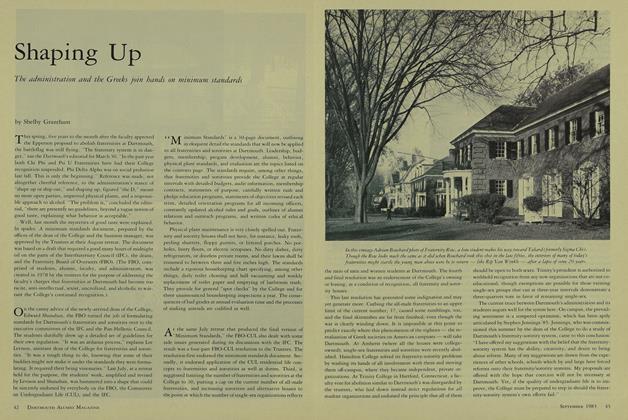
Change is becoming visible in the physical plants. Fraternities seem to be beginning to take better care of their houses. Rare these days are fists through windows or trashing of furniture. The machismo of destruction isn't as accepted as it used to be. According to Chapman, "Now the brothers get ticked-off if something gets broken." Perhaps students are taking more interest in the appearance of houses, but more likely, they are reacting out of fear of the administration's watchful eye on fraternities. The minimum standards proposal drafted by the administration demands in detail the upkeep of houses, from caulking the windows to cleaning the bathrooms. A Psi Upsilon brother says his house feels that the minimum standard rules are going to be enforced and they might as well accept them. A major effect of increasing upkeep of and pride in houses may be that people come to feel that they are guests in someone's house, not just drunks out to get "trashed" in a basement.
Houses are also limiting their parties via invitations or guest lists. This step can reverberate in two directions. It might give fraternities and sororities the proper control by which to avoid overcrowded, drunken keg parties. It also might exacerbate the cliquishness and social competitiveness inherent in a fraternity system. Wendy Folberth '84, member of Kappa Alpha Theta sorority, says, "It's becoming pre-professional, teaching people to deal in the 'right situations.' There is a greater schism between the haves and the havenots members and nonmembers."
Relief from elitism may lie in broaden- ing the functions of fraternities and sorori- ties. The minimum standards proposal, al- ready in effect in many houses, mandates a commitment to community service proj- ects, and fraternities and sororities will hold lectures, debates, movies, depart- mental parties with faculty and other similar functions. With such events, rather than with parties alone, the fraternities and sororities can perhaps serve the whole campus.
With minimum standards comes insis- tence on fraternities' and sororities' adher- ence to College policies. Until recently, though officially expected to obey College rules, the fraternity system had its own set of unwritten rules that did not always correspond to those that applied outside thsystem, especially regarding alcohol consumption. "Maybe to the outside it's abuse, but to us it's just use," explains Alan Chabot '84, member of Psi Upsilon fraternity. But now, mostly out of fear for their survival, houses are now upholding College policy with more regard.
Hijougn Won '84 notes, "The system never would have put limits on itself. If you have all that autonomy, you're not going to limit yourself." Whether in the form of self-improvement through selflimitation and control, or whether solely out of fear of the administration's hard stare, fraternities are cleaning up. Campus police records confirm that fraternity-related vandalism has declined greatly in the past year. The huge open beer-bashes are now outnumbered by smaller, more controlled parties. Fraternities are hosting lecture series and coordinating events with the Big Brother/Big Sister Program.
According to Assistant Dean of the College Lee Levison, the most important resolution sent to the Trustees by the Committee on Undergraduate Life and the Fraternity Board of Overseers is that the College own or lease all of the recognized fraternities and sororities. This would ensure that the College had the final word on a house's fate, and it would give more potency to the administration's proposals. Referred to as "this lease garbage" by Chapman, the committees' recommendation to own or lease has met with student hostility. Though most fraternities and sororities are resigned to or have accepted most proposed changes, in the end they want to be holding their own leases.
Some die-hards feel the administration is out to spoil our fun. If breaking win- dows is "our fun," they are. Some students see these new rules as tools to get rid of houses that the administration doesn't like. In general, however, students are viewing these changes and proposed changes as an upgrading and an upkeep of a system that is here to stay. Tradition at Dartmouth dies hard, but a spring cleaning of this particular tradition is long overdue.
Debbie Schupack '84
Debbie Schupack '84 is one of this year's undergraduate editors and Campbell Interns for theMagazine. She is a religion and creative writing major from Longmeadow, Mass., and,among other things, plays rugby for the College.