Hooked on Toys
. . such stuff as dreams are made of."
Necessity may be the mother of invention, but that doesn't count for much if you're lacking the Tom Edison touch; for most of us it is far more likely that necessity will be the mother of self-discovery. A crisis calls forth qualities we did not know we had; a crunch uncovers untapped reservoirs of resourcefulness; a deprivation leads us to something which makes us look at life from a different angle. For Richard Hooke '53, "necessity" opened up a whole new life.
Until nine years ago Hooke was a college art teacher. A decade with New England College, in Henniker, New Hampshire, virtually bringing an art department into existence, fully occupied as any member of a small faculty is bound to be, had brought him to the point where everything seemed to be set for a lifetime of satisfying, gainful, professional employment. But then a desire to send his children to Farm and Wilderness Camp (coupled with a cash flow problem many academics are familiar with), led to a decision which further down the road turned his life around: he offered to teach free at the camp in return for his children's enrollment. He found that there were two very big differences between that summer of teaching and what he had grown used to: facilities and equipment were minimal, and his students were grade school age. And, perhaps most important, he enjoyed the experience vastly.
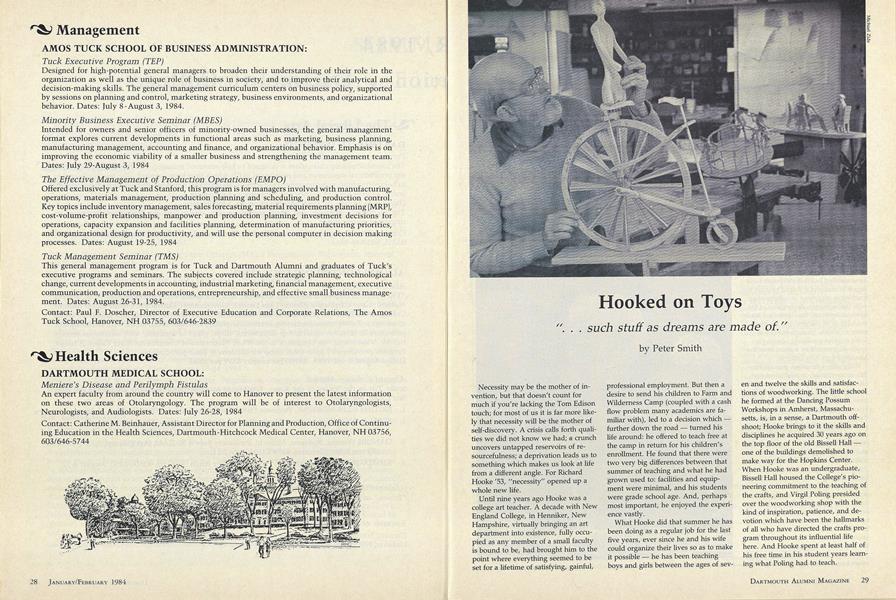
What Hooke did that summer he has been doing as a regular job for the last five years, ever since he and his wife could organize their lives so as to make it possible he has been teaching boys and girls between the ages of Seven and twelve the skills and satisfactions of woodworking. The little school he formed at the Dancing Possum Workshops in Amherst, Massachusetts, is, in a sense, a Dartmouth offshoot; Hooke brings to it the skills and disciplines he acquired 30 years ago on the top floor of the old Bissell Hall one of the buildings demolished to make way for the Hopkins Center. When Hooke was an undergraduate, Bissell Hall housed the College's pioneering commitment to the teaching of the crafts, and Virgil Poling presided over the woodworking shop with the kind of inspiration, patience, and devotion which have been the hallmarks of all who have directed the crafts program throughout its influential life here. And Hooke spent at least half of his free time in his student years learning what Poling had to teach.
In addition to the Dartmouth-learned skills, Hooke also brings to bear upon his new work a sense of priorities and a quirky imagination which will surely teach his young pupils something that may well stay with them through their lives, something that may serve them at least as well as the acquired ability to use a set of hand tools.
This "something" is the distillate of the Dancing Possum experience, for the workshops concentrate though not to the exclusion of everything else - upon the making of toys and playthings that have a connection with traditions as old as any we have in this country. Hooke starts from the fact that most young Americans are, in one important respect at least, more deprived than their counterparts in much poorer parts of the world, places where the only toys children have are those that can be made easily from the materials at hand. Most American children have to do without the unique pleasure of being able to play with toys they have made for themselves, toys which link them to a distant past, toys which have helped make a culture. But while most kids in our society do not know that satisfaction, the lucky ones who have enrolled in Hooke's classes have begun to discover it and because the teaching is organized in collaboration with the recreation department of the town of Amherst, the classes are made available to all comers, and are even more accessible through the use of some modest scholarship funds (recently augmented by a grant from the Massachusetts Arts Lottery).
Within the framework provided by this concentration on traditional toys, Hooke brings into play another emphasis that stretches his students' awareness of the world around them, for Hooke is especially keen on those things which can be made to work by various forces of nature: the toy based on the swing of a pendulum; the tightwire coasting figure; the wind-spinner and the whirligig; the rope climber. In making their own versions of these things, the children are challenged to use their imaginations so as to add something uniquely personal to the work in hand. At the Dancing Possum (unlike the Mattel factory), no two toys are exactly alike - something which opens up insights which one day may be reinforced by other such experiences and create a healthy respect for the importance of individuality.
On the brisk late winter afternoon when I encountered the Dancing Possum for the first time, the atmosphere of the barn had much to charm the visitor. Everything neat neat enough, at least, to enable anyone to find what is needed, but not so much as to suggest an obsession with tidiness. The arrival of the children added to the atmosphere. The wood stove was beginning to make its presence felt (insurance coverage for a school in an eighteenth-century wooden structure with a wood-burning stove was so difficult to get that it almost stymied the project before it could get off the ground), and each arriving pupil seemed to need to renew acquaintance with the place before getting down to work. The current project for that particular group was making a Nine Man's Morris board incorporating a drawer in which to keep the pegs with which the game is played. A certain amount of levity, some bits of boastful talk, an odd minor altercation, requests for help from Hooke and for attention from the visitor, and one realizes that there is more than wood-working going on in this barn; these youngsters are having to deal, too, with the Rewards and the demands which come from being members of a small community which is neither so close as a family nor so imposing as a school class.
When he isn't with his classes, Hooke is either preparing for them or putting the finishing touches to a manual based upon them (due to be published by Down East Books in a year or so), or adding to his stock of ingenious whirligigs and other wind-driven ornaments which he makes and keeps on hand to sell to anyone who's interested. There is something of the folk artist, the passer-on of a tradition, in just about everything he does. And though other members of the Class of 1953 have gone on to be captains of industry and builders of fortunes, it's possible that few will have derived more day-to-day satisfaction from their labors than Richard Hooke gets from helping new generations of New Englanders discover the challenge of using hand and head and heart to create something of their very own out of a few bits of wood; something which is, magically, very old as well as brand new.
Master-craftsman Hooke '53 under the watchful eye of a young apprentice.
More From This Issue
-
 Feature
Interpreting Orozco's Epic
January | February 1984 -
 Feature
"All Deaned Out"
January | February 1984 -
 Feature
The Peripatetic "Silver Fox"
January | February 1984 -
 Feature
The Outing Club at 75
January | February 1984 -
 Cover Story
Aiming for Gold
January | February 1984 -
 Article
Modern politics "up close"
January | February 1984