1950
Once in a while a bit of Vermont conspires to come south to tint the trees, even in these suburban flatlands. Autumn has been flaming.
But in suburbia contrariness abides. The standard is clean, green, gleaming lawns. Fallen leaves are anathema. They must be raked. Endlessly. The first of the season's laborious chores is done.
Gridiron gleanings: portents fulfilled. After four games, no wins. A winning season is a slim chance, especially since Weissman has been hurt and perhaps lost for the year. Consequently, the running game is ineffective, and the passing has suffered. So goes the offense. Defense, usually the saving grace, is porous. A win or two are in sight, but not much more.
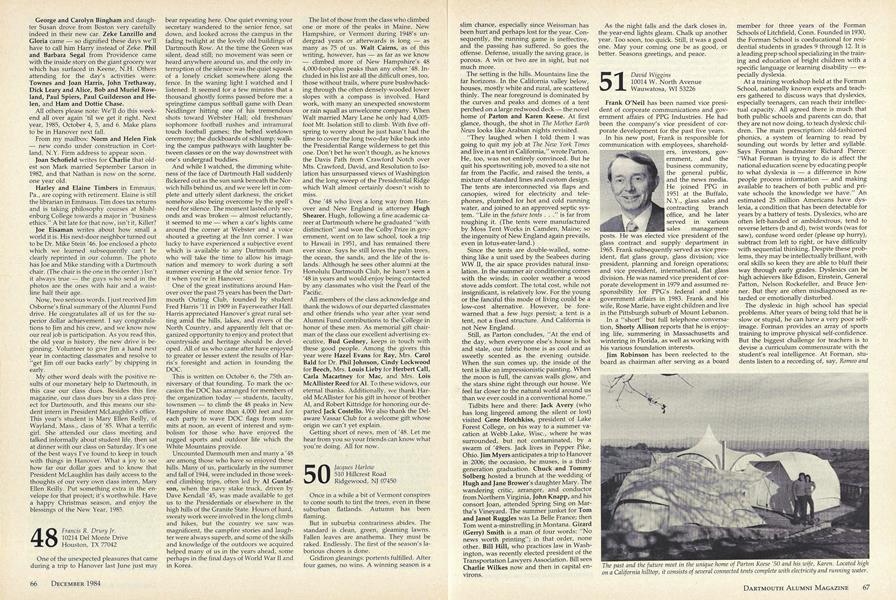
The setting is the hills. Mountains line the far horizons. In the California valley below, houses, mostly white and rural, are scattered thinly. The near foreground is dominated by the curves and peaks and domes of a tent perched on a large redwood deck the novel home of Parton and Karen Keese. At first glance, though, the shot in The Mother EarthNews looks like Arabian nights revisited.
"They laughed when I told them I was going to quit my job at The New York Times and live in a tent in California," wrote Parton. He, too, was not entirely convinced. But he quit his sportswriting job, moved to a site not far from the Pacific, and raised the tents, a mixture of standard lines and custom design. The tents are interconnected via flaps and canopies, wired for electricity and telephones, plumbed for hot and cold running water, and joined to an approved septic system. "Life in the future tents . . is far from roughing it. (The tents were manufactured by Moss Tent Works in Camden, Maine; so the ingenuity of New England again prevails, even in lotus eater land.)
Since the tents are double walled, something like a unit used by the Seabees during WW II, the air space provides natural insulation. In the summer air conditioning comes with the winds; in cooler weather a wood stove adds comfort. The total cost, while not insignificant, is relatively low. For the young or the fanciful this mode of living could be a low cost alternative. However, be forewarned that a few bugs persist; a tent is a tent, not a fixed structure. And California is not New England.
Still,as Parton concludes, "At the end of the day, when everyone else's house is hot and stale, our fabric home is as cool and as sweetly scented as the evening outside. When the sun comes up, the inside of the tent is like an impressionistic painting. When the moon is full, the canvas walls glow, and the stars shine right through our house. We feel far closer to the natural world around us than we ever could in a conventional home."
Tidbits here and there: Jack Avery (who has long lingered among the silent or lost) visited Gene Hotchkiss, president of Lake Forest College, on his way to a summer vacation at Webb Lake, Wise., where he was surrounded, but not contaminated, by a swarm of '49ers. Jack lives in Pepper Pike, Ohio. Jim Myers anticipates a trip to Hanover in 2006; the occasion, he muses, is a thirdgeneration graduation. Chuck and TommySolberg hosted a brunch at the wedding of Hugh and Jane Brower's daughter Mary. The wandering critic, arranger, and conductor from Northern Virginia, John Knapp, and his consort Joan, attended Spring Sing on Martha's Vineyard. The summer junket for Tomand Janot Ruggles was La Belle France; then Tom went a-minstrelling in Montana. Girard(Gerry) Smith is a man of four words: "No news worth printing"; in that order, none other. Bill Hill, who practices law in Washington, was recently elected president of the Transportation Lawyers Association. Bill sees Charlie Wilkes now and then in capital environs.
As the night falls and the dark closes in, the year end lights gleam. Chalk up another year.Too soon, too quick. Still, it was a good one. May your coming one be as good, or better. Seasons greetings, and peace.
510 Hillcrest Road Ridgewood, NJ 07450