Exemplary link between nations

"He looked to us very nondescript and unprepossessing . . . not in any way the great muralist," recalled an alumnus who was a freshman when Jose Clemente Orozco began painting his Epic. of American Civilization in the Reserve Corridor of Baker. Budd Schulberg '36, one of many alumni who returned for the final event in the 50th year celebration of the Orozco murals, went on to recall that "every few days we would visit him, and the mural seemed like it was blossoming before us, just like a flower. . . . Thatwas a agreatexperience."
Just as the murals blossomed before the students' eyes in the mid-thirties, so has the year-long celebration of the murals' 50th anniversary blossomed on campus. Begun last February on the very date of the work's completion, the celebration concluded in mid-October with a two-day symposium featuring several high-ranking Mexican diplo- mats, representatives of the Mexican press and Spanish television, international scholars in Orozco's art, and members of the College family. Schulberg, a writer of considerable renown, termed the symposium "a positive event since it redirected attention to the mural's panels. They really are magnificent works, brilliant in their concept as well as in their form."
The principal address of the symposium was delivered by His Excellency Ambassador Porfirio Munoz Ledo, Permanent Mission of Mexico to the United Nations. He urged an anti-parochial attitude in analyzing Orozco's works as well as in observing the relationships among nations: "The insertion of Mexican art in this North American liberal sanctuary continues to be the symbol of an exemplary link between our nations. It is a link that transcends disparate inheritances, historic scars, and the asym metry of power and well being, because it is based on the strict recognition of each country's values and legitimate aspirations." Condemning "the cult of uniformity which annihilates the richness of our cultural legacies," Munoz Ledo asserted that the Americas founded a "true mestizaje [racial mixture] of ideological pluralism, the selfdetermination of peoples, and the basis of equality and shared progress."
The scholarly presentations that preceded and followed Ambassador Munoz Ledo's address reflected the richness of which he spoke. Papers delivered by a diverse group of American, Mexican, and British academics ranged from "Myths and Realities of the Mexican Revolution" to "Orozco's Influence on Jackson Pollock." Among the scholars was Laurance Hurlbert '59, director of a research project on Mexican muralists, who returned to campus sporting his class jacket to present an interpretation of "The Dartmouth Murals: Orozco's Narrative Epic of American Civilization." The breadth and depth of the symposium's offerings presented an opportunity to reflect upon the exchanges between the artist and his aesthetic, political, and spiritual environments, and upon the exchanges among the Americas, as cultures sharing the common heritage depicted by Orozco's fresco panels. "It was a celebrated academic event that should help encourage the community to recognize and acknowledge one of its ultimately significant educational treasures," commented Leonard Rieser, director of the Dickey Endowment for International Understanding, which was instrumental in organizing and sponsoring the symposium. "The celebration was also very timely," Rieser said, "as it gave the College the opportunity to publicly honor Senora Margarita Valdez Orozco, the artist's widow, and her family." Also honored by President McLaughlin in his opening address was the artist's grandson, an artist in his own right, Jose Clemente Orozco '85.
Professor of Art History Emeritus Churchill Lathrop, who played an essential role in bringing Orozco to Hanover during the worst years of the Depression, thought the symposium a success because it encouraged thinking of the master and his murals as "dealing more with universal values than political ideologies. Orozco, in fact," asserted Lathrop, "thought that the extreme left was just as bad as the extreme right."
The success of the "educational experiment" forged half a century ago by Lathrop, President Hopkins, and Artemas Packard, then chairman of the art department, was reinforced by the symposium's closing address. His Excellency Ambassador Joaquin Bernal, consul general of the Mexican Embassy in New York, described the circumstances which the artist enjoyed while at work on his masterpiece and noted the College's important role as permanent "executor" of his epic work. Quoting from Orozco's autobiography, Bernal shared the muralist's appreciation for Dartmouth as a patron of the arts: "The authorities of the school and its 2,500 students enthusiastically backed the initiative of the Fine Arts Department and I started to work. I was given absolute liberty to express my ideas." Added the ambassador, "What impressed Orozco about Dartmouth has impressed the world about the United States." Acknowledging Orozco's inspiring influence on other American artists such as Willem de Kooning, Philip Guston, and Jackson Pollock, Bernal's closing words were a commentary on the spiritual culture that nourished the artist during his two-year stay in Hanover one that Bernal hoped will continue to prevail: "The grand inspirer was in turn inspired by the freedom he felt and was given by this same institution which today dedicates a symposium to his work and greatness."
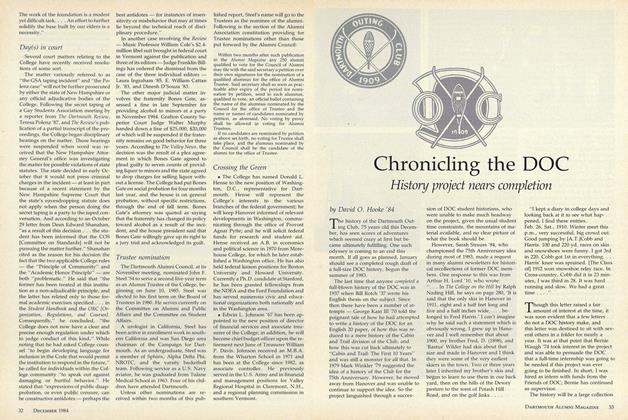
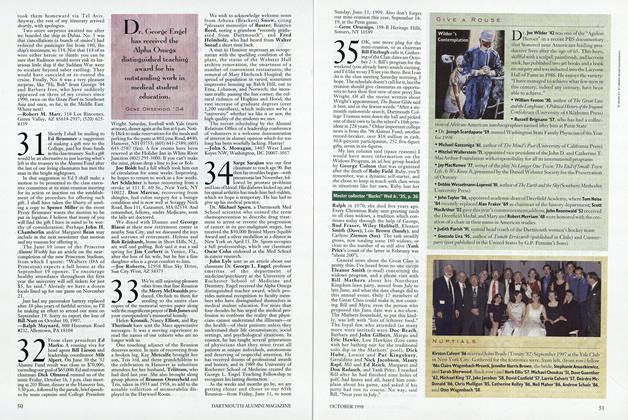
Flanked by the flags of the United States, the United Nations, and Mexico are two of theparticipants in the finalevent of the 50th-year celebration of the Orozco murals. At theUnited Nations, and on the left is Leonard Rieser, director of the Dickey Endowment forInternational Understanding, which was instrumental in sponsoring the event.
Dartmouth students are at the heart of what I like best about my job." —Assistant Dean Craig Bradley '82, in an October 23 interview in The Dartmouth