Letters
The Right Stuff
I have enjoyed and deeply appreciate the accolades bestowed upon me at retirement. (Twice, in fact; this time for real.) Bruises from brickbats that sometimes came my way (of which a number were unquestionably deserved) are now faded, pain forgotten. Memories of many things are warm and mellow.
Unhappily I have no medium through which fully to pay tribute to classmates, other alumni, collegiate and school friends, much less to admissions office associates who over the years shared the joys and sorrows of difficult decisions and who charitably endured my not infrequent displays of irascibility.
It is impossible here to come close to naming all the people to whom I owe an incalculable debt for their contributions to the joy in the Dartmouth Fellowship with which my life has been blessed. But I must cite a few whose influences, whether through tutelage, understanding or tolerance "made all the difference": John Dickey, Andy Gustafson, Bob McKennan, Bill Eddy, Al Foley, Al Dickerson, and, especially, Earl Blaik and Bob Strong who jointly took me under their wings two weeks after I graduated. And, yes, Spud Bray, whose self-inflicted myopia permitted some of you guys out there to gather in your diplomas.
But it was Mr. Hopkins-his educational acumen, his personal mores, his utter devotion to Dartmouth-who set the course I strove to navigate howsoever true or erratic its wake may show it to have been.
May Hoppy's spirit ever remain ingrained in the "stuff" of this great institution and the wisdom of his recorded philosophies be a beacon on which it will periodically take a fix to see where it is and where it is going.
Hanover, N.H.
The Symbol (cont.)
F. Sheldon Prentice '72 argued in November with respect to the Symbol, "the decision to terminate the Indian ... is irreversible." Few things in this life are irreversible outside of the natural world. In his words, recovery of the Symbol would constitute a "return to the past, which will not happen." "Return to the past" is a loaded phrase, fraught with emotion. (Besides, it could happen.) We are constantly returning to the past for direction in politics, law, religion, for various tricks and devices in the crafts, building and architecture, and, yes, even in education.
As to the Symbol, its rejection was due in part to an error. It was adjudged a caricature. There was a caricature but its life-span was short. The insignia rejected was not a caricature but a schematic design, of the type employed by many organizations since earliest times. The committees that rejected the Symbol judged its character falsely. They had forgotten their Art 1 if they ever had it.
Furthermore, why couldn't the College have acquainted our Indian brethren with the meaning and sacredness of the Symbol for most of our alumni? It shouldn't have been difficult.
Concord, Mass.
Bravissimo!
As a sixth generation Dartmouth graduate reader (Dad was '03, great-great-great-grandfather Sam Peabody 1803) I say Bravissimo! The April '84 edition of the Alumni Magazine is one of the very best I have read in nearly fifty years. I don't care who says what; you are right on the mark in all respects. Keep it up. Phooey to your detractors!
Speaking of yesteryear and Peabody relatives, I recently learned while touring Westminster Abbey that my great-great-uncle, George Peabody of South Danvers, Mass., Yale, and Harvard Museum fame, is "the only American ever buried in Westminster Abbey." He was childless. In deference to them (Sam and George) I've resumed spelling out my middle name.
Keep up your excellent work. From a browser you've made a reader out of me.
Minneapolis, Minn.
Although a friend and partisan of Dennis Dinan, I'm very happy to find myself enthusiastic about the"new" Magazine.
The Kenneth Andler '26 article collected my bit-and-piece Robert Frost recollections into a newly significant "tool for living" . . . Shelby Grantham's "Consortium" gave me a new evaluation and appreciation of scholarly publishing . . . O. Ross McIntyre '53 opened a new window on faculty scholarship in contemporary function . . . and I still have Robert Conn '61 (so he's graying!) for tonight.
Who knows I may even start reading the next issue from the front of the book.
Los Angeles, Calif.
What Price Technology?
I view the mass computerization of Dartmouth students with skepticism and alarm. The "computer revolution" is another component of an increasing depersonalization which means handing over more and more of our thought and decisions to machines rather than people. It is what Marcuse called reificatiort, the process of treating the world as a thing in which we ourselves also become things. As dialogue among students and professors is gradually replaced by dialogue with the machine, I'm afraid it's not the Apples but the students who will end up being programmed.
Too little attention is paid to the negative by-products of technological advances. As the telephone replaces the letter, people can no longer write. As high fidelity is perfected, we stop reading and playing music and be- come passive listeners.
It's marvelous that high-power computer technology is available to those Dartmouth students who choose to go that way. But the concept that "every student will own an Apple computer" implies a personal decision preempted by College policy and a dangerous pressure to conform. I'm always proud to read that Dartmouth is a leader in something. But when it's the progressive mechanization of our culture, I'd rather hand the lead over to someone else.
Bar Harbor, Maine
On Being Number One
As an alumnus of moderate seniority, may I enthusiastically echo your sentiments expressed in the March 1984 Magazine under the title "On Being Number One" (Editor'sRemarks). As you say, it's always nice to win, but the grand thing about Dartmouth, even during the war years when I was one of Dartmouth's "adopted Navy V-12 sons," has been the wide student participation in almost every conceivable athletic and intellectual extracurricular activity -and the availability for all students of the wide variety that exists at Dartmouth! If most Dartmouth students wanted a perennially winning football team, they would have gone to Nebraska or Notre Dame in the first place! Those not yet graduated still have that option. I am not aware, however, of any overwhelming waiting line for such transfers in the past or the present.
I also applaud the ever increasing participation in athletic and other activities of the female students who have arrived on campus since my time there, as well as the straightforward, non-token, no-nonsense coverage given their activities in the Magazine.
May we always have schools like Dartmouth where athletic programs exist primarily for wide student participation and not for media publicity, cash income, or alumni ego purposes.
Hollidaysburg, Pa.
The DOC in the War
The letter from Merrill McLane '42 in the April number, while accomplishing its main purpose of correcting the record with regard to John Rand's pivotal importance to the postwar history of the DOC, expresses a view which is incorrect. He states, "There could obviously have been no phenomenal growth from 1942 to 1945," presumably because these were the war years. In the DOC was indeed just,about shut down. My classmate John White has a, picture of his car, grossly overloaded, bringing back blankets and mattresses from cabins that were being closed up "for the duration" as the expression was. But just a few months later, back they went and the DOC was going full blast.
What had happened in the meantime was that the Navy Y-12 unit had moved in and suddenly there were some 2500 young men on the campus. The. first weekend leave in July 1943, was a disaster. The Navy in its wisdom granted liberty to about 700 sailors who were free to mill up and down Main Street, but not to leave town. The rest were confined to the dorms. The result is imaginable. .
On Monday, Tom Dent, who had been made manager of the DOC, went to the commandant of the V-12 Unit and told him the DOC could solve his problem. Very quickly the DOC organized for large trips and other activities. The Navy provided a truck and unlimited gasoline (very important then), plus all the food the men would need. We were back in business. From then on each weekend saw trips of all kinds including mass expeditions of 30 or more in the truck and numerous smaller ones on foot to the cabins. Best of all, there was no limit to how many weekends you could go on trips; they did not count against your once-a-month weekend leave.
Needless to say, membership zoomed: The Ledyard Canoe Club made their canoes available and there were trips to Winnepesaukee and Mascoma Lake, as well as river paddling. Doug. Wade, College Naturalist, went on many of those trips. Tom Dent even went with us to Mt. Washington where he had arranged for us to use the base station. Tom had all the shrewd political skills of his Scottish ancestry and he smoothed the way for.many of us who were apprentice seamen as well as DOC leaders and needed. exemption from certain Navy routines if we were to run the club.
I don't know what Merrill means when he says., "many traditions had been lost, during the war years." I recall all kinds of gut-busting mountain hikes, Moose Mountain feeds, Johnny Johnson turkeys at Thanksgiving, a Hanover to Moosilauke snowshoe hike, songfests at the drop of a harmonica. We even ran an IOCA at Ravine Camp in 1944 at incredible expenditure of labor, opening up the Camp, toting bedding in the Navy truck all the way back up from Hanover, packing in vast amounts of food supplied by the Navy. We had all the trimmings, too, including a square dance and stories by Bateese. We took our cues from the DOC files and included everything the pre-war parties had.
Many illustrious DOCers emerged from that era, not the least of whom was Jim Schwedland. After the war, he took over the job of woodcraft advisor when Ross McKenney retired. Schwed was a V-12 student who otherwise never would have attended Dartmouth. I could name dozens more whose names are in the cabin logbooks and on the rosters of C&T.
The story of how the DOC battened down in 1942 but then set full sail again in 1943, is not well known except among us who lived it and relished it. Fortunately, I preserved copies of newsletters and the DOC Trail Blazer from those years. I have turned them over to Dave Hooke '84 for his 75th anniversary volume. I trust there will be enough in the final volume to fill in what seems to be an open chink in DOC chronology. Why those years were lost I don't know, but let's see the record set straight. .T .
Dexter, Maine
Wild Dogs
I have seen nothing in the Magazine about putting wild dogs on the athletes' shirts instead of the Indian. I have heard that this is planned for next year. If this is not true, I am sure many alumni will be pleased and welcome your announcement. If this is true, I am sure many alumni would join with me in requesting an answer to the following questions: 1. Who made this decision? 2. Was this authorized by the President? 3. Was this authorized by the Trustees? 4. If authorized by the Trustees, please publish a copy of the resolution making this authorization. 5. Who, or what body, recommended this change? 6. Why was a dog chosen to replace a man?
Waukegan, III.
[We've heard some rumors about wolves, butnothing about wild dogs. Ed.]
The Ivies: an End-Around?
Editor Douglas Greenwood's commentary on Dartmouth sports in April makes a valid point and, I believe, misses one.
Mr. Greenwood does not wish to see Dartmouth become a football factory like the University of Nebraska. Agreed. He also, however, implies that spectator interest in Dartmouth sports is of secondary importance. I disagree. 1 submit that spectator-interesting sports at Dartmouth is part, or rather was part, of the Dartmouth tradition.
The overall quality of Ivy League sports seriously is really at the present time not much better than high school competition. Dartmouth-Columbia in football, Dartmouth Brown in basketball, Dartmouth-Princeton in hockey is of very limited general interest to spectators who like to see quality sports.
And by "quality" sports I'm not talking the University of Nebraska. I'd like to see and enjoy something part way between the high school level and the Nebraska level.
Today's college costs make it extremely difficult to recruit to Dartmouth and other Ivy institutions quality athletes. As a consequence, the Trustees and the administration have apparently thrown in the towel. In the longer run, this is probably a mistake; while recruiting should be kept in perspective and subject to strict controls, Dartmouth could budget something more and try harder in recruiting efforts.
North Stonington, Conn.
No UnbridledCurmudgeon (?)
Les Huntley '33 wants an answer to his suggestion concerning the words of "Men of Dartmouth." I am only too ready to oblige. For crying out loud, haven't we had enough trouble with the NAD, the GSA, and the Eastman gang without having some gee who's worried about being misinterpreted when he sings or recites his "anthem" for strangers in California? Hey, man, let our Alma Mater be. If there are wimps who do not understand the poetic references to our eternal affection for the hills of New Hampshire, throw them no pearls. We don't change our outlook or position every time we change our shoes. Although sometimes it does seem like that.
On another subject, the Magazine is improving and we did get our May issue in June, but it seemed a little weighted in terms of undergraduate prose.
A self-interview is not the most exciting technique and those of us who endured the depression of the 30s and saw the children of Germany after WW II are not totally moved by kids who starve themselves.
Lest you brand me as nothing but an unbridled curmudgeon cheers for the letter of Ray McMahon '43 suggesting that student life might be improved by better casting at the admissions level as opposed to cultural programming at the counseling level.
It has occurred to me that the College could remedy mistakes made during the admissions process by not inviting obvious undesirables to return; admitting highly qualified transfer students to replace them. I recognize that this idea is opposed to current policy but policies seem to be always in a state of flux. Either that or bound up by rampant indecision.
New London, N.H.
More From This Issue
-
 Feature
Professor John Stearns '16: Rara Avis Una
June | July 1984 -
 Feature
Creativity: The Open Dance at Dartmouth
June | July 1984 -
 Feature
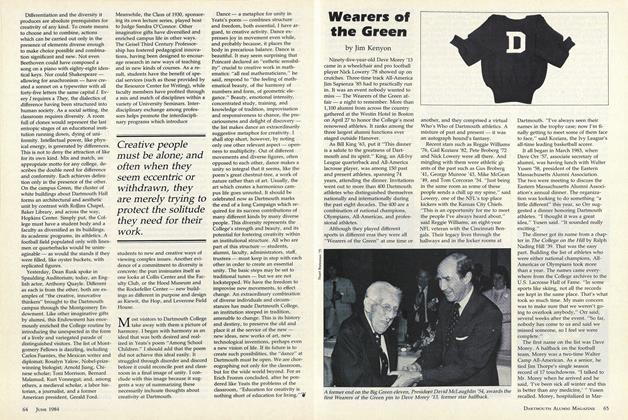
Wearers of the Green
June | July 1984 -
 Feature
The Best Part of My Academic Life Here
June | July 1984 -
 Feature
Making it Happen
June | July 1984 -
 Feature
The Quiet Good Man
June | July 1984
Letters to the Editor
-
 Letters to the Editor
LETTERS FROM AUSTRIA AND GERMANY
March 1919 -
 Letters to the Editor
WHY SEND A BOY TO DARTMOUTH?
May, 1923 -
 Letters to the Editor
Letters to the Editor
APRIL 1968 -
 Letters to the Editor
Letters to the Editor
March 1980 -
 Letters to the Editor
LETTERS
JUNE 1990 -
 Letters to the Editor
Letters
Nov/Dec 2009


