1944
It may not be quite fair, but I'm going to snitch this entire space this month to carry on some about our 15-day trek in November to Mount Everest Base Camp in Nepal.
Three of us, wife Anne, my son, Gar, and I flew for what seemed a century from Nepal's capitol, Kathmandu. From there we puddle-jumped another 80 miles by air towards Everest to save two weeks of walking.
There were 10 others in our group, five Canadians, three Englishmen, a German, and an American - nine men and four ' women in all. We had seven Sherpas and 30 porters who carried most of our gear: tents, sleeping bags and mats, duffle bags, mess tent and equipment, lanterns and fuel, and food for two weeks. All we had to lug was a day-pack with a clothing change, cameras, field glasses, notebooks, and any other personal knickknacks.
But if we had Sherpas and porters lead- ing and carrying, no one was carrying us. Our overriding common denominator was basic: we all had to walk - from four to eight hours every day for 15 days. There are no shortcuts on the trail in Nepal. There are no roads, no substitute transportation. Whatever your individual pace on the trail, you get where you're going on your own two legs, and each of us with our own puffs, pulls, and pains.
Sherpas woke us each morning with a cheerful "Good morning, hot tea, hot wash water," and we were soon out of our sleeping bags, in and out of latrine tents, and assembled for a breakfast of porridge, crackers, and tea or coffee. We then packed up and hit the trail, the trail being a narrow, sometimes sandy but mostly rocky, winding ribbon that made its way up valleys, along mountainsides, through tiny villages, and over mountain streams (which we often crossed on swaying, makeshift bridges that approximated walking across Niagara Falls on a spiderweb). Our cooks were always ahead of us and would have an 11:00 a.m. lunch waiting: lemonade and tea, an omelet, potatoes, sausage. A short respite in the sun and we're off again. We usually stopped by 3:30, when the sun was lost behind the 25,000-foot peaks, and the chill moved in. Tea at 4:30 (you need lots of liquid at high altitudes), a stroll, a nap, sorting gear, diary-writing, talk. Dinner in the mess tent at 6:00: noodles and yak meat, potatoes, cauliflower or broccoli, fruit cocktail. Pretty snazzy.
Chatter after dinner. Then bed (ha sleeping bag) at 8:00 for 11 hours sleep. None of us had slept 11 hours since we were three, but what else do you do when day is done and it's dark and there is no electricity, only flashlights, and it's cold? And the nearest library, symphony hall, bar, grill, or TV set is two million miles away . . .
We took 10 days to get to Everest Base Camp, five to come back down. It wasn't just a case of uphill versus downhill; the going up involved acclimatization. You can't go from 8,000 to 18,000 feet in a Jiffy (or even in a helicopter); you have to go slowly and let the body get used to thin air. Our final night before Base Camp was at a tiny settlement called Loboche, just over 16,000 feet high. By then we all had colds and sore throats; some had heavy headaches. Sleeping was haphazard. You pant for breath, and you lie there listen- ing to yourself pant - all night long.
Saturday, November 24, is our day for "the summit." We are out of our tents at 5:00 a.m., and underway an hour later. We are high above the tree line, rocks and snow and ice as far as one can see Everest and Nuptse and Lhotse and Pumori surround us; we are like ants amongst the 10-pins in a bowling alley. A long, long hard pull and we reach our goal - an 18,000-foot minor mountain called Kala Pattar, which looks across the glacier to Everest Base Camp. There is the infamous Ice Fall and Everest itself, rising another 11,000 feet above us, two miles to 29,028 feet.
Standing at Everest's foot makes one weep, and I did. Son Gar and I threw our arms around each other - "We made it" - and we took pictures and then the wind came up and damn near blew us away.
We decided it was high time to blow ourselves away, too, and so we left the top of Kala Pattar and headed "home " It was a good feeling. We had been two weeks on top of the world, literally and figuratively, and there's not much in this life to top that.
We're happily back in Cornish Flat, N.H. A bed feels good after two weeks of sleeping on the ground. Our woodstoves, ike our memories, are glowing. Our yellow labs are wagging. The cross-country ski trails are beckoning.
But we wouldn't have exchanged the Everest experience for anything. The dream of a lifetime. From The Tempest: this was "such stuff/As dreams are made on . . ."
That's it. Blessings.
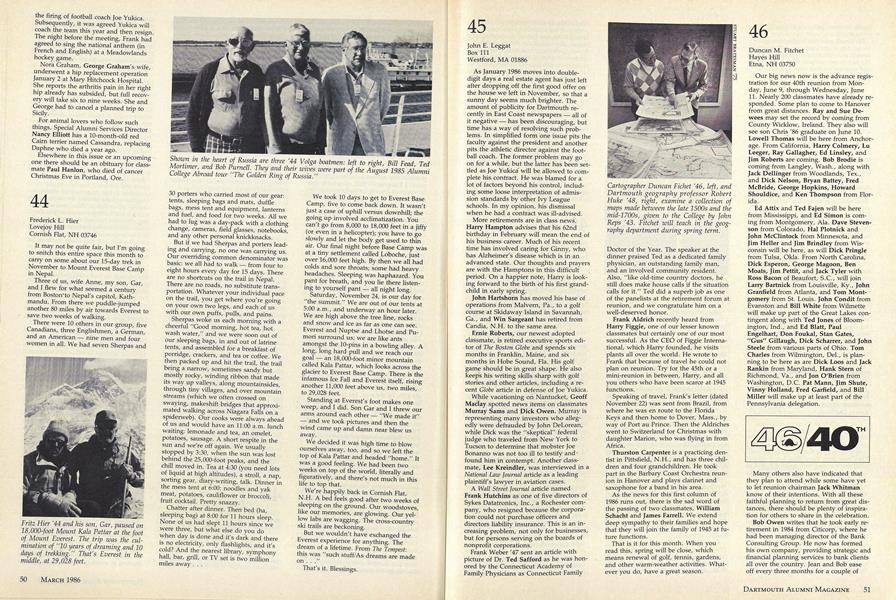
Fritz Hier '44 and his son, Gar, paused on18,000-foot Mount Kala Pattar at the footof Mount Everest. The trip was the culmination of "10 years of dreaming and 10days of trekking." That's Everest in themiddle, at 29,028 feet.
Shown in the heart of Russia are three '44 Volga boatmen: left to right. Bill Fead TedMortimer and Bob Purnell. They and their wives were part of the August 1985 AlumniCollege Abroad tour "The Golden Ring of Russia."
Lovejoy Hill Cornish Flat, NH 03746