Dartmouth Authors
Terrible Beauty
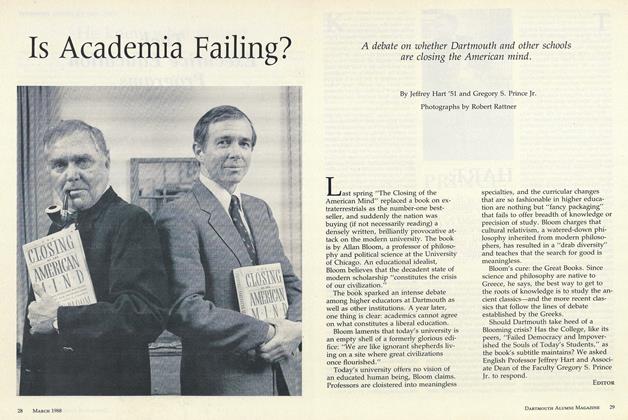
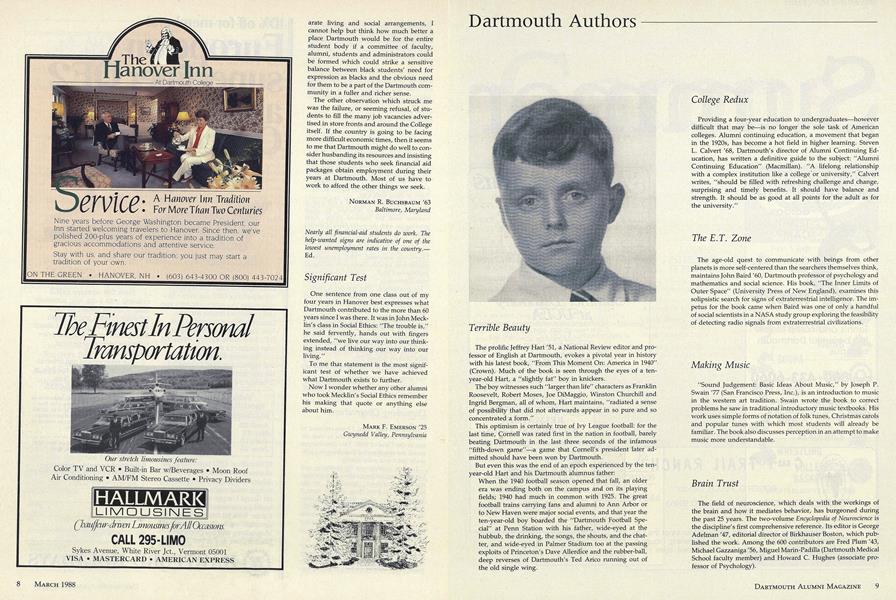
The prolific Jeffrey Hart '51, a National Review editor and professor of English at Dartmouth, evokes a pivotal year in history with his latest book, "From This Moment On: America in 1940" (Crown). Much of the book is seen through the eyes of a ten-year-old Hart, a "slightly fat" boy in knickers.
The boy witnesses such "larger than life" characters as Franklin Roosevelt, Robert Moses, Joe DiMaggio, Winston Churchill and Ingrid Bergman, all of whom, Hart maintains, "radiated a sense of possibility that did not afterwards appear in so pure and so concentrated a form."
This optimism is certainly true of Ivy League football: for the last time, Cornell was rated first in the nation in football, barely beating Dartmouth in the last three seconds of the infamous "fifth-down game"—a game that Cornell's president later admitted should have been won by Dartmouth.
But even this was the end of an epoch experienced by the ten-year-old Hart and his Dartmouth alumnus father:
When the 1940 football season opened that fall, an older era was ending both on the campus and on its playing fields; 1940 had much in common with 1925. The great football trains carrying fans and alumni to Ann Arbor or to New Haven were major social events, and that year the ten-year-old boy boarded the "Dartmouth Football Special" at Penn Station with his father, wide-eyed at the hubbub, the drinking, the songs, the shouts, and the chatter, and wide-eyed in Palmer Stadium too at the passing exploits of Princeton's Dave Allerdice and the rubber-ball, deep reverses of Dartmouth's Ted Arico running out of the old single wing.
College Redux
Providing a four-year education to undergraduates—however difficult that may be—is no longer the sole task of American colleges. Alumni continuing education, a movement that began in the 1920s, has become a hot field in higher learning. Steven L. Calvert '68, Dartmouth's director of Alumni Continuing Education, has written a definitive guide to the subject: "Alumni Continuing Education" (Macmillan). "A lifelong relationship with a complex institution like a college'or university," Calvert writes, "should be filled with refreshing challenge and change, surprising and timely benefits. It should have balance and strength. It should be as good at all points for the adult as for the university."
The E.T. Zone
The age-old quest to communicate with beings from other planets is more self-centered than the searchers themselves think, maintains John Baird '60, Dartmouth professor of psychology and mathematics and social science. His book, "The Inner Limits of Outer Space" (University Press of New England), examines this solipsistic search for signs of extraterrestrial intelligence. The impetus for the book came when Baird was one of only a handful of social scientists in a NASA study group exploring the feasibility of detecting radio signals from extraterrestrial civilizations.
Making Music
"Sound Judgement: Basic Ideas About Music," by Joseph P. Swain '77 (San Francisco Press, Inc.), is an introduction to music in the western art tradition. Swain wrote the book to correct problems he saw in traditional introductory music textbooks. His work uses simple forms of notation of folk tunes, Christmas carols and popular tunes with which most students will already be familiar. The book also discusses perception in an attempt to make music more understandable.
Brain Trust
The field of neuroscience, which deals with the workings of the brain and how it mediates behavior, has burgeoned during the past 25 years. The two-volume Encyclopedia of Neuroscience is the discipline's first comprehensive reference. Its editor is George Adelman '47, editorial director of Birkhauser Boston, which published the work. Among the 600 contributors are Fred Plum '43, Michael Gazzaniga '56, Miguel Marin-Padilla (Dartmouth Medical School faculty member) and Howard C. Hughes (associate professor of Psychology).