John Turkevich '28 on Leon Richardson
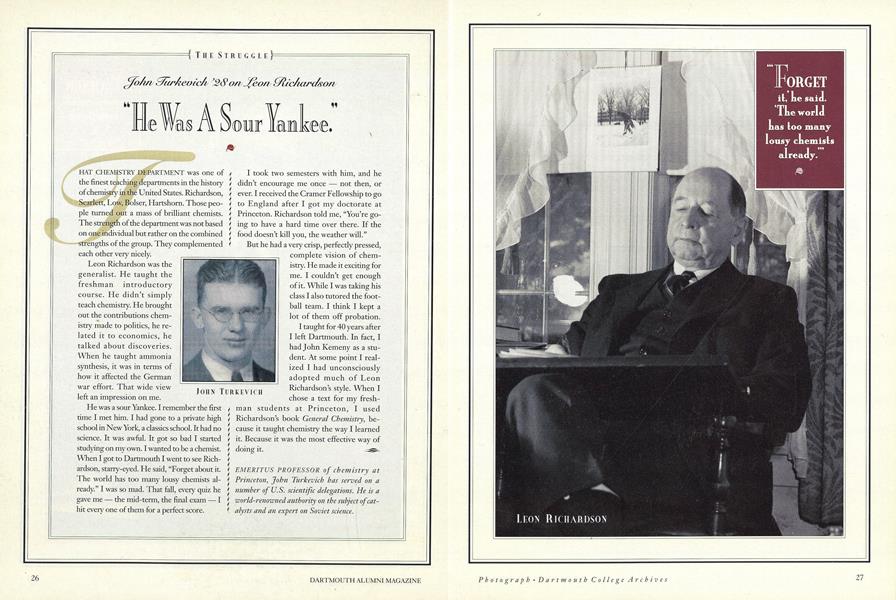
"He Was A Sour Yankee."
HAT CHEMISTRY DEPARTMENT was one of the finest teaching departments in the history of chemistry in the United States. Richardson, Scarlett, Low, Bolser, Hartshorn. Those people turned out a mass of brilliant chemists. The strength of the department was not based on one individual but rather on the combined strengths of the group. They complemented each other very nicely.
Leon Richardson was the generalist. He taught the freshman introductory course. He didn't simply teach chemistry. He brought out the contributions chemistry made to politics, he related it to economics, he talked about discoveries. When he taught ammonia synthesis, it was in terms of how it affected the German war effort. That wide view left an impression on me.
He was a sour Yankee. I remember the first time I met him. I had gone to a private high school in New York, a classics school. It had no science. It was awful. It got so bad I started studying on my own. I wanted to be a chemist. When I got to Dartmouth I went to see Richardson, starry-eyed. He said, "Forget about it The world has too many lousy chemists already." I was so mad. That fall, every quiz he gave me the mid-term, the final exam I hit every one of them for a perfect score.
I took two semesters with him, and he didn't encourage me once — not then, or ever. I received the Cramer Fellowship to go to England after I got my doctorate at Princeton. Richardson told me, "You're going to have a hard time over there. If the food doesn't kill you, the weather will."
But he had a very crisp, perfectly pressed, complete vision of chemistry. He made it exciting for me. I couldn't get enough of it. While I was taking his class I also tutored the football team. I think I kept a lot of them off probation. I taught for 40 years after I left Dartmouth. In fact, I had John Kemeny as a student. At some point I realized I had unconsciously adopted much of Leon Richardson's style. When I chose a text for my freshman students at Princeton, I used Richardson's book General Chemistry, because it taught chemistry the way I learned it. Because it was the most effective way of doing it.
John Turkevich
EMERITUS PROFESSOR of chemistry atPrinceton, John Turkevich has served on anumber of U.S. scientific delegations. He is aworld-renowned authority on the subject of catalysts and an expert on Soviet science.
More From This Issue
-
 Feature
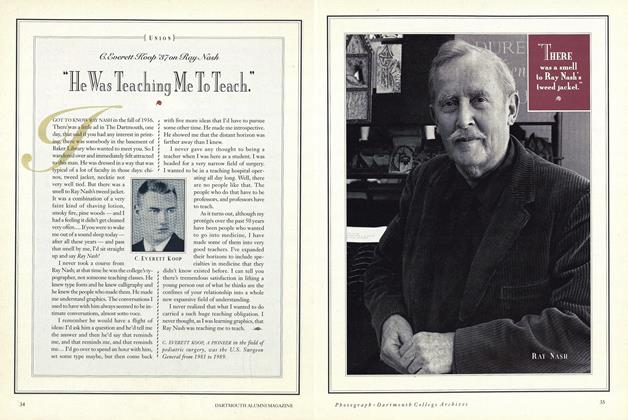
C. Everett Koop '37 on Ray Nash
November 1991 -
 Feature
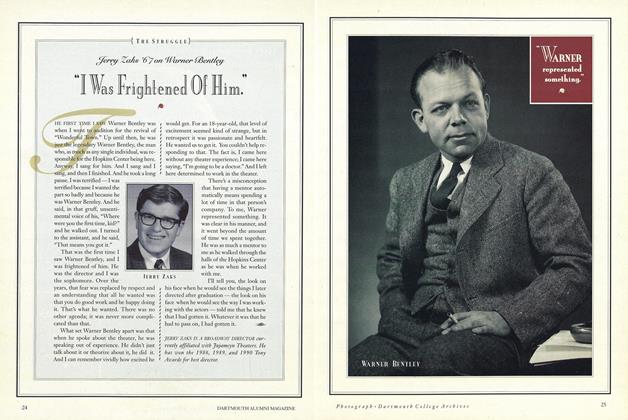
Jerry Zaks '67 on Warner Bentley
November 1991 -
 Feature
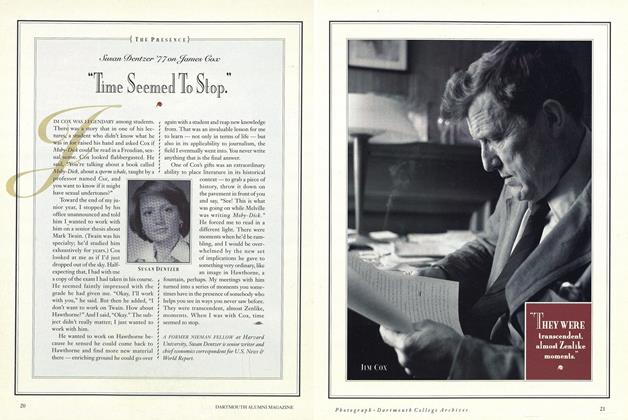
Susan Dentzer '77 on James Cox
November 1991 -
 Feature
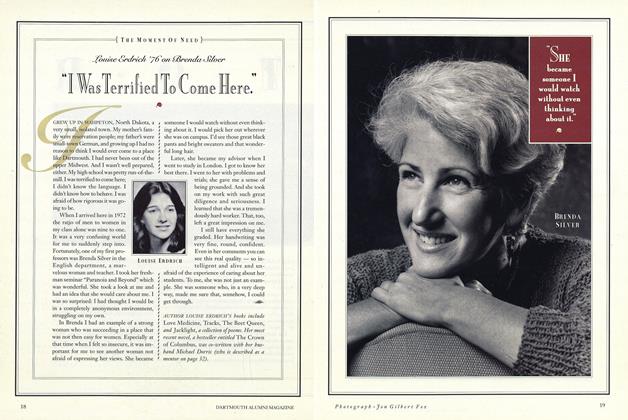
Louise Erdrich '76 on Brenda Silver
November 1991 -
 Feature
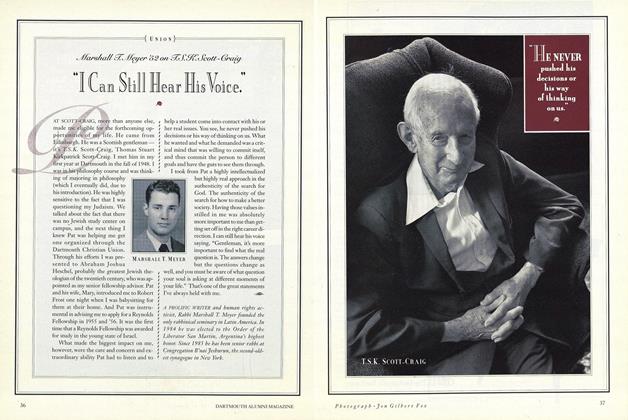
Marshall T. Meyer '52 on T.S.K. Scott-Craig
November 1991 -
 Feature
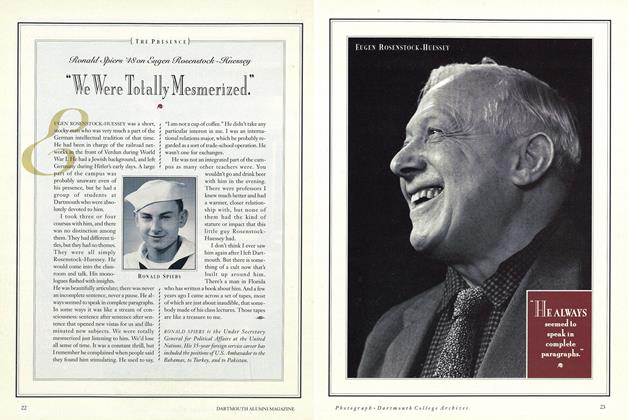
Ronald Spiers '48 on Eugen Rosenstock-Huessey
November 1991
Features
-
 Feature
UNDERWATER TREASURE
December 1960 -
 Feature
IN THIS SPECIAL SECTION
OCTOBER 1972 -
 Feature
The Unbelievable Truth
Sept/Oct 2011 -
 Feature
Serenity Now
SEPTEMBER | OCTOBER 2017 -
 COVER STORY
“Take This Advice Today!”
Jan/Feb 2009 -
 Feature
The Growing Threat to Privacy Posed by Computer Data Banks
FEBRUARY 1972

