Dr. Wheelock's Journal
Divers Notes & Observations
Surprise communique' on June 25, from Provost John Strohbehn: "The Native American Council has recommended that the Hovey murals be considered a part of the institution's art collection and therefore be treated in the same manner as the Orozco murals in Baker Library. As such, they should be permanently uncovered and available for viewing."
There was no headlong rush by the nation's press to "rip out the front page" so for the benefit of alumni of 1979 onward, this brief clarification: The murals were painted in the late thirties by illustrator Walter Beach Humphrey' 14 in response to alumni objections that the Orozco work was less than fully characteristic of the Dartmouth scene. Humphrey's art lent color and humor to the basement of Thayer Hall until the early seventies, when the College rededicated itself to its original mission, to educate Native Americans. This could hardly be done when a prominent campus gathering place featured four tall walls of inebriated braves and bare-breasted squaws, no matter how revered were the Richard Hovey lyrics therein depicted. Although it took eight years of uneasiness and protest, in 1979 President Kemeny decreed that the murals be subject to limited access. And last week, the former Native American Program Director, Colleen Larimore 'B5 (a Comanche) said, "While we still consider the murals to be degrading, we cannot deny how Native Americans were viewed in the past at Dartmouth and in this country. But rather than fleeing from the past, we must face it and learn from it."
Not so propitious, perhaps, was the outcome of another Native American plea, to replace the shattering of clay pipes on the stump of the Old Pine with another Class Day ceremony less offensive to their religious beliefs and spiritual practices. It was voted that instead, a toast be drunk out of clay mugs. But these really shattered, sending at least a half-dozen senior celebrants to Dick's House for stitches. So it's back to the drawing board, or else to mugs of a more clay-pipe-like consistency
or, if anyone asks our opinion, the candlelight ceremony of two years ago. The academic years's end saw an unusually large number of dignitaries in Hanover, bringing with them the land of memorable observations that challenge the budding journalist to assiduously scratch them down in the notebook (and try to decipher them the next day). In no special order:
U.S. News editor and new Alumni Trustee Susan Dentzer, at the Upper Valley Dartmouth Club's annual dinner, on the problem of national entitlements: "We spend 5 0 cents out of every dollar to mail checks to each other," and "Why are we optimistic about the deficit? The same reason we watch Ivy League football."
• Financier Warren Buffett. Just before he spoke at the dedication of Tuck's new Byrne Hall, he adjusted the mike: "Testing... One million, two million."
• Presidential Scholar Aly S. Jeddy '93, engineering and economics double major, in one of the more inspiring and idealistic Dartmouth valedictories in many a year: "The Gandhis of tomorrow will emerge only if we choose to be them."
• Senator Phil Gramm at Tuck , who could do no better than: "Life is a journey and not a destination."
• Fellow-Texan Bill Moyers, at Commencement, quoting George Bernard Shaw: "It is the mark of a truly educated person to be deeply moved by statistics." He warned the graduates, "It's no Utopia that's about to receive you from the bosom of Dartmouth."
• And a diverse parade of other faces: United Farm Workers' Cesar Chavez, who died tragically, in California, only a week later; 80-year-old Chuckjones, renowned film animator who gave the world Bugs Bunny; semioticist Umberto Eco, author of Name of the Rose and Foucault s Pendulum, who pursued his Quest for a Perfect Language from the podium of 105 Dartmouth; former Pennsylvania Governor, U.S. Attorney General, and U.N. Undersecretary Dick Thornburgh, on the need for U.N. reform; and you'd never believe, filmdom's Eddie Bracken, whose granddaughter, Julia Gordon '93, wrote about his career as a Preston Sturges film comedy star for her Senior Fellow project.
A new dining establishment has struggled onto Main Street, across the alley from the C & G house. Its appeal seems to be to the cappucino-and-yogurt set, but that does little to clarify the joint's tide, which is The Dirt Cowboy Cafe. (Or perhaps that's another loop that we are out of.) More conventionally, the Hanover Inn, the only four-diamond hotel on the Appalachian Trail (whose 2,144 miles include several blocks along Wheelock Street), offered soft drinks and snacks (and trail mix?) to all hikers going through town on June 5, the Trail's 25th anniversary.
In a manner of speaking, Dartmouth's largest class by far celebrated its 50th Reunion on July 16-17. They were the V-12s, the navy and marine unit who drilled on the Green between July 1943 and spring 1945. More than 4,700 men went through V-12 in six and ninemonth tours, 1,500 of them already alumni or alumni-to-be. A special service re-dedicated Dartmouth's official memorial to veterans of World War II and Korea. The memorial was recently moved to a more prominent
location in the Zahm Courtyard, between the Inn and Hopkins Center. Two alphabetical items, hardly of equal consequence. The far more significant: investors consulting Moody's credit rating service recently may have noticed that Dartmouth has just been rated Aaa, to join only 11 other educational institutions in the nation with that distinction. Second, the home of the dissolved Xi Kappa Chi sorority will be taken over by a new local, tentatively called Kappa Delta Epsilon. For those brothers in Pi Chapter of a similarly named, but unhappily also dissolved organization, we revise a few lines of the old marching song:
"So merrily sing we all to KDE; Who'da thought that our symbols three...Would bedeck a soror-i-ty..."
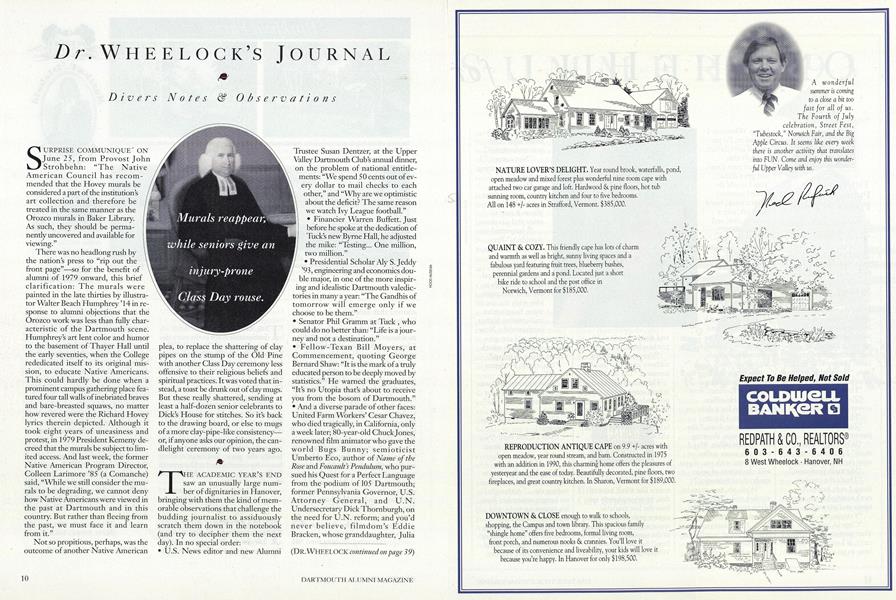
Murals reappear, while seniors give an injury-prone Class Day rouse.