The Iron Major
This coach s style would fail to pass muster in these nineties.
1895
Edward Hall, class of 1892 and the father of modern football, recruits a young football player who initially had no college ambitions. Frank Cavanaugh plays varsity as a freshman and drops out after three years.
1898
A coaching job opens at Holy Cross. Cavanaugh leaves Dartmouth to fill it. Eventually he winds up in law school.
1911
Cavanaugh becomes Dartmouth's head football coach.
1913
Harvard drops Dartmouth from its schedule, hinting that Cavanaugh's ethically questionable coaching is a reason.
1914
Dartmouth defeats Syracuse 40-0 in a Fenway Park season-ender. The Green proclaims its best fall ever: 359 points scored, 25 given up.
1916
With a year left on his contract, Cavanaugh resigns under pressure from influential alumni. The official word is that he wants to spends more time on his growing legal practice.
1917
At age 40, Cavanaugh volunteers to serve in World War I. "I've got to go," he says. "I can't stay away. In that thing over there are the boys I have coached." Sent overseas, his hard-fisted disciplinary style earns him the nickname Iron Major.
1918
Two weeks before the Armistice, a shell fractures Cavanaugh's skull and destroys half his face.
1921
Cavanaugh's Yankee division holds a reunion. The Iron Major concedes his lack of popularity with the troops: "I knew that if I got you hating me more, you'd forget to hate the conditions around you, the muck, and the slime, blood and death. I knew I'd keep your morale up that way, though it wasn't pleasant."
1924
Knute Rockne and Cavanaugh design the modern lightweight football uniform.
1926
Cavanaugh's Boston College Eagles are untied and unbeaten. Nonetheless, the coach is defeated in his bid to become secretary of state for Massachusetts.
1930
Cavanaugh publishes a book, Inside Football. "I have little use for the classroom drone," he writes. "Men who are stupid in their studies are stupid on the football field."
1933
Cavanaugh dies. A newspaper obituary notes: "It would be nice and poetic and in accordance with the very best journalistic style in reference to the dead to say they all came to love him in the end. They didn't. He looked upon football as war. Perhaps he forgot that men fight wars and boys play football."
1943
Pat O'Brien portrays Cavanaugh in the Cecil B. DeMille production of the The Iron Major.
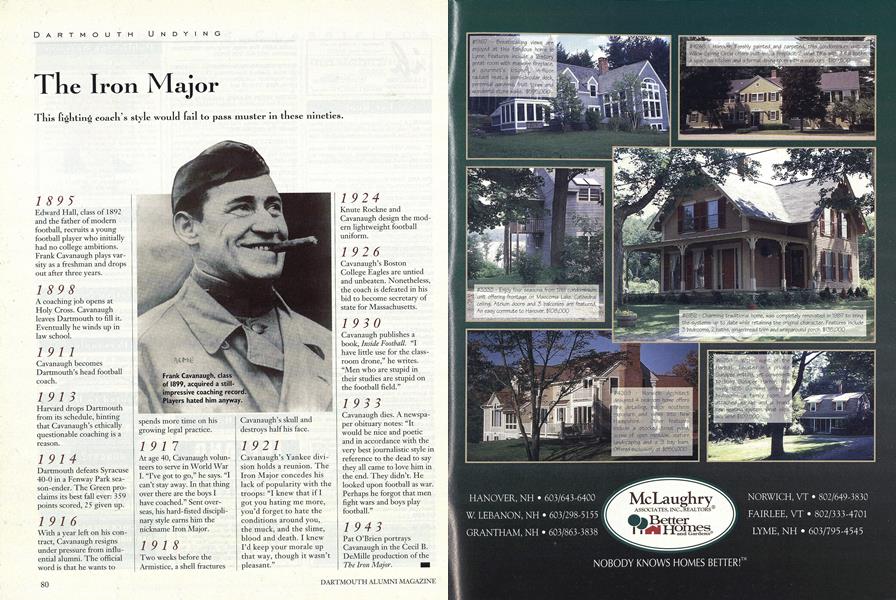
Frank Cavanaugh, classof 1899of 1899, acquired a stillimpressive coachincoaching record. Playersplayers hated him anyway.