Of 'Netniks, Faux Fevers, the Smithsonian, and More
Did you hear the one about the 2 5-year-old Dartmouth alum who passed up $4 million in his old company's stock so he could invent a new company? Probably an Internet software thingamajig, right? Right. The story broke in The New York Times Magazine in July, under the headline "Instant Company." While there were six founders, it was Naval Ravikant '95 who first had the startup idea and resigned from @Home so he could create Epinions.com. They were up and running—with $8 million in seed financingin only 12 weeks. What this new web site offers all you 'Netniks out there are consumer opinions and product reviews of just about anythmgyou might want to purchase. And every time you decide to click on "Buy," Ravikant and his cohorts get a "tiny commission," explains The Times. Pretty soon we're talking real money.
If you happened to click on a pair of pricey Reebo'ks, you would also be helping Pete Roby '79, vice president of consumer marketing for ReebokNorth America—and' former head coach of Harvard's basketball team. Roby's role with die sneaker giant was recently explained in Ebony's "Speaking of People" feature.
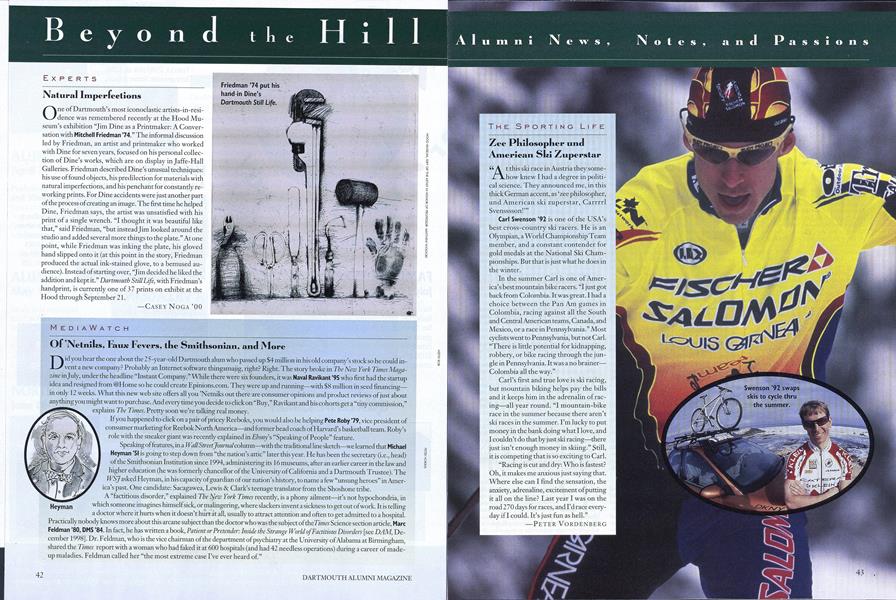
Speakingof features, in a Wall Street Journal column—with the traditional line sketch—we learned that Michael Heyman 'SI is going to step down from "the nation's attic" later this year. He has been the secretary (i.e., head) of the Smithsonian Institution since 1994, administering its 16 museums, after an earlier career in the law and higher education (he was formerly chancellor of the University of California and a Dartmouth Trustee). The WSJ asked Heyman, in his capacity of guardian of our nation's history, to name a few "unsung heroes" in America's past. One candidate: Sacagawea, Lewis & Clark's teenage translator from the Shoshone tribe. A "factitious disorder," explained The New York Times recently, is a phony ailment—it's not hypochondria, in which someone imagines himself sick, or malingering, where slackers invent a sickness to get out of work. It is telling a doctor where it hurts when it doesn't hurt at all, usually to attract attention and often to get admitted to a hospital. Practically nobody knows more about this arcane subject than the doctor who was the subject of thcTrmes Science section article, Mart Feldman 'BO, DMS 'B4. In fact, he has written a book, Patient or Pretender: Inside the Strange World of Factitious Disorders [see DAM., De- cember 1998]. Dr. Feldman, who is the vice chairman of the department of psychiatry at the University of Alabama at Birmingham, shared the Times report with a woman who had faked it at 600 hospitals (and had 42 needless operations) during a career of madeup maladies. Feldman called her "the most extreme case I've ever heard of."
Heyman