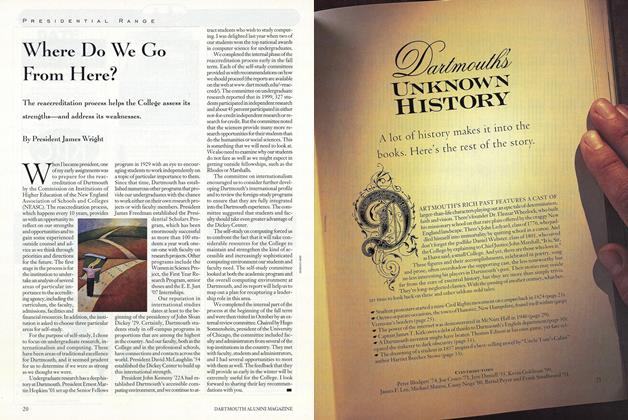
Dartmouth’s Unknown History
A lot of history makes it into the books. Here’s the rest of the story.
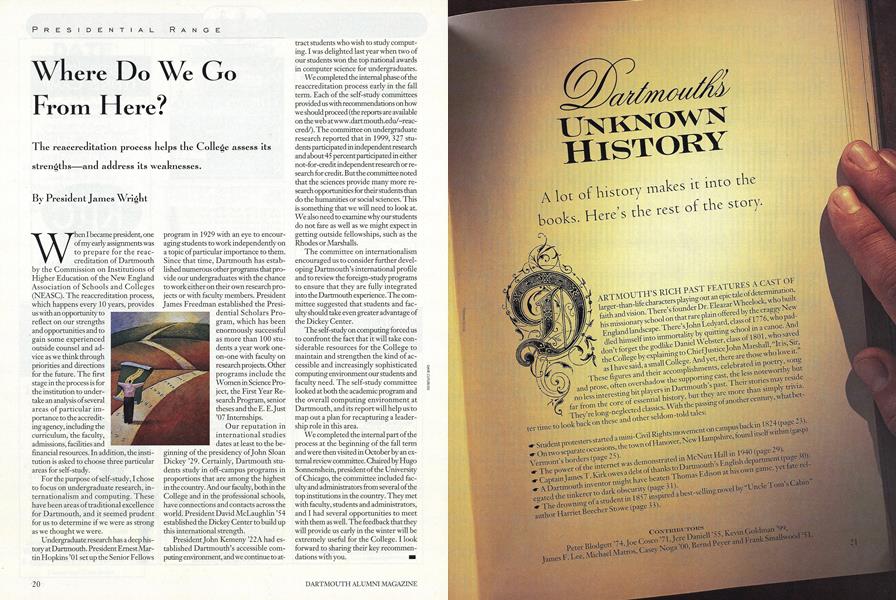
A lot of history makes it into the books. Here’s the rest of the story.
A lot of history mates it into the books. Here's the rest of the Story.
ARTMOUTH'S RICH PAST FEATURES A cAST OF larger-than-life characters Playing out an epic tale of determination, faith and vision. There's founder Dr. Eleazar Wheelock,who built his missonary school on that rare plain offered by the craggy New England landscape. There's John Ledyard, class of 1776,who padded himself into immortality by quittng school in a canoe. Aand don't forget the godlike Daniel Webster, class of 1801,who saved the college by explaiming to Chief Justice John Marshall, "It is Sir, as I have said, a small college. And Yet, there are those who love it" These figures and their accomplishments, Celevrated in poetry,song and prode, often overshadow the sipporting cast, the less noteworthy but no less interesting bit players in Dartmouth's past. Their stories may reside far from the core of essential history, but they are more than simply trivia. They're long-neglected classics. Whith the passing of another century, what better time to look back on these and other seldom-told tales:
Student Protesters started a mini-Civi Rights movement on Campus backin 1824 (page23) On two separate occasions, the town of Hanover, New Hampshire, found itsself within (gasp) Vermont's borders (page 25) The power of the internet was demonstrated in McNutt Hall in 1940 (page 29). Captain James T. Kirk Owes a debt of thanks to Dartmouth's English department (page 30) A Dartmouth inventor might have beaten thomas Edison at his own game,yet fate relegated the tinkerer to dark obscurity (page 31) The drowning of a dtudentin 1857 inspired a best-selling novel by "Uncle Tom's Cabin" author Harriet Beecher Stowe (page 33).
CONTRIBUTORS Peter Blodgett '74, Joe Cosco '71, Jere Daniell '55, Kevin Goldman '99, Jame F.Lee, Michael Matros, Cadey Noga '00, Bernd Peyer and Framk Smallwood '51.
THE POET AND THE RASCAL
Talk about unlikely pairings. One of Dartmouth's most distinguished alums held high regard for the College's most notorious alum. The illustrious alum was poet Robert Frost, class of 1896. The object of his fascination was Stephen Burroughs, class of 1786, author of "Memoirs of the Notorious Stephen Burroughs of New Hampshire." First published in 1798, Burroughs' book takes the reader through his life of crime and misdemeanors.
Bom in 1765, Burroughs was the son of Dartmouth Trustee Eden Burroughs, a rancorous Hanover Presbyterian preacher. At 14, Stephen ran off to join the Continental Army. Soon thereafter he begged for and won his release from the army. He attended Dartmouth in 1781 but fled after allegedly robbing a beehive and courting a "widow" whose husband soon reappeared. Burroughs apparently had few misgivings: "I had been a member of the seminary of Dartmouth College sufficiently long, to be filled with that sort of learning which gave me an exalted idea of my own importance, and which was of no manner of use, in my pursuits through life."
And such pursuits! Burroughs embarked on an infamous post Dartmouth career as a ship's surgeon, school teacher, escaped convict, parson, counterfeiter and general sharper. At one point he stole his father's sermons and established himself as a preacher in Pelham, Massachusetts. Eventually Burroughs' life wound its way to Canada, where he died in 1840.
Nearly a century later, his memoirs came to 'Frost's; attention. The poet so relished the tale that he volunteered to write the preface for a 1924 Dial Press edition. In it , he defended the scoundrel. "I see little in the story to count against him," Frost wrote. "If the sermons were sound and the; preacher able, it couldn't have mattered much that they were stolen and he not ordained." Frost also praises the rascal's writing and his unique brand of wickedness: "Burroughs comes in reassuringly when there is question of our not unprincipled wickedness, whether we have had enough of it for salt. The world knows we are criminal enough. We commit our share of blind and inarticulate murder, for instance. But sophisticated wickedness, the kind that knows its grounds and can twinkle, could we be expected to have produced sO fine a flower in a pioneer state? The answer is that we had it and had it early in Stephen Burroughs."
In his conclusion, Frost thanks his friend W.R. Brown fori bringing Burroughs to his attention, calling the book one that he would have been "sorry to have missed,"
A FORGOTTEN FIRST
The archives in Rauner Library contain a manila folder marked "Laura Bridgman." In that file rests a faded, typewritten letter dated 1937. It reads, "the remembrance thrills me afresh of the first deaf-blind person in the world to be taught whom I met in the first glad days of my awakening. It is well for us to rejoice together in Laura Bridgman's triumph over a cruel fate, but in a true sense her anniversary cannot be celebrated until hundreds of beseeching, broken lives of which hers was one are healed with renewing love and the power of the mind." The letter is signed by famed deaf and blind author Helen Keller. But who was Bridgman?
A century ago she was a household name. Her story became a classic in psychological literature and captured the attention of intelligentsia on two continents. "Her face was radiant with intelligence and pleasure. Her hair, braided by her own hands, was bound about her head, whose intellectual capacity and development were beautifully expressed," wrote Charles Dickens. William James mention her in his "Principles Of Psychology," and Andre Gide fictionalized her life in his "La Symphonie." Sophia Peabody, wife of Nathaniel Hawthorne, sculpted a bust of her, and Samuel Longfellow and Horace Mann both called on her. Bridgman was the subject of two fall-length biographies and merited a chapter in an 1885 biographical anthology entitled "Daughters of Genius." But that all came later.
Bridgman's story began on a farm in Hanover, where she born in 1829. Scarlet fever at age 2 left her deaf, blind and without a sense of smell or taste;. By age 7, Bridgman was capable of helping with household tasks such as setting the table, knitting ami slewing. But she could not communicate, except for a 'few rudimentary-hand gestures.
Bridgman never would have been educated and become a celebrity had she not lived in close proximity to Dartmouth. Dr. Reuben class of 1803, and head of the .Medical School, published an account of the Bridgman casein 1837. The article caught the attention of Dr. Samuel Howe, founder of the newly opened Perkins School for the Blind: in Boston. Massachusetts.
"It struck me at once that here was an opportunity of assisting an unfortunate child. arid moreover, of deciding the question so often asked, whether a blind-mute could be taught an arbitrary language;": Howe later wrote.
Howe knew that the best scientists and educators in England had firmly stated that people without sight and hearing could never be taught to communicate. If Howe could succeed with Bridgman, his method and his school would become world-famous.
Bridgman moved to the school. After much hard work, the communication barrier was broken in 1837. A century later an anniversary celebration was held in Hanover. Keller, unable to attend, sent her regards in the form of a letter.
THEY HAD A DREAM
In 1828 Edward Mitchell became the first black to graduate from Dartmouth—but he was admitted only after students petitioned on his behalf.
A servant of President Francis Brown, the 30-year-old Martinique native passed Dartmouth's examination for entrance to the freshman class in 1824. But the Trustees denied him admission; historians speculate it was because the Trustees worried about offending parents or students. Students, in fact, were upset with what they viewed as a racist decision. They held class meetings, appointed a committee to intercede on Mitchell's behalf and drew up a petition stating their admiration for Mitchell and calling for his return to the College.
The Trustees reconsidered and admitted Mitchell. "This was a precedent-setting development," says sociology professor Raymond Hall, who is writing a history of the College. "While 21 blacks entered the College during the remainder of the 19th century, this small number was much higher than elsewhere,: Mitchell managed to climb over the gate at Dartmouth instead of opening it."
The same year .Mitchell graduated, the Rev. Nathan Lord succeeded Bennett Tyler as the College's sixth president. An ardent abolitionist, he soon reversed his stand and,became one of the North's most prominent pro-slavery ministers. "Despite this, Lord did not allow his sentiments to interfere with his support of black students at Dartmouth." says Hall.
Mitchell went on to become a Baptist preacher in Vermont and Canada. He died in Quebec in 1872.
WITNESS AT WOUNDED KNEE
I counted 80 bodies of men who had been in the council and who were almost as helpless as the women and babes when the deadly fire began, for nearly all their guns had been taken from them," wrote Charles Eastman, class of 1887, of the 1890 massacre of Native Americans at : Wounded Knee. The scene would have been hard enough for Eastman in his capacity as physician at the Pine Ridge reservation in South Dakota. The massacre took an even greater toll oh Eastman as a man who lived his childhood as a Native American. "All this was a severe ordeal," Eastman wrote, "for one who had so lately put all his faith in the Christian love and "lofty ideals of the white man."
The spiritual and physical journey that took Eastman from Hanover to Wounded Knee was no less remarkable than that whit brought him to Dartmouth. Eastman tells the tale in his autobiography "From the Deep Wood to Civilizations Eastman's father Many lightenings; had left his son, then known as Oyihesa, wish relatives when he went off to fight the white man in Minnesota in 1862. When Many Lightenings failed to return, he was presumed dead. His family fled to Canada, : raised Ohiyesa in Sioux tribal ways", and taught him "never to spare a citizen of the United States."
Then, in 1873, Many Lightenning reappeared. He was a changed man. Saved from the gallows by Abraham Lincoln after the Minnesota incident, he had spent three years in a federal jail, changed his name to Jacob Eastman, converted to Christianity and established a homestead in South Dakota. Now he wanted his son.
The reunion left the youngster with mixed emotions. His elation at seeing his father was tempered by the realization that the man had become like the people he had been taught to hate. Ohiyesa returned to the United States with his father. "Without expression he submitted to being dressed in white man's clothing and taken away from life in the forest by a father transformed beyond recognition," noted Eastman biographer Frances Kartunnen. Ohiyesa was baptized Charles Alexander Eastman and enrolled in school—a major change for a teenager who didn't speak English, but the first step toward Dartmouth and Boston University Medical School.
Later, when Eastman and his wife published accounts of the massacre at Wounded Knee, government bureaucrats tagged them as troublemakers and forced them from Pine Ridge. Eastman went on to work on Native American issues for the government, introduce Native American lore to the Boy Scouts and Camp Fire Girls, start his own summer camp, and write and lecture. Accounts of his achievements during those years fill volumes, all with the theme of a life caught between two cultures.
"The ultimate dichotomy in Charles Eastman's thought was not between good Indian society and the bad white society, but between the good natural world and the perverse human world," wrote Kartunnen. After his death in 1934, Eastman was largely forgotten by the general public, but not at Dartmouth. His legacy includes grandson Ernst J. Mensel '50 and great-grandson Ernst J. Mensel Jr. '73.
WELCOME TOHANOVER, VERMONT
Wartime makes for strange bedfellows. During the American Revolution, Hanover and 15 other New Hampshire towns voted to secede from the state, in part because residents regarded the government in Exeter, 100 arduous miles away, as too remote. Vermont agreed to annex the New Hampshire towns. As of june 11, 1778, Dartmouth's official address was Dresden, Vermont.
Four months later, objections from western Vermonters tore the alliance apart. Hanover and the other towns, once again a part of New Hampshire, considered founding their own state. In 1781 the western Vermonters changed their tune, and Dartmouth once again became part of Vermont. With the end of the Revolution a few months later came the end of Dartmouth's identity crisis, and the College's address was fixed once and for all in Hanover, New Hampshire.
Two remnants of those early ties to Vermont still exist. Hanover and Norwich form the Dresden School District, the first interstate school compact in the country. And Dartmouth maintains a special tie to Wheelock, Vermont, which the Green Mountain state granted to the Big Green in 1785, despite Dartmouth's New Hampshire location. For years rents from the town provided substantial revenue for the College. As a measure of thanks, Dartmouth's sixth president, Nathan Lord, decided in 1828 that students from Wheelock could attend Dartmouth tuition-free. Over the years the College sold its holdings in Wheelock, but any of the town's residents accepted at Dartmouth can still attend the College tuition-free. The most recent of seven students to take advantage of the historical oddity was Maura Nolan '88.
SUMMER BREAKSOLDIERS
When PresidentAbraham Lincolncalled for 40,000 men to join the Union Army for the summer in 1862, Sanford S. Burr, class of 1863, stirred fellow students to form a cavalry division of the Rhode Island volunteers. At first it seemed that the whole College would join up, though Dartmouth President Nathan Lord and the faculty advised students to keep to their books' rather than ride off to war. In the end, 35 determined students were mustered into the U.S. Army July 3 with Burr as their captain.
Deployed to Winchester, Virginia, to patrol the Blue Ridge Mountains, the cavalry carried out seven I relatively uneventful reconnaissance missions, then received orders to head for Harpers Ferry, West Virginia. Cut off from the North, the student soldiers watched General Robert E. Lee's Confederate Army cross into Maryland, then were ordered to retreat. "By the next morning," their major told them, they would "either be in Pennsylvania, or in hell, or on their way to Richmond!"
The Dartmouth cavalry made it to Greencastle, Pennsylvania, just in time to join General George McClellan's army. The students fought in the battle at Antietam, even though their three months' service was up. Only one man was lost, a 19-year-old victim of typhoid fever. Several were captured by rebels and incarcerated in Libby Prison in Richmond, Virginia. When the remaining students returned to Hanover in October, they were welcomed royally.
Even as students, however, they weren't finished receiving orders. The faculty insisted that the soldiers pass examinations on the studies they had missed while they were at war. Refusing, the cavalry threatened to ride off again. The professors withdrew the requirement when they learned that Brown University would be happy to accept the student soldiers. the army in the last days of World War I swelled the numbers to 89 for the course they nicknamed "Bolshevik One."
"As the first woman teacher in a man's college I felt I must be sure to assert my authority, and perhaps I was a bit severe. At least I set a high standard!" Hapgood wrote in her journal. She found that not all students had a gift for die language. "There was one of them who used to go down on his knees to me at the end of the class and beg to be 'let Out of here.
Hapgood's stay on campus was short-lived. A year after she arrived, the professor left Dartmouth to travel with her husband, Norman Hapgood, who had beep named special envoy to Denmark by President Woodrow Wilson.
Oddly Dartmouth's loss was the acting orld's eventual gain. Back in the United States in 1924, the Hapgoodsmet famous Russian director Konstantin Stanislavskii and talked him into writing a book about his acting system. Elizabeth became his encourager translator, editor and friend. Stanislvskill's influential 1936; book. "An Actor Prepares." would not have been published without her help.
FIRST PROFESSORTo WEAR A DRESS:
Dartmouth's first female professor, accomplished linguist and Russian language expert Elizabeth Reynolds Hapgood, brought something to the classroom that her male predecessors never had: beauty as well as brains. A mere 24 years old, she had lived in Russia for several years, published articles and established a program in Russian language and culture at Columbia University. In 1918, Dartmouth President Ernest Martin Hopkins '01 recruited her to initiate a Russian program at the College. She expected a dozen students at most. Whether lured by her subject or the novelty of having a woman prof, 28 students showed up the first day. An influx of studen bound for
WATER WATER EVERYWHERE (AND NO ONE HERE TO DRINK)
Twelve thousand years ago, it was safe to call the Upper Valley the land of the lakes. As the final Ice Age glaciers melted away, they left in their wake not one, but two giant lakes that immersed a long swath of New England, including the Hanover area. Geologists calculate that Baker Library's clock face would have barely cleared the surface, an estimated 660 feet above sea level.
Dartmouth geologists figured prominently in proving the existence of these lakes, known as Hitchcock and Upham. Professor Charles Hitchcock introduced Louis Agassiz's glacial theory to the United States in 1868 and later organized die first geological survey of New Hampshire. Hitchcock's protege Warren Upham, class of 1871, became an expert in American glaciology. He discovered, among other tilings, the Hanover-area esker (Oceom Ridge is part of it) that formed the hilly northern shoreline of one of the lakes. One lake was named after him; the name of the other honors Hitchcock's father, Edward, an Amherst professor who had proposed in 1818 that clays along the Connecticut River indicated the prior presence of a lake.
FORBIDDEN "FRUIT!OF PHILOSOPHY"
Today Dartmouth students can talk openly about sex while sitting on the Collis porch, walking across the Green or even on line to see a movie at the Nugget theater.
Society wasn't quite as permissive in 1832, when Charles Knowlton,an 1824 graduate of Dartmouth Medical Scholl, authored "Fruits of Philosophy: The Private Companion of Mar ried People, by a Physician," the first English-language medical guide to contraception written expressly for ordinary people.
The volume's straightforward language and low price—50 cents—made it readily accessible to the public Knowlton wanted! to reach, particularly the working poof who could least afford unwanted pregnancies. Some of Knowlton's advice has stood the test of time. He warned, for example, against relying on coitus interruptus. On the other hand, as far as we know his tips for getting pregnant—including dressing in flannel and ingesting steel filings that have been soaked in wine or cider don't work.
Not surprisingly for the times, Knowlton, who practiced: medicine in Massachusetts, came up against obscenity charges. After a lawyer complained that "Fruits of Philosophy" stripped prostitution of its "inconveniences and dangers," Knowlton was prosecuted and fined $5O. Later he was sentenced to three months hard labor for distributing the book. A third prosecution was dropped when the jury failed to reach a verdict. :
Controversy over the book spread across the Atlantic, The first British edition appeared in 1833 and found a wide audience for 40 years. However, when a publisher re-issued the book in 1877, he was prosecuted on obscenity charges. Outraged, British birth control advocates Charles Bradlaugh and Annie Besant formed the Free Thought Publishing Co. and reprinted the book. They deliberately informed the police when and where they would be selling it and were promptly arrested. A series of sensational, widely publicized obscenity trials followed, eventually resulting in two inevitabilities: a verdict of not guilty and a big boom in book sales.
TRLALOF THE (LAST) CENTURY
It's no surprise to learn that lawyer, senator and orator Daniel Webster, class of 1801, turned the course of the most famous murder trial of 1830. What isn't well known is that the case marked the first and only time Webster served as a prosecutor in a criminal case.
On the morning of April 7,1830, the body of Joseph White was found by his housekeeper in Salem, Massachusetts. White, a wealthy,"82-Year-old merchant, had been bludgeoned and stabbed to death in his bed. Police arrested four young men two pairs of brothers from two prominent local families—and charged them with the murder. The motive? A brutal scheme to circumvent White's revised will, which greatly reduced the inheritance of his niece, the mother-in-law of one of the accused.
The ensuing trial created an immediate sensation. Reporters and crowds thronged the courthouse. Headlines trumpeted sensational news of the proceedings, leading the presiding judge to declare the media circus a threat to justice. Then the main defendant committed suicide in prison. Ten days later, the judge suffered a stroke and died.
Enter Webster. "It seems he joined the prosecution in part because of personal relationships," says Dartmouth history professor .Kenneth Shew maker. Webster's close friend, associate justice of the Supreme Court Joseph Story, was the brother-in-law of Stephen White, heir and nephew of the murder victim. Although Senator Webster lacked experience as a capital trial lawyer, the prosecution reasoned that his formidable rhetorical skills might run circles around the defense. At first, the strategy failed and the trial (for only one of the remaining defendants) ended in a hung jury. But a new jury was quickly called, and Webster pulled out all his oratorical stops.
According to contemporary accounts, Webster held the courtroom spellbound with his vivid recreation of die crime scene. "The object was money, the crime murder, the price blood," he told the jury. "It is said that laws are made, not for punishment of die guilt}-, but for the protection of the innocent.' This is not quite accurate, perhaps, but if so, we hope they will be so administered as to give that protection. But who are the innocent, whom the law would protect? Gentlemen, Joseph White was innocent."
Arguing that the law must punish the guilty, he stunned the assembly with his portrait of the nonchalance with which the conspirators carried out the murder. "This bloody drama exhibited no suddenly excited, ungovernable rage," Webster said. "The actors in it were not surprised by any lion-like temptation springing upon their virtue, and overcoming it, before resistance could begin. Nor did they do the deed to glut savage vengeance, or satiate long-settled and deadly hate. It was a cool, calculating, money-making murder."
Webster won the case. The accused, Frank Knapp, was hanged.
Webster maintained his strategy in the next trial, and Joseph Knapp, originator of the plot, followed his brother to the gallows. Defense attorney Franklin Dexter attributed the convictions entirely to Webster's skills. (Webster didn't prosecute the third defendant, who was acquitted in part due to an alibi supported by testimony from prostitutes.)
The sensational White murder trial widened Webster's fame as a spellbinding orator. His summation in the first conviction has been called the greatest ever delivered to an American jury. Clearly, the case showed "Webster's ability to move people with words," according to Shewmaker.
HE WROTE THE BOOK ox PUBLIC SPEAKING
He was the oratorical expert of his day and a Dartmouth alum. He wrote his century's best-selling guide to public speaking, "The Columbian Orator." Among his most devoted readers were abolitionist Frederick Douglass and President Abraham Lincoln. His name? Not Daniel Webster. It was Caleb Bingham, class of 1782.
DARTMOUTH: BIRTHPLACEOF THE INTERNET?
Long before Al Gore was ever born, George Stibitz demonstrated the fundamental concept behind the internet in Dartmouth's own McNutt Hall.Stibitz, who joined the Dartmouth Medical School faculty in 1964, began his career as a research mathematician with Bell Telephone Laboratories in 1930. A lifelong tinkerer, he created an electronic, binary adding machine out of two telephone relays, some metal strips cut from a tobacco can, dry-cell batteries and a few flashlight bulbs. His wife—noting that he created the contraption on their kitchen table—dubbed the primitive computer the Model-K. The year was 1937.
Little did Stibitz realize that his hobby would lead to greater things. When he showed fellow engineers his invention, everyone enjoyed a good laugh. "We were all more amused than impressed with our visions of a binary computer industry." he later recalled. "Nor did it occur to me that my work would turn ..Out to be a beginning step into what we now call the Computer Age,"
The next year Stibitz's binary adding machine evolyed into the Model 1 Complex Number Calculator, the. world's, first digital computer. In 1940, Stibitz's research brought him to McNutt for a conference of the American Mathematical Society. He delivered a paper on his device to a group of incredulous mathematicians, highlighting a remote-access capability he'd recently devised. Putting his lofty claims to the test, he had audience members key in problems on a Teletype, which carried the input via long-distance telephone line to the calculator, 250 miles away in New York City. Within seconds, the Model 1 returned the correct answers, marking the first remote operation of a digital com puter. "The experiment was really the beginning of the marriage between telecommunications and computing, long before the internet," says Dartmouth engineering professor George Cybenko. Today, a plaque in McNutt commemorates Stibitz's feat.
BEAM US UP, HERB
At first, a Dartmouth connection to "Star Trek" seems about as plausible as the existence of Tribbles and Vulcans. But the truth is, in its own way, out there Vucans.Dartmouth's Herb Solow '53 , Captain Kirk and crew would have boldly gone nowhere.
In Solow's 1997 book, "Inside Star Trek: The Real Story," the former vice president at Desilu (Lucille Ball's studio) tells of his role in the series, Gene Roddenberry, whose pitch already had teen rejected by MGM, turned to Solow in 1964. His first inpression of Roddenberry was "that this unkempt person recently learned how to dregs himself but Hain't yet quite gotten the knack," he wrote. Apparenty. it was just the style Solow was looking for. "I've seen the way you dress, and I figure you must be able to write," Solow told Roddenberry. Solow was smitten with the idea even before reading Roddenberry's presentation.
Solow, a literature major, also takes credit for giving "Star Trek" a literary- dimension. "Having studied Jonathan Swift and 'Gulliver's'Travels' at college, 1 accepted what Swift wrote because he treated it as something that already had happened," he wrote. "My recommendation to Roddenberry: 'The voyages of the Enterprise have already taken place; all Star Trek adventures are already history.'" Captain Kirk's stardate log had just been created, and the series was off and running.
However, not ail of Solow's modest proposals flew. At one point he went so far as to suggest that show be called "Gulliver's Travels." He also: suggested that the captain of the Enterprise be named Gulliver. As Spock would say, "Most illogical."
HE SAW THE LIGHT BUT DIDN'T HAVE THE POWER
Considering the speed with which the internet has created billionaires, it is hard to conceive of an electrical engineer getting too far ahead of the power curve. But that's literally what happened to Moses Farmer, class of 1841. In 1847, three decades before Thomas Edison electrified the world, Farmer lit his house with his own brand of electric lights. The achievement should have rocketed Farmer's name to the top of the list of notable inventors, but there was no simple way to generate electricity at the time. Farmer had to use primitive batteries to light his Dover, New Hampshire, home. But he knew he was on to something big, and with Yankee practicality, he went about his work. Two decades later, he emerged from the lab with a re liable generator and apparatus to control the flow of current. Important inventions, yes, but not on the scale of Edison. (The wizard of Menlo Park brought forth the first commercially viable light bulb in 1879 and developed the world's first central electric light power station in 1882.)
"If the generating, regulating and distributing apparatus of Moses G. Farmer and the vacuum carbon lamp of Henry Goebel had chanced to have been brought together, it is quite possible that we might have lighted our houses by incandescent lamps 20 years earlier than we did," noted the July 1893 issue of Engineering Magazine.
Farmer's diligence and vision led to other firsts. He built the nation's first electric fire-alarm system in Boston, in the process giving birth to a brand-new field: electrical engineering. He also invented what he called an automatic printing telegraph, a predecessor to Wall Street's ticker-tape machine, and he built the first electric locomotive. The locomotive was Lilliputian in size and towed a passenger car that seated four, but it led directly to the development of the streetcar.
Though nearly forgotten today, Farmer received an honorary degree from Dartmouth in 1853.
HE SPANKED THE NAUGHTYFRESHMEN WELL
The story will sound familiar to Dartmouth alumni: Eager to train young missionaries, a preacher persuades an English lord to underwrite his college in the American wilderness. The college takes the lord's name, then evolves into one of the nation's finest liberal arts institutions.
Dartmouth's influence can be seen throughout the career of Kenyon College founder Episcopal Bishop Philander Chase, class of 1796. Like his mentor,Eleazar Wheelock, Chase was a hardy,multi-talented visionary. Just as Wheelock selected Hanover for his school because it was off the beaten track, Chase bought 8.000 acres in Ohio for the same reason. John Piatt, Chase's biographer, wrote that Chase wanted his school to be "be yond the immediate influence of cities, on wide lands of its own, through which it could have a power by right of the soil, and exercise as trong local influence and government."
By that measure, Chase was a complete success . Not only was he the college founder and president, he acted as. postmaster, building contractor, superintendent of the; waterworks and real estate agent for new settlers. He was also adept at wooing the British royalty, no doubt quite a feat after the American Revolution. Chase garnered an endowment from Lord Kenyon, named the college for him, then named his new town Gambier after another royal benefactor, Liord Gambier.
What Chase died not do was manage people. In Gambier, He knew his children and: Students would be far from the corrupting influences of city life—and solidly under his own imperious authority. the Old Testament (and some say to both Eleazar and John Wheel ock) for management inspiration, Chase referred to his own bearing as "patriarchal." The attitude left no room for academic freedom. "There was nothing he deprecated more than discussion," an associate wrote. "No greater offense could be offered him than thinking him in error."
Not surprisingly, six years after he founded kern on College, Chase no longer spoke to the faculty. Instead, says biographer Piatt, the bishop made "college law a matter of his own personal discretion. He was arbitrary, impetuous, fierce and unjust at times."
When the Episcopal Convention tried to limit his power, Chase cited the Dartmouth College Case of 1818, in which the will of the original donors prevailed over the New Hampshire legislature.Kenyon's donors, he asserted, had endorsed his supreme authority, and he too should prevail. He didn't.
Chase resigned his post and promptly moved his family to Michigan. A few years later, his confidence restored after he was named bishop of Illinois, Chase again headed for the frontier to found a school with a mission. His Jubilee College survived long enough to become his final resting place.
An obituary in the Peoria Republican did its best to wish him well: "It is not wonderful that a man of his temperament should have had enemies, but we trust that now as the grave has closed over his mortal remains his good deeds will be remembered, and his foibles be forgotten."
An old Kenyon College song pays a more memorable tribute: He built the college, built the dam,He milked the cow, he smoked the ham.He taught the classes, rang the bell,And spanked the naughty freshmen well.
To THIS DAY, A CONNECTICUT TOWN LAYS CLAIM TO DARTMOUTH
"Town of Columbia: Birthplace of Dartmouth College," declares the website of the quiet Connecti cut town where the original Moor's Charity School still stands. The claim is a stretch, for sure. The town seal—a woodcut of the schoolhouse beneath a tree—is more accurate. It reads: "Columbia Lake Moor's Indian School." In 1755 Eleazar Wheelock established the school—named for Colonel Joshua More, who donated the land and schoolhouse next to Wheelock's mansion and ministry in Lebanon, Connecticut—to provide Native American children with a Christian education.
In 1768, Wheelock contemplated a collegiate branch of the school to provide for a complete course of education and to curtail expenses (he had been sending older boys to Princton and Yale). But he was also growing disenchanted with Moor's as the number of Native American students enrolled there dropped from some 20 to three. By the time he obtained a charter from King George 111 in 1769 to establish Dartmouth College, he had set his sights on educating "Youth of the Indian Tribes...English Youth, and any others." The next year Wheelock moved to the Hanover wilderness to build his College.
Wheelock also brought Moor's few remaining pupils to Hanover and built a new school for them. The building they left behind in Columbia gained a new educational life. It served as a one-room schoolhouse for the local school system until the 19405. It now houses artifacts for Columbia's historical society.
A COURAGE BORN OF DESPAIR
The injustices of slavery pained Harriet Beecher Stowe enough to prompt her to pen her most famous novel, "Uncle Tom's Cabin," published in 1852. Little did she know that the pain of personal tragedy would soon prompt her to write what some critics hailed as her greatest masterpiece.
In July of 1857,Stowe received a telegram from Dartmouth College, tier oldest and dearest son, Henry, had drowned while swimming across the Connecticut River. In those days, before the river was dammed downstream at Wilder, Vermont, the current above the boathouse was strong, unpredictable and. in this case, deadly.
Stowe was inconsolable Her grief was exacerbated by a Calvinist fear that Henry had died before attaining the state of grace that would assure him of salvation in heaven. Her faith challenged as before,Stowe turned to spiritualism in a desperate attempt to contact Henry But she didn't stop writing. In ''The Minister's Wooing," a novel centered on the consequences of a youthful hero being lost at sea, Stowe-in the guise of her characters—poured ? out her grief in a way that greatly contrasted with the emotionstifling stoicism expected of Calvinists.
Not surprisingly, Calvinist ministers criticized the book, But Stowe, driven in a spiritual courage born of despair, became a source of solace to other women suffering from personal losses. "The things "I said to you," she wrote to one such woman in 1860, " I said hoping perhaps they might have at least some influence in relieving your good heart of a burden which our dear Father never meant us to carry—the awful burden of thinking that every person who does not believe certain things and is not regenerated in a certain way in this life is lost forever."
The book inspired by Henry's drowning had a profound effect on American religion, according to Stowe historian Forrest Wilson. "It was almost as revolutionary in the religious life of the nation as was 'Uncle Tom's Cabin' in its political life," he wrote in 1941. "It marked the beginning of a more liberal and emotional type of religious observance."
WEBSTER'S ROOTSARE REALLY I. KANSAS
Nathan J Morrison, class of 1853, found fame by be coming the first president of Fairmount College (now Wichita State University). There he took on another, more unusual role: prairie tree farmer.
Arriving in Kansas in 1895, Morrison found himself in the middle of a 20-acre prairie campus devoid of trees. Having grown up near the farm of his boyhood hero, Daniel Webster! class of 1801, Morrison had the idea to ship elm trees from the Webster farm, to his Kansas edition of a New England liberal arts college. A few years later he ordered more trees sent his way. This time it was a batch of evergreens. The Men of Webster, die first literary club on the fairmount campus, planted the second group of trees in the form of a seven-pointed star, representing the seven letters in Webster's name, and they buried bottles containing their names beneath each tree.
It is not known if all the trees still stand, but historians agree that three old pines on the campus today may indeed be from Webster's farm. As for the Men of Webster, the organization continues today as the Delta Upsilon fraternity.
SONS OF WENTWORTH GIVE A ROUSE
Dartmouth easily could have been named Went worth College. Or Savage College, or Thornton College. Eleazar Wheelock certainly had options. Originally, he wanted to show his appreciation to New Hampshire Gov. John Wentworth by naming the school Wentworth. After all, it was Wentworth who granted the land to Wheelock. Declining, the governor suggested that the honor go to Lord Dartmouth, who helped persuade George III to grant Wheelock's request for a royal charter for the school.
If Wheelock had decided to honor the school's most generous individual donor, Dartmouth would now be known as King George College (he gave £200). Failing that, the choice could have gone three ways:Hollis College (after Isaac Hoilis). Savage College (after Samuel Savage, a Trustee) or Thornton College (after John Thornton, a Trustee and treasurer). Each of them gave £100.
Alternatively, if Wheelockhad named the College for the man most responsible for raising £11,000 for schooling Native Americans—the most money for American education anyone had snared from England and Scotland in pre-Revolutionary times—DartMouth would have been called Occom College, after Samson Occom.
HOPES FOR ACLASS OF AVIATORS
Time was when the "Green Book" wasn't just a freshman face book. The class of 1932's version got off the ground with Amelia Earhart as its inspirational. sponsor. The book ran her autographed, photo and uplifting comments: "Some of us who are aging rapidly are wont to think that the Possession of youth is all that is necessary to accomplish anything. Of course this isn't true entirely—something more is needed really. There must be dreams and the realization of work to do before energy can be effective.
"And so I hope the Class of 1932 will be skillful enough tobag a dream or wo; and that four years from now they won't be too old still to believe in them.
"My addiction to aeronautics makes me believe that it offers great opportunities to college men. The physical requirements for flying should be found in greater proportion among them than in any other group, They have in most places the advantages of scientific training for it.
My wish is that 1932 will be an aeronautic class and that they may do some of their dreaming really in the clouds."
Five years after the '32s graduated,Earhart accomplished her dream of flying around the world. Her plane, but not her spirit,went down in 1937.
Robert Frost waxed poetic over a phony preacher who was Dartmouth's most notorious con man.
Thanks to a Dartmouth doctor, Laura Bridgman was the first deaf and blind person to learn a language.
Charles Eastman lived the white man's life but refused to abandon his Native American heritage.
In Revolutionary times, Vermont and New Hampshire played tug-of-war over Hanover.
Back in 1862, a student trip to the South was no vacation.
Elizabeth Reynolds Hapgood (shown here in Russian attire) introduced students to Russian as their first woman prof.
Even in prehistorictimes, Dartmouth wasnot a dry campus.
An alum's early sex guide made for yarresting reading.
In the only case he prosecuted, Daniel Webster sent two men to the gallows.
When it came to public speaking, greats like Frederick Douglass and Abraham Lincoln turned to Caleb, not Daniel, for inspiration.
George Stibitz paved the way to the information superhighway.
A sartorially astute alum launched Kirk and crew on their literary enterprise.
Moses Farmer beat ThomasEdison at his own game.
Perusing his Ohio land purchase, Wheelock wanna-be and Kenyon College founder Philander Chase proclaimed, "This will do."
The original Moor's Charity School still stands in Columbia, Connecticut
After her son Henry (inset) drowned at Dartmouth, novelist Harriet Beecher Stowe poured her grief into one of her greatest books.
Trees from Daniel Webster's farm cultivated a New England look at Wichita State.
Wheelock had several choices in naming the College.
Amelia Earhart urged the class of 1932 to "bag a dream or two."
PLEASE HOLD YOUR APPLAUSE UNTIL THE END OF THE CEREMONY ■| evi Frisbie was the primordial Dartmouth graduate, the first of the four learned young men to receive a diploma j from the hands ot Eleazar Wheelock at the College's first commencement in 1771 (assuming that graduation A m ceremonies have ah* n s recognized honorees in ilnhaheticil order") Here's- m hit became of him -inrl his claw GRADUATE OCCUPATION CLAIM TO FAME Levi Frisbee Pastor Wrote a 180-line poem as a eulogy on the demise of Moor's Charity School. Samuel Gray Court clerk While attending the 1827 Commencement, he pointed out the touchstones from his era, including the College barbecue. Sylvanus Ripley Professor of theology at Dartmouth Married Eleazar Wheelock's daughter. John Wheelock Dartmouth's second president Removed from office by the Trustees in 1815 and started Dartmouth University in retaliation.
In 1867,the Rev. George T. Chapman, class of 1804, wrote "Sketches of the Alumni of Dartmouth College from the First Graduation in 1771 to the Present Time." In it he recorded the usual—career highs and personal woes—and the unusual. One entry involves Alphonso Converse Stuart, class of 1809. "He fell in a duel at Belleville, III. Feb. 8,1819," Chapman recorded. "It was said that Stuart and the seconds had agreed not to use bullets, and that his antagonist, Timothy Bennett, knowing or suspecting this, put a ball into his pistol with the fatal result. On this charge, he was arrested, indicted for murder, tried, found guilty, sentenced to be hung, and executed in the presence of thousands."
Class Note PART II Silas Dinsmore, class of 1791, a goverment to the Cherokee and Choctaw Indians, learned the hard way that the government doesn't have a sense of humor. "It was to 1 him, a man of great energy and integrity," wrote Chapman, "that a Cabinet Secretary wrote inquiring, How far does the Tombigbee run up into the country?' Dinsmore replied, 'The river ran down and not up at all.' This sarcasm from a Federalist cost him his office."
PART III Of John Cox Morris, class of 1798, Chapman writes, "His fortune was very large and his whole life honourable and humane." Unfortunately, Morris' student days weren't so tranquil. "It was in his room that Dartmouth Hall took fire March 4,1798, during divine service on Sunday, and was happily extinguished with difficulty. This wooden building was erected in 1786, and has wonderfully escaped destruction by fire although occupied by so many pupils."
PART IV The youngest graduate of the College was William Willard Moore, class of 1804. He picked up his degree at the tender age of 12 years, 8 months, and 10 days. "His precocity," wrote Chapman, "was indeed very remarkable, his scholarship bright, and such was his affectionate, genial disposition that he was the pet of the class and college."
PART V Joseph Steward, class of 1780: "It was by him that Pres. Eleazar Wheelock's likeness was painted, taken from memory some years after the good man's death, and the features are said to be well executed. It is now in the College Library, as is also his portrait of the Hon. John Phillips, a college trustee and benefactor." Chapman writes. "Being among his earliest efforts, he used to call them facetiously, his 'evil deeds.'" Wheelock's portrait now hangs in the Hood Museum of Art.