ONE SOLDIER'S STORY
CLASSICS MAJOR NATHANIEL FICK '99 LEARNED AS A MARINE THAT NOT MUCH HAS CHANGED SINCE THE PELOPONNESIAN WAR.
THE KEY TO SUCCESS AS AN OFFICER IN THE U.S. MARINE Corps is this: Be bold.
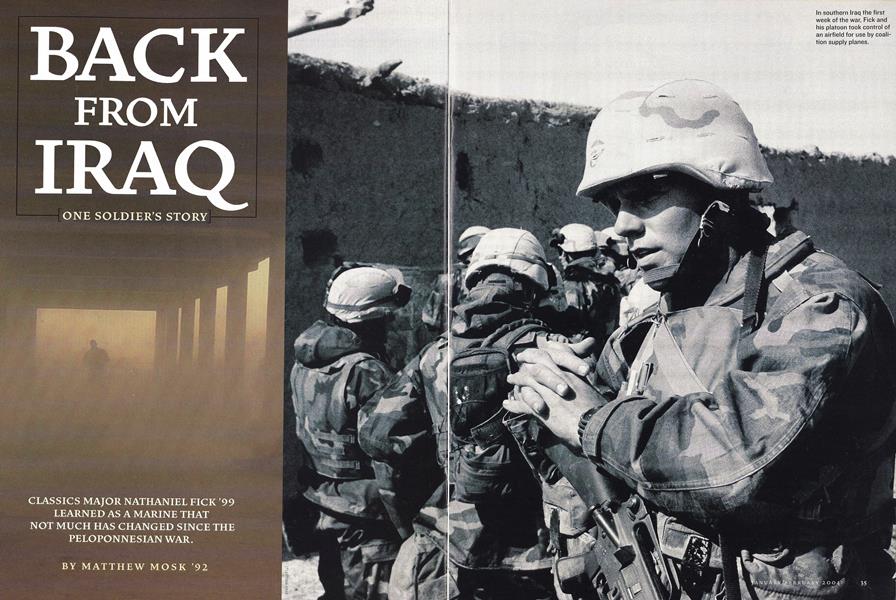
Nathaniel Fick was repeating this mantra to himself as he leaned over a map spread out across the hood of a Humvee, on a dusty road, 100 miles southeast of Baghdad. Be bold. Be bold. A few feet away, the 22 men in his platoon were taking catnaps in shifts against the hubs of their vehicles after 10 straight days on the move. As members of the 1st Reconnaissance Battalion, these guys were what Fick liked to call "the tippity tip of the spear," some of the first American troops to put their boots on Iraqi soil last spring.
Fick listened coolly as his colonel mapped out how the platoon would approach a bridge at the edge of Al Muwaffaqiyah, a small but strategically important town on the march north. They would quietly move their five Humvees across the narrow span in the dead of a moonless night. Then, they would use heavy machine guns to clear out the enemy and secure the bridge for the long columns of Marines that would need to pass over it the following day.
But there were problems with this plan, and Fick knew it. No recon party had been sent ahead to silently scope out who might be waiting for them. The bridge was a natural choke point—and a prime place for an ambush. Anyone wanting to enter Al Muwaffaqiyah would have to cross it. And if there were any Iraqis with dreams of defending the town, they would be planted at the base of this bridge.
Fick swallowed hard as he walked back to his platoon and tried to figure how best to lay out the plan. Though he had a strong rapport with most of the 22 men under his command, they had taken dramatically different routes to this patch of desert. One soldier hailed from rural Missouri, raised by a working mother who had only enough money to buy him one pair of shoes each year. Another was a former Los Angeles repo man who enlisted after a childhood that was split between a broken home in Riverside, California, and state facilities. A third worked at a Wichita, Kansas, Wal-Mart through high school and joined to escape the boredom of his hometown.
Then there was Fick. An honors student whose father was a successful Baltimore attorney, Fick joined the Marines after graduating from Dartmouth in 1999. While in college he subscribed to The Economist, studied Greek and Latin, and joined a noncredit discussion group to learn more about the salient moments in history. He was commissioned among the oak desks and leather chairs of Baker Library before shipping off to Quantico, Virginia, for elite training. If he wanted to sell these men on this outlandish mission, the earnest then-25-year-old first lieutenant had to look at the task like a high school football coach. What he needed was a pre-game pep talk that would erase thoughts of defeatism—and timidity. Something to get them revved. An embedded reporter from RollingStone magazine, now at work on a book and HBO series about the unit, described Fick as "sounding almost glib. Like a salesman."
The bad news is, we won't get much sleep tonight," Fick told them. "The good news is, we get to kill people!"
The soldiers knew enough to recognize false bravado. There were real dangers in the plan Fick was describing. The road was believed to be well traveled by Saddams Fedayeen. One sergeant repeatedly questioned Fick about the enemy situation. Shouldn't they take more time, he asked, and send someone up ahead to scope out the bridge? But Fick pressed them. "I'm not hearing the aggressiveness I'd like to," he said. "You have to swallow that pit in your stomach, the feeling you'd get driving down the highway at 120 miles per hour with your seat belt off, and accept your orders."
The men began packing their gear. By 11 p.m. they were driving north along a desolate desert road. The sound of Iraqi artillery rounds slamming into a nearby field rang in their ears. No one spoke. They were headed directly into the mouth of confrontation. If Fick was worried, he didn't say so. This was, after all, the military. They were at war. And, he was reminding himself again and again, wars aren't won by being careful.
THE TWO-STORY COLONIAL HOUSE WHERE NATHANIEL Fick grew up sits under a shaded canopy of dogwood and poplar trees, part way down a meandering road in the scenic north Baltimore suburb of Hunt Valley. In the front yard the Ficks' golden retriever, Sam, chews on a rubber ball. Inside, the spotless living room is peppered with pictures of Nathaniel and his two sisters. On a break front shelf in the den is a black-and-white portrait of Nathaniel's grandfather in his World War II Navy uniform. A Dartmouth class of 1999 banner hangs in the small upstairs bedroom where Nathaniel grewup. And behind the house, beyond a brick patio and manicured lawn, is an unmarked trail that weaves three miles through a thick grove of maples and oaks to the Loch Raven Reservoir.
Built in 1881, the reservoir holds more than 23 billion gallons of water that come spilling in from the Great Gunpowder Falls River, which once cut a path for Union soldiers traveling south to fight the Civil War. This was the majestic backdrop for Nathaniel Fick's childhood. "I could walk out the back door and hike for 15 miles and not retrace my steps," he says. "That's how I spent all my time. Out in the woods, on a mountain bike or with my friends, going off on daylong expeditions." After a youth spent outdoors Fick was drawn to Dartmouth. When he graduated from high school in 1995 he headed to Hanover with two goals: prepare for a career in medicine and try to climb every 4,000-foot peak in the White Mountains.
As a wide-eyed freshman, he wrote a letter to The Dartmouth to describe his first trip to Storr's Pond after a stressful week in class: "I shuffled my way around the pond, schussing through the leaves and smiling uncontrollably. Chipmunks, red squirrels, blue jays and a fearless porcupine stared as I passed by. With each footstep, each breath of crisp air, I felt the pressures of the week slide away. Equations and declensions have no place here. Nature reigns supreme. Man, water, trees and sky trading whispers and cleansing spirits. Like a huge washing machine, the woods leave me sparkling and ready to tackle the world. I ride back to campus feeling like I am 8 years old again. Pedaling furiously, with my hair swept back, racing the darkness to my dinner."
Despite the subtle urgings of his parents to meet his premed requirements, Fick gravitated instead to the course offerings in one of the Colleges smallest and most obscure departments: classics. He studied Greek language and Roman history, archeology and, as his major gathered focus, ancient warfare. During his sophomore year he traveled to Greece and Turkey with classics professor Frank Russell. On the rooftop of the Hotel Achilleas in Athens, Fick and Russell smoked cigars beneath a darkened sky, stared out at the golden silhouette of the Parthenon and discussed the obligations that faced citizens of ancient Greece. For the men, that meant going to war. The wisdom of the time, the professor told Fick, was that a society that separates its scholars from its warriors will have its decisions made by cowards and its wars fought by fools.
Fick started surfing military Web sites during the fall of his junior year, and stopped when he stumbled on a Marine Corps program that offered students the chance to spend a summer at Quantico between their junior and senior years.It was officer training without obligation. Upon graduation he could be commissioned and join up or he could chalk up the summer as away to earn $2,500 for jumping out of airplanes. Fick took this idea to Russell for a gut check. Leaning forward in one of the black, wooden chairs in Russell's Reed Hall office, Fick explained his interest. "We live in a society so homogenized, so padded—safety is inherent to everything we do," he told Russell. "But in the infantry, courage still counts. It's all about action, not bluster. That rite of passage means something to me."
Russell was impressed. He had always been inclined to the cynical position that students in elite colleges "have a sense of noblesse without the oblige," he says. Now a student was seeking out service, and the professor wanted to support him. It helped that Fick's father, who had done a stateside tour in the Army during the Vietnam War, was also behind the idea. Niel Fick had told his son, "They'll teach you all the things I love you too much to teach you myself." Nathaniel's friends thought all this military talk seemed out of character. "It wasn't like he kept a gun under his bed," one of them says. Austin Whitman '99 assumed Fick just "couldn't think of anything better to do with his summer."
Only his mother sounded alarms. Jane Fick is a social worker whose every previous brush with the military had brought her a vivid reminder of the perils of war. Growing up, she heard how her father narrowly escaped death when a kamikaze pilot struck his Navy ship. Shrapnel went flying, and one piece hit her dad square in the chest. It lodged in the pages of a prayer book he had been carrying in his breast pocket. Later, he had the hunk of metal melted into the shape of a horseshoe to wear around his neck the rest of his life. Jane also had a cousin, a tank commander in Vietnam, who returned home after watching everyone in his unit perish in a single, horrific battle. When Nathaniel called his mother from Hanover to report that he had driven two hours to a strip mall in Portsmouth to meet with a Marine recruiter, she couldn't shake the image of her cousin, damaged by war, weeping without provocation on her living room couch. Nathaniel tried to soothe her, saying he understood this was a hard decision for a mother to hear. But the world was largely at peace, he said. This was his time to serve. Jane was unconvinced. When they hung up the phone, she says, "I think I just started to cry."
THE ARCHIVES AT DARTMOUTH ARE FILLED WITH OLD photos of students gearing up for war. There are grainy shots from World War I of them digging trenches on the athletic fields and conducting drills in uniform on the Green. Other photos show Dartmouth students in the Navy's V-12 program, which was established in 1942 to provide accelerated training for those heading off to fight in World War 11. If there was a time when large numbers of Dartmouth students felt the obligation to enter the military, as these archival photographs suggest, those days are long since past. Fick is one of a handful of Dartmouth alums known to have seen combat in Afghanistan and Iraq. Records kept by the dean of students for the last five years show that fewer than 1 percent of graduating seniors planned to serve.
Whitman, Fick's roommate from senior year, says he thinks he knows why. For a lot of his fellow students, he says, the military was viewed as a place where people aren't free to make decisions of their own, to question authority, to think critically—which is precisely what they are taught to do in college. "For most Dartmouth students there is a well-scripted action plan," he says. "Wall Street, corporate consulting, education, law, nonprofits. To join the military, to many, is to squander ones education."
Fick says he had his own doubts about joining the Marines, even after he returned from the leadership course at Quantico. But as graduation grew closer, he saw no better alternatives. So he returned to Quantico for six months of basic training. When he finished he was assigned an infantry battalion at Camp Pendleton, near San Diego, and given four months to train 45 men. That meant darting out to San Clemente Island in small inflatable Zodiacs and spending the night roaming the brush to hone navigational skills. They camped in the Nevada desert and called in air strikes while ducking behind red rock formations. Fick recalls that doubts surfaced as the group took a midnight ride off the California coast. By 1 a.m. the men were soaked and shivering."Was I wasting my Dartmouth education?" he wondered. "Should I be off in a 9-to-5 job somewhere making good money?" But when the sun came up, the doubts slipped away.
On August 13,2001, with training completed, Fick and his platoon boarded the U.S.S. Dubuque. They were what the Marines call "a force of readiness," destined for six months of light duty and sightseeing in exotic ports. They crossed under the Coronado Bridge and sailed for Australia, Singapore, Hong Kong, Thailand, the Seychelles and Bahrain. When the amphibious assault ship pulled into Darwin, Australia, Fick had little on his agenda: a few days of light training in the outback, a kangaroo hunt, a paddle up the Adelaide River to feed hungry 20-foot crocs. On the evening of September 11 (as day was breaking in New York City), Fick and his friends were downing cocktails at Rorke's Drift, a local pub. Suddenly, the raucous crowd grew uncomfortably silent. "It was like a party had been stopped in midstream," he says. Everyone stared at the images on CNN. The Marines gathered their wits and headed for the door. Back aboard the Dubuque, the scene was eerie. "Probably half the battalion had had too much to drink. Everyone was dressed in Hawaiian shirts and flip-flops. And there we were, on the flight deck of this warship, getting ready to go. The machine guns all along the sides of the ship were manned. We had orders to get under way immediately." Before the sun came up, Fick was steaming for the North Arabian Sea.
A MONTH LATER HE WAS CROUCHED IN THE CAVERNOUS hanger bay of the Navy warship Peleliu, under the green glare of fluorescent flood lights, carefully loading live rounds into his weapon. In a matter of moments he would be boarding a CH-53 Super Stallion, a chopper the size of a school bus, for the 90-minute flight to Afghanistan. For the first time, he would enter hostile territory. 'All of a sudden, it hit me," he says. "This is no joke. It's no longer about fun stories or traveling or having something neat on your resume." Launch time was 1 a.m. Fick and 30 members of his platoon climbed aboard. They hugged the Pakistani coast, then watched out the chopper's rear bay door as they skirted within feet of knife-edge peaks, headed for the crash site where a special ops helicopter had gone down. Just before 3 a.m. the pilot announced, "Two minutes to the LZ," and then they touched down. As the rotor wash subsided, the silence was replaced by the disembodied echoes of the mullahs morning call to prayer. In front of them was a crumpled Blackhawk. Fick checked for booby traps. The troops wrapped a sling around the aircraft so it could be lifted away. Their work was done in less than an hour. "I remember we set back down just before dawn. I walked into the ward room still filthy, covered in dirt and dust, sat down and ate an omelet," he says with a grin of satisfaction. "It was my first real mission."
In short order Fick's unit was assigned to capture Taliban fighters who were breaking for the mountains. On December 4, in the dark of night, they strung strands of concertina wire across the narrow paved road that led out of southern Afghanistan. The troops then melted back into the darkness, about 500 meters from the roadblock, and waited. This was trackless desert, about 100 miles from the nearest friendly forces. The endless sky stretched out above them like a sequined blanket. High overhead, a P-3 surveillance aircraft was watching the road around them. The radio broke the silence. "You've got traffic coming your way," the pilot told them. "It's one vehicle." Fick saw the headlights in the distance. It was a white pickup. The driver slowed when he saw the flicker of wire, then gunned the engine to try and break through. As the truck skidded to a halt, two Humvees from Fick's unit moved in. All of a sudden, two men who had been hiding under a blanket in the back of the truck popped up. "As they sat up, they brought AK-47S with them. Our guys started shooting," Fick says. The truck was jammed with ordnance, so when the bullets started spraying, the truck exploded. Fick decided this was a good time to leave. But the radio crackled again. This time it was two trucks. "We just tried to duck into the shadows," Fick says. A minibus and a flatbed truck approached the fiery scene. Dozens of armed men got out and started peering into the darkness. Fick's unit was outnumbered, so he ordered his men to hide. Using laser guns from cover, they painted the trucks with targets for a Navy pilot. Two 500-pound bombs screamed in from overhead. Dust clouds choked the air. When they cleared, Fick saw a gruesome scene. All the Afghans were dead, many of them in pieces. The next morning Fick returned to his Humvee to find holes in the door, where he'd been sitting. "I didn't even realize they had gotten shots off at us," he says.
Fick's platoon was the last to leave Camp Rhino. They literally closed and locked the gate before walking into the desert south of Kandahar to wait for a C-130 to take them to Kuwait—and the Dubuque, which then steamed for the States. In March 2002 they were home. The country had changed. "Before I left people would say, 'You went to Dartmouth. What happened?' Like joining up was some sort of rebellious move. Now people looked at me, and at everyone in uniform, in a different way," Fick says. In December Fick received orders for Iraq, where he finally landed the day before the ground war started.
BY LATE LAST MARCH FICK HAD BEEN MOVING THROUGH Iraq, almost nonstop, for 10 days. Already he had seen sites of unimaginable destruction. He saw rubble cities and burning vehicles. Dead Iraqis were splayed out in the street. When his Humvee passed a uniformed Iraqi being held at gunpoint, the prisoner stared at him and hissed. He drove by a burning bus full of charred corpses, its maimed driver gesturing feebly at them. The body of a child, maybe 6 or 7 years old, was in the road.
On the night of April i the 1st Recon platoon headed north on the road to Baghdad, their sights set on securing the only bridge into Al Muwaffaqiyah. Fick was in the second of five Humvees that inched ahead, moving through the blackness by staring intently through night-vision goggles. None of the soldiers liked this mission, but Fick's orders were firm. "Everyone from the White House on down was screaming, 'Get to Baghdad, get to Baghdad!' Under those conditions, you can't sit and dillydally. Yes, it would have been nice to have two or three hours to observe the bridge," he says, "but the bottom line was, we didn't have time." As they closed within about 300 meters of the bridge, Sgt. Brad Colbert, who was driving the lead car, radioed back to Fick.
"Okay, we're there. I'm set," Colbert said.
"No good," Fick radioed back. "I can't see it."
They crept ahead another 100 meters.
"Okay," Colbert said again. "I think I'm set."
"No," Fick replied curtly. "I still cant see it. Our mission here is to clear this bridge and I still can't even see the damned thing."
So they inched forward a third time, moving right up onto the front edge of the bridge. Colbert radioed again. Normally, his voice was cool and calm. This time, Fick says, he sounded funny. Something was wrong.
"There's an obstacle on the bridge," Colbert said.
Ahead of them, right in front of Colbert's Humvee, was a dumpster full of dirt, a pile of debris and some sheet metal. The bridge was impassable. And everyone in Fick's unit instantly knew why: They had driven into an ambush.
"I told him, let's turn around and fall back," Fick said. "We'll reassess and maybe bring some helicopters in to do a sweep. But as he's starting to turn around, he sees people in the trees to our left, just off the road." They're armed.
The Marines in Colbert's Humvee opened fire at the shadowy figures moving through a stand of tall eucalyptus trees about five meters from the edge of the road. Bullets whizzed back. Fick spotted attackers to the right, firing a rocket-propelled grenade. Up ahead, at the far side of the bridge, enemy soldiers had set up a machine gun, and it started firing straight down the road. "We were pinned," Fick says. "Taking fire from three sides. My Humvee was literally jolting as the rounds hit." Almost immediately one of Fick's team leaders came on the radio and said, "I'm hit." The Marine sitting directly behind him, in the back seat of his Humvee, yelped out. He was hit. Fick tried to keep calm. One of the fundamentals he had learned at Quantico was that if someone's shooting at you, shoot more at them. Gain and maintain fire superiority. Fick figured if they could just bog the enemy down, maybe get them so busy worrying about their own safety, they wouldn't be aiming when they fired back. "We gave them everything we had," he says.
It was dark. While the enemy couldn't see clearly, everyone in Ficks unit was wearing night-vision goggles. His mens guns all had lasers on them so Fick could watch the red lines converge on an enemy soldier in the tree line and see the man go down. Fick got back on the radio to tell the colonel what was happening and to ask for air support. The Flumvees were still stuck in the kill zone. Fick looked around. Now there were five or six voices on the radio, all with different suggestions about how to get the cars turned around. The situation was too chaotic for five vehicles to reverse in sequence. He realized what needed to be done. To get out of this fix, he would have to get out of the Humvee, wade into the mael strom and physically guide the drivers out.
There's a great deal written in the literature of war about how soldiers overcome their fears and get motivated to fight. The military historian John Keegan wrote that some soldiers at Agin court in 1415 were coaxed into battle by the presence of the king, who provided a morale boost. For others it took drink, or prayer, to summon the will to march onto the battlefield. Even more important, Keegan wrote, was the physical compulsion—the force of an unavoidable circumstance—that drove men forward in the face of flying arrows, swinging blades and charging horses. As the mass of soldiers drove forward, the men in front were simply unable to turn back. And so, they found courage.
Three weeks before Fick stood on the bridge to Al Muwaffacjiyah, he wrote a letter to his girlfriend back home, explaining his own coping strategy for combat. There are three ways people deal with it, he told her. Some persuade themselves they are invincible and think the bullets won t touch them. That might work for a brainwashed 18-year-old, but not forme," he wrote. Another is to say, "It's all in God's hands." But, he said, there was not a lot of overt religion in his unit. The third way was what he and the soldiers in the platoon called the "Dead Man Walking" strategy. "I'm going to die, so I might as well do a good job. In the heat of the moment, that's what we fall back on," he wrote. That, Fick says now, is what allowed him to open the door to the Humvee and step out onto the bridge.
As Fick stood there, loaded down with his vest, flak jacket and bulky gear, his first concern was that he'd be shot by one of his own men. The Rolling Stone account of this moment describes him running directly into the melee: "With his 9mm pistol raised in one hand, Fick almost appears to be dancing on the pavement as streams of enemy machine gun fire skip past his feet." Fick says he felt like a traffic cop, screaming at each driver, "Go here!" and "Go there!" It took about five minutes to get them out of the jam. How he emerged unharmed is a mystery. Fie may have been protected by darkness or by quick feet—or by his grandfather s lucky horseshoe necklace, which he wore to Iraq at his grandmother's request. During the next five hours tanks and helicopters assaulted the bridge, leveling about three square blocks of Al Muwaffaqiyah on the other side.
When they were a safe distance away, Fick assessed the damage Tires were shredded and windshields shot out. Scores of holes pocked the vehicles, which were all leaking fuel. His men were low on ammunition. Two were wounded, one shot in the leg, the other in the foot. Fick sat down to grasp it all. "We were truly playing with our lives," he says bleakly, thinking back. "I hadn't felt I had been cavalier with my decision making up to that point. But I definitely agonized over it afterwards."
Later, Fick's unit went back to see the scene of the firefight in the light of day. About a dozen enemy bodies were lying near the road. Their passports, Fick says, identified them not as Iraqis, but as Syrians, Palestinians and Egyptians. On the Iraqi visas stamped inside the passports, where the reason for visiting Iraq had been given, was scribbled the word "Jihad."
After Baghdad fell, Fick's platoon went south to a town called Al Diwaniya, where they stayed for about a month. While there an Army civil affairs buddy told Fick he was within striking distance of Babylon, and asked if he wanted to go. The ancient city, where Alexander the Great died, hadn't been seen by more than a handful of westerners in probably 30 years. "I told my platoon, lets take a field trip!" Fick says. Near the edge of the ruins, they met a man named Ishmael who spoke perfect English and had once worked in Babylon as an archeologist. He took the soldiers to the mammoth stone lions and crumbling city walls, sharing Babylon's stories and legends with them for nearly three hours.
It may be that civilization has changed dramatically since biblical times. For Fick, his time in Iraq put flesh on the history books he'd been poring over to craft his senior thesis on the Peloponnesian War. "I look back at everything I read, and I think the realities of infantry combat on the ground have probably changed very, very little in the last 2,000 years. The emotions, the sights, the smells, the sounds—I think it's all pretty much the same. You change the weapons, you change the clothing, but the human element hasn't changed very much," he says.
By the time of his visit to Babylon, Fick had come to believe it was crucial for the nations best and brightest to consider a career in the military. But after seeing war up close, he had concluded that the military was not for him. "I didn't care enough about anything in Iraq to make it worth the life of one Marine under my command," he says. "I didn't want to come home and have to visit a family and explain to them why their son was killed working for me. To be a good general, you have to be willing to make that trade. We should all be happy that there are-guys out there who are willing to do it. But I'm not one of them."
In October Fick left the military as a.captain. He has applied to graduate schools (Tuck among them) to study business and foreign policy, and for the time being is living back at home in Hunt Valley. His mother,jane, says she remains torn by her son's decision to join the Marines. There's no question, she says, that the military training was extremely valuable. But she is pained, having learned so much about his experience. "I feel like he's gone through an awful lot," she says. "He's only 26. He may not look like it on the outside, but he's been through trauma. He's not missing an eye or missing a limb. But in some ways he's hurting just as much."
That's apparent as Fick tries to assess the experience himself. "It was dirty, heartbreaking, difficult work," he says. "I didn't see a whole lot of glory or even satisfaction." On the other hand the experience left him without questions about how he would respond in dire situations: "I wonder sometimes if people have nagging doubts about whether they've ever really tested themselves," he says.
Those doubts are not likely to plague Nathaniel Fick. When it was time to be bold, he acted.
MATTHEW MOSK is a metro reporter covering local and state politics for The Washington Post He lives in Annapolis, Maryland.
More From This Issue
-
 Feature
Is This Any Way to Make a Living?
January | February 2004 -
 Feature
Brenda and Mindy and Matt and Ben
January | February 2004 -
 Alumni Opinion
Dollars and Sense
January | February 2004 -
 Article
Charting a New Financial Course
January | February 2004 -
 Interview
“Responding to Reality”
January | February 2004 -
 Personal History
Life In a Cubicle
January | February 2004