Free Bird
Christopher Wren ’57 walked the walk, all the way from Times Square to Fairlee, Vermont.
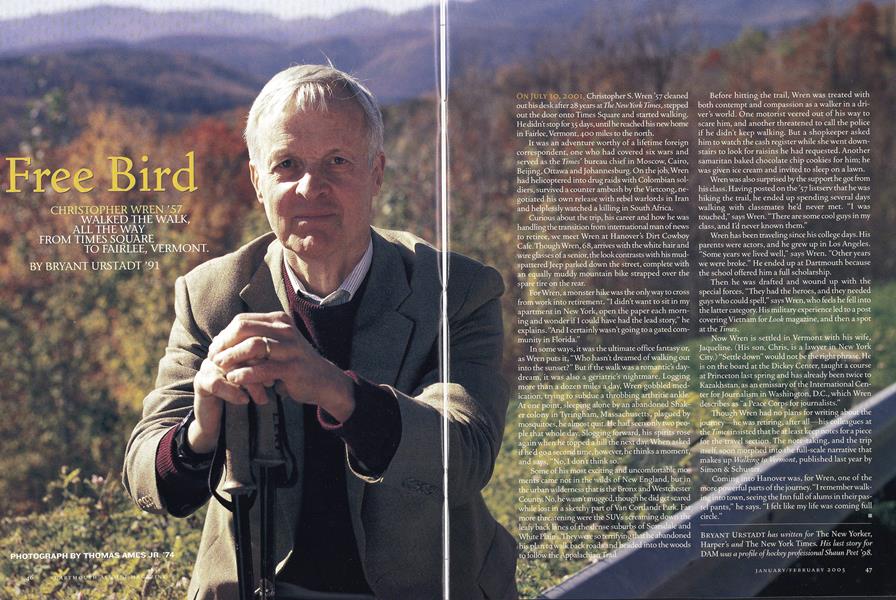
Christopher Wren ’57 walked the walk, all the way from Times Square to Fairlee, Vermont.
CHRISTOPHER WREN '57 WALKED THE WALK, ALL THE WAY FROM TIMES SQUARE TO FAIRLEE, VERMONT.
On July 30,2001 Christopher S. Wren '57 cleaned out his desk after 28 years at The New York Times, stepped out the door onto Times Square and started walking. He didn't stop for 35 days, until he reached his new home in Fairlee, Vermont, 400 miles to the north.
It was an adventure worthy of a lifetime foreign correspondent, one who had covered six wars and served as the Times' bureau chief in Moscow, Cairo, Beijing, Ottawa and Johannesburg. On the job, Wren had helicoptered into drug raids with Colombian soldiers, survived a counter ambush by the Vietcong, negotiated his own release with rebel warlords in Iran and helplessly watched a killing in South Africa.
Curious about the trip, his career and how he was handling the transition from international man of news to retiree, we meet Wren at Hanover s Dirt Cowboy S Cafe. Though Wren, 68, arrives with the white hair and wire glassei of a senior, the look contrasts with his mudan spattered Jeep parked down the street, complete with equally muddy mountain bike strapped over the spare tire On the rear.
In some ways, it was the ultimate office fantasy or, as Wren puts it, "Who hasn't dreamed of walking out into the sunset?" But if the walk was a romantic's daydream, it was also a geriatrics nightmare. Logging more than a dozen miles a day, Wren gobbled medication, trying to subdue a throbbing arthritic ankle. At one point, sleeping alone by an abandoned Shaker colony in Tyringham, Massachusetts, plagued by mosquitoes, he almost quit. He had seen only two people that whole day. Slogging forward, his spirits rose again when he topped a hill the next clay. When asked if he'd go a second time, however, he thinks a moment, and says, "No, 1 don't think so."
Some of his most exciting and uncomfortable mo- ments came not in the wilds of New England, but in the urban wilderness that is the Bronx and Westchester County. No, he wasn't mugged, though he did get scared while lost in a sketchy part of Van Cortlandt Park. Far more threatening were the SUVs screaming dwyn the leafy back lanes of the dense suburbs of Scarsdale and White Plains.They were so terrifyingthat he abandoned his plan to walk back roads and headed into the woods to follow the Appalachian Trail
Before hitting the trail, Wren was treated with both contempt and compassion as a walker in a dri- ver's world. One motorist veered out of his way to scare him, and another threatened to call the police if he didn't keep walking. But a shopkeeper asked him to watch the cash register while she went down stairs to look for raisins he had requested. Another Samaritan baked chocolate chip cookies for him; he was given ice cream and invited to sleep on a lawn.
Wren was also surprised by the support he got from his class. Having posted on the '57 listserv that he was hiking the trail, he ended up spending several days walking with classmates he'd never met. "I was touched," says Wren. "There are some cool guys in my class, and I'd never known them."
Wren has been traveling since his college days. His parents were actors, and he grew up in Los Angeles. "Some years we lived well," says Wren. "Other years we were broke." He ended up at Dartmouth because the school offered him a full scholarship.
Then he was drafted and wound up with the special forces. "They had the heroes, and they needed guys who could spell," says Wren, who feels he fell into the latter category. His military experience led to a post covering Vietnam for Look magazine, apd then a spot at the Times.
Now Wren is settled in Vermont with his wife, Jaqueline. (His son, Chris, is a lawyer in New York City.) "Settle down" would not be the right phrase. He is on the board at the Dickey Center, taught a course at Princeton last spring and has already been twice to Kazakhstan, as an emissary of the International Center for Journalism in Washington, D.C., which Wren describes as "a Peace Corps for journalists."
Though Wren had no plans for writing about the journey—he was retiring, after all—his colleagues at ihe limes insisted that he at least keep notes for a piece for the travel section. The note-taking, and the trip itself, soon morphed into the full-scale narrative that makes up Walking ip Vermont, published last year by Simon & Schus ten
Coming into Hanover was, for Wren, one of the more powerful parts of the journey. "I remember walking in to town, seeing the Inn full of alums in their pastel pants," he says. "I felt like my life was coming full circle."
Bryant Urstadt has written for The New Yorker, Harper's and The New York Times. His last story for DAM was a profile of hockey professional Shaun Peet '98.

BRYANT URSTADT ’91

Features
-
 Feature
The Honorary Degree Citations
July 1956 -
 Feature
Six Faculty Members to Retire
June 1962 -
 Feature
The Hopkins Administration Steps Forward as a National
OCTOBER 1964 -
 Feature
It Was A Dartmouth Jinx All the Time
November 1960 -
 Feature
Of Sun-Gazers and Seal-Hunters
JAN./FEB. 1978 -
 Cover Story
M. Lee Pelton
OCTOBER 1997

