Letters
QUOTE/UNQUOTE "Like Gina Barreca '79 I have an overwhelming sense of having forged, friendships and achieved academically in spite of a pervasive culture of misogyny and anti-intellectualism." KIRK READ '81
Hail to the Chief
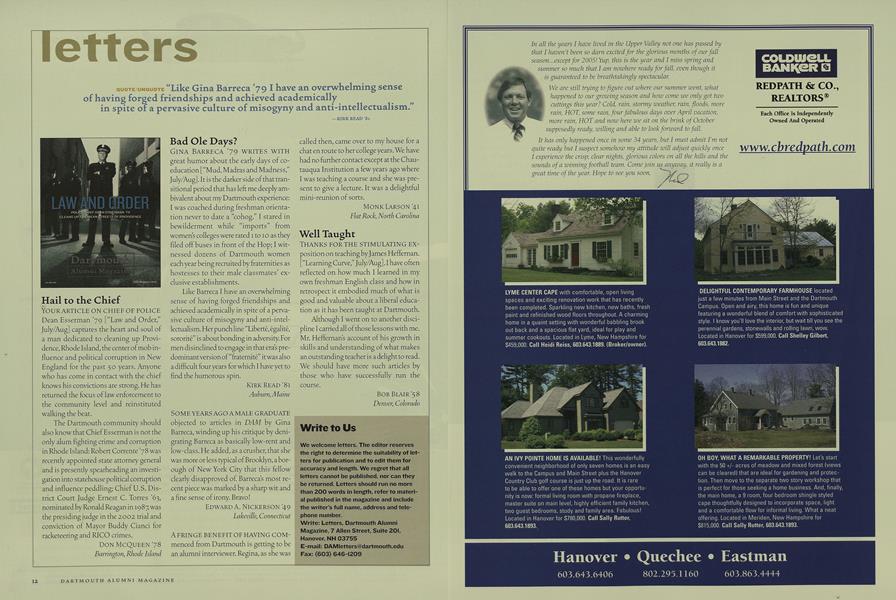
YOUR ARTICLE ON CHIEF OF POLICE Dean Esserman '79 ["Law and Order," July/Aug] captures the heart and soul of a man dedicated to cleaning up Providence, Rhode Island, the center of mob influence and political corruption in New England for the past 50 years. Anyone who has come in contact with the chief knows his convictions are strong. He has returned the focus of law enforcement to the community level and reinstituted walking the beat.
The Dartmouth community should also know that Chief Esserman is not the only alum fighting crime and corruption in Rhode Island: Robert Corrente '78 was recently appointed state attorney general and is presently spearheading an investigation into statehouse political corruption and influence peddling; Chief U.S. District Court Judge Ernest C. Torres '63, nominated by Ronald Reagan in 1987, was the presiding judge in the 2002 trial and conviction of Mayor Buddy Cianci for racketeering and RICO crimes.
Barrington, Rhode Island
Bad Ole Days?
GINA BARRECA '79 WRITES WITH great humor about the early days of coeducation ["Mud, Madras and Madness," July/Aug], It is the darker side of that transitional period that has left me deeply ambivalent about my Dartmouth experience: I was coached during freshman orientation never to date a "cohog." I stared in bewilderment while "imports" from women's colleges were rated 1 to 10 as they filed off buses in front of the Hop; I witnessed dozens of Dartmouth women each year being recruited by fraternities as hostesses to their male classmates' exclusive establishments.
Like Barreca I have an overwhelming sense of having forged friendships and achieved academically in spite of a pervasive culture of misogyny and anti-intel-lectualism. Her punch line "Liberte, egalite, sororite" is about bonding in adversity. For men disinclined to engage in that era's predominant version of "fraternite" it was also a difficult four years for which I have yet to find the humorous spin.
Auburn, Maine
SOME YEARS AGO A MALE GRADUATE objected to articles in DAM by Gina Barreca, winding up his critique by denigrating Barreca as basically low-rent and low-class. He added, as a crusher, that she was more or less typical of Brooklyn, a borough of New York City that this fellow clearly disapproved of. Barreca's most recent piece was marked by a sharp wit and a fine sense of irony. Bravo!
Lakeville, Connecticut
A FRINGE BENEFIT OF HAVING COMMENCED from Dartmouth is getting to be an alumni interviewer. Regina, as she was called then, came over to my house for a chat en route to her college years. We have had no further contact except at the Chautauqua Institution a few years ago where I was teaching a course and she was present to give a lecture. It was a delightful mini-reunion of sorts.
Flat Rock, North Carolina
Well Taught
THANKS FOR THE STIMULATING EXPOSITION on teaching by James Heffernan. ["Learning Curve," July/Aug]. I have often reflected on how much I learned in my own freshman English class and how in retrospect it embodied much of what is good and valuable about a liberal education as it has been taught at Dartmouth.
Although I went on to another discipline I carried all of those lessons with me. Mr. Heffernan's account of his growth in skills and understanding of what makes an outstanding teacher is a delight to read. We should have more such articles by those who have successfully run the course.
Denver, Colorado
HEFFERNAN CITES THE ONE-MAN chorus in Henry V, who summons up the auditor's powers of imagination fully to visualize the great events depicted in "this wooden O," as evidence that even Shake-speare "could fall short of perfection, that even he needed our imaginations to make his plays work." The chorus is suitably apologetic, but is this a shortcoming to be regretted? Theatrical production values of the Elizabethan age did indeed lack the live horses, the soundtrack of thundering hooves, the army of extras, the appropriately "vasty fields of France"and the computer-generated imagery that might nowadays be employed to produce a more realistic account of the events related. In 1600 the effects had to be generated, in large measure, by the spoken words. Shakespeare ripened under these restrictions and surely his spirited play on the imagination is a fundamental element of his enduring greatness.
Tallahassee, Florida
By the Numbers
THE 22 PERCENT MALE/FEMALE faculty salary gap, almost double that of the next worst Ivy League school, reproted in "Around the Green" ["Campus," July/Aug] is appalling. DAM is to be commended for reporting it, but it's a problem that needs to be explained and fixed.
Hesperus, Colorado
Remembering Ned
MANY THANKS TO ANDY ROWLES '65 for his piece on Noel Perrin, who had and continues to have a great influence on me ["Stories in Stone," May/June].
It started in spring 1981 when I took his fantastically entertaining "Science Fiction" class, in which he shared with us the subtle humor of that genre. It continued with his "Curmudgeon" columns in DAM, most of which exposed to us an area of our college, if not our lives, that required attention. It reached a peak when last year I encountered a wonderful book: Daniel Carter Beards The American Boy's HandyBook; the author of the foreword was none other than Noel Perrin. In it Perrin returns us to the world of Holden Caufield, Huck Finn and Booth Tarkington's Penrod.
I sought to have the professor personalize 15 books for my son and the other boys in his Cub Scout den. Although Professor Perrin's illness prevented that, I did have a very memorable five-minute phone conversation with him.
Last spring I handed each boy a copy of that special book with an inscription about the author of the foreword.
Cincinnati, Ohio
Religion on Campus
SOMETHING I EXPECTED TO SEE IN "Finding God on Campus" [May/June] was the number of Dartmouth students that attend local Hanover churches for worship each week. I remember attending Our Savior's Lutheran Church, next to Leverone Field House. Frequently Pastor John Lemkul and his wife, Eunice, would invite a group of students to their home for dinner after worship. Other church members also invited those of us who did not go home for Thanksgiving into their homes as if we were family. These served as fitting examples of people living their faith and reaching out to Dartmouth students separated from their own families by hundreds or even thousands of miles.
Apple Valley, Minnesota
Mail Call
JOHN BALDWIN'S LETTER ("LETTERS, July/Aug] is timely in recognizing the critical need for meaningful immigration reform. Responsible organizations such as the Federation of America for Immigration Reform (FAIR) and Numbers USA promote a reduction in legal immigration to a sustainable level, such as existed in the 1960s—roughly 250,000—and enforcement of our laws with regard to illegals. Present levels are unsustainable and trigger a multitude of problems.
At www.numbersusa.com it's amaz- ingly simple to voice your opinions to your legislators about pending legislation. Our senators and i representatives have finally realized they may jeopardize their reelection by ignoring this issue. Although we are all descendants of immigrants, responsible reform is vitally needed.
Bend, Oregon
I FOUND THE JUXTAPOSITION OF the letters from Jim Sapienza '85 and Richard Fairley '55 at al ["Letters," May/June] interesting: The former wrote about how the Bryan Randall '88 story ["Coming Undone," Jan/Feb] should lead to "support" and "dialogue" on mental illness; the latter wrote that focusing on the Randall story was an "abuse" and a "disgrace," that only "uplifting and relevant stories" should be included in DAM.
Please put me in Sapienza's camp. Advancing the myth that life always has fairy tale endings is a disservice to all in the College community. I think we're big enough people to handle both sides of the bell curve.
Lower Gwynedd, Pennsylvania
Bagging It
CHRISTOPHER KELLY'S PERSONAL history ["Bag of Tricks," May/June], reminded me of my experience in the Air Force: I was stationed in England, on temporary leave in Germany, when I needed to store my bag at a rail station. Later I returned to find an empty locker. After reporting the loss to authorities I wrote the bag off. A few months later I received a card in the mail written in German. A few weeks later, in Lake Charles, Louisiana, I received a wooden crate containing my bag, safe and sound.
New Hampton, New Hampshire
Future Reader
THANK YOU FOR LISTING MY WEBLOG with Professor Samwick's and the others in DAM ["Campus," May/June], This was the first copy of the magazine I've read. The layout, articles, printing—even the paper—is top-notch. We treat alums well.
Hanover
Write to Us We welcome letters. The editor reserves the right to determine the suitability of letters for publication and to edit them for accuracy and length. We regret that all letters cannot be published, nor can they be returned, Letters should run no more than 200 words in length, refer to material published in the magazine and include the writer's full name, address and telephone number. Write: Letters, Dartmouth Alumni Magazine, 7 Allen Street, Suite 201, Hanover, NH 03755 E-mail: DAMletters@dartmouth.edu Fax: (603) 646-1209

More From This Issue
-
 Cover Story
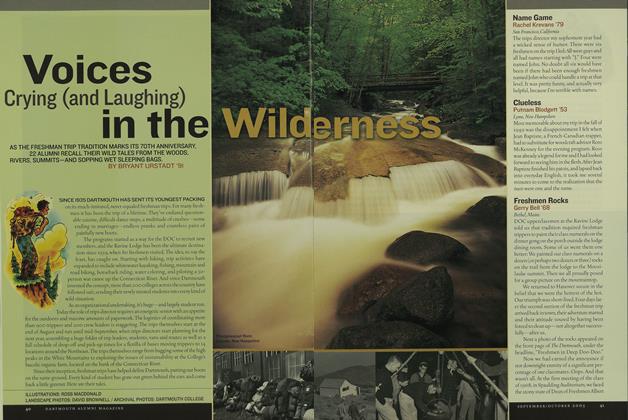
Voices Crying (and Laughing) in the Wilderness
September | October 2005 -
 Feature
Sex, Lies... and a Pulitzer Prize
September | October 2005 -
 Feature
Soviet Union
September | October 2005 -
 PERSONAL HISTORY
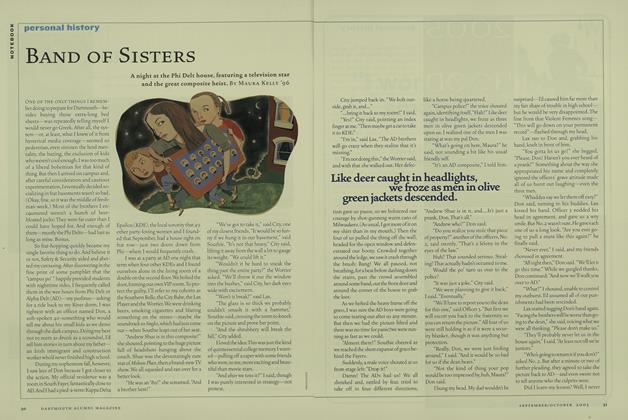
Band of Sisters
September | October 2005 -
 TRIBUTE
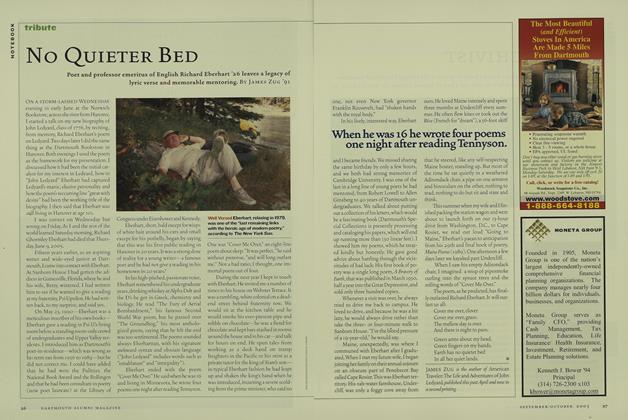
No Quieter Bed
September | October 2005 -
 Interview
The Archivist
September | October 2005
Letters to the Editor
-
 Letters to the Editor
Letters to the Editor
JUNE 1930 -
 Letters to the Editor
Letters to the Editor Ulmus Americana
December 1937 -
 Letters to the Editor
LETTERS
JULY 1959 -
 Letters to the Editor
Letters to the Editor
February 1977 -
 Letters to the Editor
Letters to the Editor
April 1979 -
 Letters to the Editor
Diana's Story
MARCH 1999


