Life with Oppenheimer
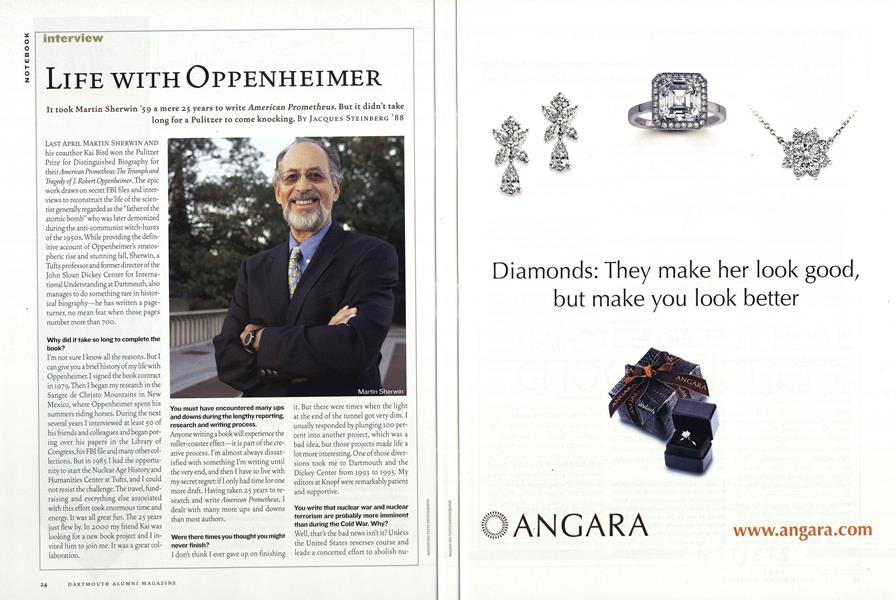
It took Martin Sherwin '59 a mere 25 years to write American Prometheus. But it didn't take long for a Pulitzer to come knocking.
LAST APRIL MARTIN SHERWIN AND his coauthor Kai Bird won the Pulitzer Prize for Distinguished Biography for their American Prometheus: The Triumph andTragedy of J. Robert Oppenheimer. The epic work draws on secret FBI files and interviews to reconstruct the life of the scientist generally regarded as the "father of the atomic bomb" who was later demonized during the anti-communist witch-hunts of the 19505. While providing the definitive account of Oppenheimer s stratospheric rise and stunning fall, Sherwin, a Tufts professor and former director of the John Sloan Dickey Center for International Understanding at Dartmouth, also manages to do something rare in historical biography—he has written a pageturner, no mean feat when those pages number more than 700.
Why did it take so long to complete thebook?
I'm not sure I know all the reasons. But I can give you a brief history of my life with Oppenheimer. I signed the book contract in 1979. Then I began my research in the Sangre de Chris to Mountains in New Mexico, where Oppenheimer spent his summers riding horses. During the next several years I interviewed at least 50 of his friends and colleagues and began poring over his papers in the Library of Congress, his FBI file and many other collections. But in 1985 I had the opportu- nity to start the Nuclear Age History and Humanities Center at Tufts, and I could not resist the challenge. The travel, fundraising and everything else associated with this effort took enormous time and energy. It was all great fun. The 25 years just flew by. In 2000 my friend Kai was looking for a new book project and I invited him to join me. It was a great collaboration.
You must have encountered many upsand downs during the lengthy reporting,research and writing process.
Anyone writing a book will experience the roller-coaster effect—it is part of the creative process. I'm almost always dissatisfied with something I'm writing until the very end, and then I have to live with my secret regret: if I only had time for one more draft. Having taken 25 years to research and write American Prometheus, I dealt with many more ups and downs than most authors.
Were there times you thought you might never finish?
I don't think I ever gave up on finishing it. But there were times when the light at the end of the tunnel got very dim. I usually responded by plunging 100 percent into another project, which was a bad idea, but those projects made life a lot more interesting. One of those diversions took me to Dartmouth and the Dickey Center from 1993 to 1995. My editors at Knopf were remarkably patient and supportive.
You write that nuclear war and nuclear terrorism are probably more imminent than during the Cold War. Why?
Well, that's the bad news isn't it? Unless the United States reverses course and leads a concerted effort to abolish nuclear weapons, the number of nations that will acquire those weapons will certainly increase. North Koreas recent nuclear test is a case in point. Some of the nuclear-armed governments will be unstable, some will be aggressive and get involved in wars. The chance of nuclear weapons being used in one of those wars is high. And with the proliferation of nuclear weapons, the chances of a terrorist group acquiring nuclear capability is increased. Oppenheimer recognized this danger, and he worked to avert it. But people in government who believed nuclear weapons would increase our security stymied him. They were wrong then, and their acolytes are wrong now. Their influence poses as great a long-range danger to our security as those terrorists who threaten us. In a sense, they are in league with each other.
How much did you rely on secret FBI documents about Oppenheimer and the records from Los Alamos?
There were thousands of pages of FBI documents and they were an important part of Oppenheimer s story. Not because they offered accurate information—they were inaccurate more often than notbut because those files were used against him at his 1954 Atomic Energy Commission security hearing. Those files certainly contributed to stretching the writing to 25 years. I had to spend a lot of time figuring out what the FBI got right, and why they had so much bad information. Those raw FBI files are appalling. They are like lethal garbage cans—anything that anyone says about a subject is dumped into them—and because they are FBI files they take on an aura of authenticity. I recommend that everyone submit a Freedom of Information Act request for his or her file.
In what ways are the Bush administration's restrictions on documents that can be released under the Freedom of Information Act already having an impact on scholars trying to do work such as yours?
The restrictions are making it more difficult for the American people to learn the truth about many things, both historical and current.
Could you have embarked on this project today?
Yes, but I would surely run into many more restrictions than I had to face in the 1980s and 19905. Probably not from the FBI, but I used a lot of documents from Los Alamos, and the restrictions there would probably be more in play now.
Do you see any parallels between thegovernment's effort to root out Communists in America in the 1950s and theways it has responded to the war on terror in recent years?
History doesn't repeat itself, but patterns of behavior do. One of the great flaws in the American political system is the apparent ease with which fear can be used to promote a political agenda. The McCarthy period— so-called because McCarthy was not alone responsible for the abuses of the rights of U.S. citizens—demonstrated how effective fear-mongering can be as a political force. What we are seeing today is the same basic game plan, and it seems to work just as well as it did 50 years ago. Sad.
Truman and later Eisenhower tried to freeze out the viewpoints of scientists such as Oppenheimer who, however belatedly, tried to sound the alarm of the perils of nuclear technology. Is the same thing happening now with regard to other issues ?
There are parallels between Oppenheimer's experiences and the major scientific battles today over global warming, stem cell research, energy sources, etc. They do not have the same intensity as the nuclear debate, but they are fierce and important. And the administration does its best to discredit views that are critical of its policies.
To what extent is an element of Oppenheimer's legacy, for good or ill, theway in which the government treatsscience and scientists today?
Oppenheimer s humiliation at the hands of the Atomic Energy Commission in 1954 was a warning to scientists that you cannot bite the hand that feeds you without suffering severe consequences. Today almost all science depends on government support, and scientists are therefore more or less at the mercy of the system that provides funding for their work. This has created a far more cautious culture in the science community than existed before 1954. There are notable exceptions, of course, and we should honor and support them.
What's up next?
I am writing a book on the Cuban Missile Crisis. The title is Gambling withArmageddon: The Military, the Hawks and theLong, Straight Road to the Cuban Missile Crisis,1945-1962.1 was in the Navy during the crisis, and when it was over I began to think about how easily we had all slipped into the role of warriors ready to fight a conflict that would have ended life as we knew it. So I've been thinking about this book for a long time. It's a story about the rationalization of stupidity and it, too, will be frighteningly relevant.
Martin Sherwin
"Today almost all science depends on government support, and scientists are therefore more or less at the mercy of the system," MARTIN SHERWIN
JACQUES STEINBERG coven television andother media for The New York Times.
More From This Issue
-
 Cover Story
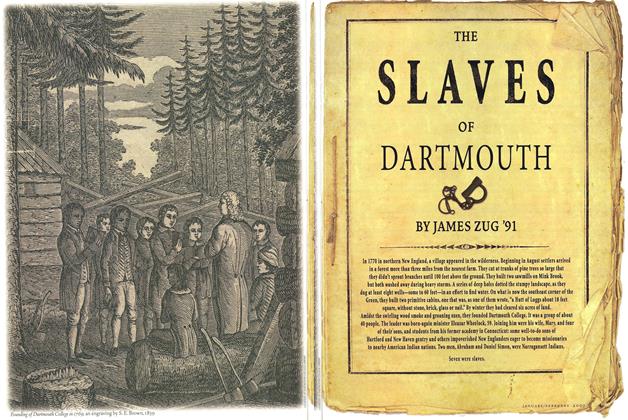
The Slaves of Dartmouth
January | February 2007 -
 Feature
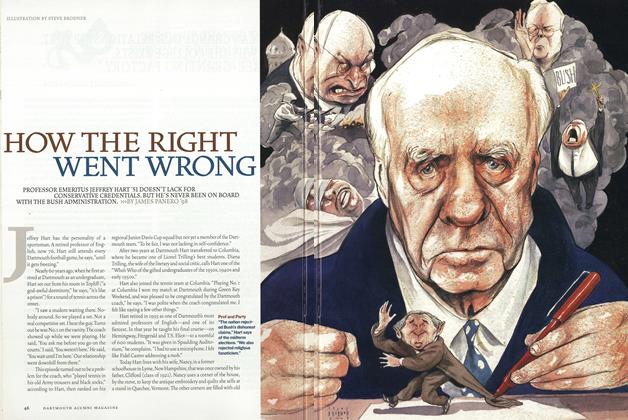
How the Right Went Wrong
January | February 2007 -
 Feature
Picking Up the Pieces
January | February 2007 -
 Feature
Notebook
January | February 2007 -
 Feature
Alumni News
January | February 2007 -
 OUTSIDE
Are You a Chubber?
January | February 2007
Jacques Steinberg '88
Interviews
-
 Interview
Look Who’s Talking
MAY | JUNE 2020 -
 Interview
“We’ve Got To Go For It”
July/Aug 2002 -
 Interview
Dartmouth on the Brain: Green Research and Gray Matter
SEPTEMBER 1999 -
 Interview
“Vulnerabilities Exist”
Jan/Feb 2002 -
 Interview
Q & A
Jan/Feb 2007 -
 Interview
“We’ve Got a Job to Do”
JANUARY | FEBRUARY 2021

