CLASS OF 1866
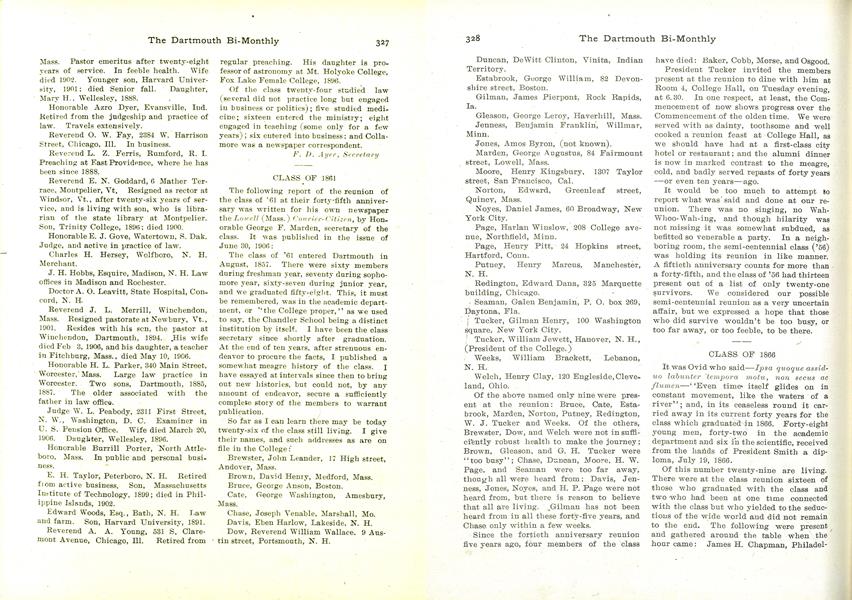
It was Ovid who said—Ipsa quoque assiduo labunter tempora motu, non secus acflumen— "Even time itself glides on in constant movement, like the waters of a river”; and, in its ceaseless round it carried away in its current forty years for the class which graduated in 1866. Forty-eight young men, forty-two in the academic department and six in the scientific, received from the hands of President Smith a diploma, July 19, 1866.
Of this number twenty-nine are living. There were at the class reunion sixteen of those who graduated with the class and two who had been at one time connected with the class but who yielded to the seductions of the wide world and did not remain to the end. The following were present and gathered around the table when the hour came: James H. Chapman, Philadelphia; George E. Chickering, Lawrence,Mass; Schiller Hosford, Moline, Ill., Nathan P. Hunt, Manchester; J. Edgar Johnson, Philadelphia; Henry A. Kendall, Somer ville, Mass. ; Charles E. Lane, Chicago; Francis W. Lewis, Newtonville, Mass. ; Horace E. Marion, Brighton, Mass. ; George H. Pills bury, Lowell, Mass. ; Levi Rogers, Greenwich, Conn. ; William B. T. Smith, Charles town, N. H. ; James A. Spanlding, Portland, Me. ; Henry Ward- well, Salem, Mass. ; George W. Wing, Montpelier, Vt. ; Henry Whitte more, Framingham, Mass. ; and two non-graduates: Theodore Robinson, Lexington, Mass. ; and W. B. Fisher, Boston.
Chester W. Merrill of Cincinnati presented his resignation as class secretary. A resolution of thanks was unanimously adopted expressing the appreciation of the class for his service. Henry Whitte more was elected as his successor.
It was voted that the class should publish a class history which should give in a brief sketch the life of every member who graduated and, as far as possible, of those who had at any time been connected with the class. This duty was assigned to Charles Lane, J. Edgar Johnson, and the secretary.
It was voted to meet again in 1911.
It cannot be said with Lucretius: "They passed the night without sleep, they whiled the time away in humorous songs and drollery." This was left to younger men to do. But there was a quiet, deep feeling of thankfulness that so many could come together and renew in word and in spirit the deeds of their College life.
More From This Issue
-
 Article
THE MATERIAL DEVELOPMENT OF THE COLLEGE
August 1906 -
 Article
THE PRESENT CALL TO WISDOM
August 1906 -
 Article
WALT WHITMAN AND DARTMOUTH COLLEGE
August 1906 -
 Article
THE CONFERRING OF DEGREES
August 1906 -
 Article
ONE HUNDRED AND THIRTY-SEVENTH COMMENCEMENT OF DARTMOUTH COLLEGE
August 1906 -
 Article
PHI BETA KAPPA ADDRESS BY THE HONORABLE ANDREW D. WHITE, LL.D
August 1906