CLASS OF 1889
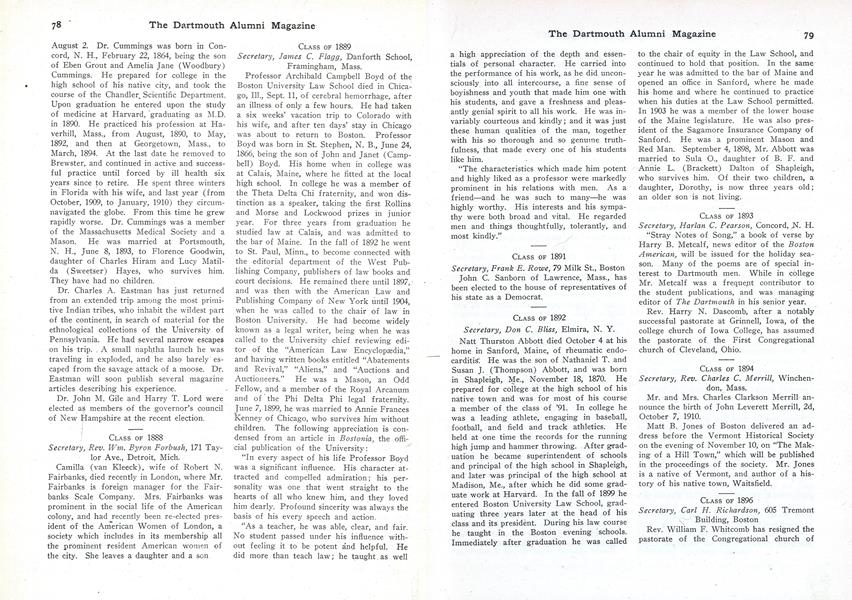
Professor Archibald Campbell Boyd of the Boston University Law School died in Chicago, Ill, Sept. 11, of cerebral hemorrhage, after an illness of only a few hours. He had taken a six weeks' vacation trip to Colorado with his wife, and after ten days' stay in Chicago was about to return to Boston. Professor Boyd was born in St. Stephen, N. 8., June 24, 1866, being the son of John and Janet (Campbell) Boyd. His home when in college was at Calais, Maine, where he fitted at the local high school. In college he was a member of the Theta Delta Chi fraternity, and won distinction as a speaker, taking the first Rollins and Morse and Lockwood prizes in junior year. For three years from graduation he studied law at Calais, and was admitted to the bar of Maine. In the fall of 1892 he went to St. Paul, Minn., to become connected with the editorial department of the West Publishing Company, publishers of law books and .court decisions. He remained there until 1897, and was then with the American Law and Publishing Company of New York until 1904, when he was called to the chair of law in Boston University. Pie had become widely known as a legal writer, being when he was called to the University chief reviewing editor of the "American Law Encyclopaedia," and having written books entitled "Abatements and Revival," "Aliens," and "Auctions and Auctioneers." He was a Mason, an Odd Fellow, and a member of the Royal Arcanum and of the Phi Delta Phi legal fraternity. June 7, 1899, he was married to Annie Frances Kenney of Chicago, who survives him without children. The following appreciation is condensed from an article in Bostonia, the official publication of the University:
"In every aspect of his life Professor Boyd was a significant influence. His character attracted and compelled admiration; his personality was one that went straight to the hearts of all who knew him, and they loved him dearly. Profound sincerity was always the basis of his every speech and action.
"As a teacher, he was able, clear, and fair. No student passed under his influence without feeling it to be potent and helpful. He did more than teach law; he taught as well a high appreciation of the depth and essentials of personal character. He carried into the performance of his work, as he did unconsciously into all intercourse, a fine sense of boyishness and youth that made him one with his students, and gave a freshness and pleasantly genial spirit to all his work. He was invariably courteous and kindly; and it was just these human qualities of the man, together with his so thorough and so genuine truthfulness, that made every one of his students like him.
"The characteristics which made him potent and highly liked as a professor were markedly prominent in his relations with men. As a friend—and he was such to many—he was highly worthy. His interests and his sympathy were both broad and vital. He regarded men and things thoughtfully, tolerantly, and most kindly."
Secretary, James C. Flagg, Danforth School, Framingham, Mass.
More From This Issue
-
 Article
THE DIARY OF WILLIAM SMITH
December 1910 -
 Article
Honor Night
December 1910 -
 Article
Football
December 1910 -
Article
Football
December 1910 -
 Article
The degree of rapidity with which reports
December 1910 -
 Article
Edward K. Hall's Services to Dartmouth—Resolutions by the Athletic Council
December 1910