Mr. Tuck's Gift to Dartmouth
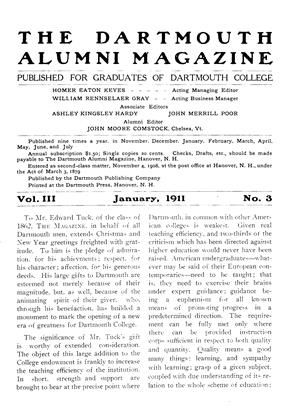
Nearly half a million dollars has suddenly been added to the endowment of Dartmouth College through the renewed generosity of the Honorable Edward Tuck of the Class of 1862. The news came as a glad surprise to faculty, alumni, and undergraduates alike. The secret of the coming Christmas gift had been well kept. When on Saturday night, December 10, the College was informed that a mass-meeting would be held in Webster Hall, the following Monday afternoon, the wildest speculations were indulged in as to the reason for the call.
As a result, on Monday, Webster was packed with faculty and students. As the college bell ceased tolling, President Nichols rose and briefly addressed his eagerly expectant audience. "I wish," he said, "to read to you a letter which seems to me of sufficient importance to warrant my calling you together to hear." And thereupon he presented Mr. Tuck's brief, but eminently clear and specific statement of the nature of his new gift to Dartmouth and of the uses to which it is to be put: "The par value of this donation is $400,000," continued President Nichols. "Its market value is considerably above that sum. The securities bear seven per cent interest and mean, in additional income to be applied directly to improving the teaching efficiency of the College, the sum of $28,000 per annum."
There was a moment's silence after the President had ceased speaking; then broke a great wave of tumultous applause, in the midst of which Cheerleader Paul rose up to demand three cheers for Mr. Tuck and three cheers for President Nichols. They were given with a will.
THE AMOS TUCK ENDOWMENT FUND
The lucid thinking that lies back of Mr. Tuck's benefactions to Dartmouth and the thorough understanding which he has of Dartmouth's work and Dartmouth's needs is evident upon perusal of the letter accompanying the recent gift. It is as follows :
82 CHAMPS ELYSEFS, PARIS November 16, 1910
PRESIDENT ERNEST F. NICHOLS
Hanover, N. H.
DEAR DR. NICHOLS:
I am instructing the Chase National Bank, of New York, to forward to you certificates registered in the name of the Trustees of Dartmouth College for:
2000 shares Great Northern Preferred Stock.
2000 shares Northern Pacific Stock. I donate these shares to the College, to be added to the present "Amos Tuck Endowment Fund." I desire the income from them to be applied, as was the purpose of my original foundation of the fund in 1899, to the improvement of the existing scale of salaries of the Faculty of the College in all its Departments, as now constituted and as increased later by the addition of new Professors and Instructors, including a Librarian.
I wish the Trustees of the College to apportion the additional income received from this gift according to the relative importance and value, in their best judgment, of the services rendered in the different Chairs, with due regard to length of service and professional distinction.
Yours very truly,
(Signed)
EDWARD TUCK
The history of the fund to which this addition is made is interesting. In October, 1899, Mr. Tuck established it by the presentation to the College of 1700 shares of Great Northern railway stock of a total value of $300,000. This enabled an immediate advance in faculty salaries and such further increase in the instruction corps as was necessary to found the Amos Tuck School of Administration and Finance, the first of its particular scope in the country and the model for the majority of those since founded at other institutions. A year later Mr Tuck gave $100,000 to provide a building suited to housing the School. In the meantime, the great value of the original gift began to make itself apparent. In February, 1900, the College was able to avail itself of rights accruing from the original holding. This occurred again in May, 1901. Hence in November of the same year, the 1700 shares had increased to 2000 shares and were exchanged for 3600 shares of the newly organized Northern Securities Company. Upon the dissolution of that company in April, 1905, the division of its securities gave the College in Great Northern and Northern Pacific Railways of a book value of $500,000. This was followed in November, 1906, by the distribution of Great Northern ore certificates. In December, 1906, various rights to Great Northern and Northern Pacific stockholders were taken advantage of. The College Treasurer's report for 1908-1909 shows what had become of the original 1700 shares of Great Northern stock. The exhibit is remarkable:
1397 shares Great Northern Railway Co.
1230 shares Great Northern Ore Properties.
1771 shares Northern Pacific Railway Co.
37 shares Northern Securities Co. Stubs.
The value of these as carried in the books of the College was $500,000. Their market value at the time was considerably in advance of this. The aggregate of the first Amos Tuck Endowment, the money given for the Tuck School building, and the recently received gift brings the permament enrichment of Dartmouth, through Mr. Tuck's generosity, to the million dollar mark.
This, however, does not by any means represent the entire sum of his giving to the College and its allied interests. He has been quick to respond to innumerable needs. To mention but a few examples: He was the most liberal subscriber to the fund which saved the beautiful pines along the river, immediately north of the village, from the ravages of a match company; he contributed $3,000 toward meeting the running expenses of the College during the past year; he was the largest contributor to the Psi Upsilon building fund; not long since, he purchased a valuable French private library in Paris and presented the collection to the Dartmouth College Library; he gave $10,000 to the Dartmouth Hall fund and $5,000 for the New Gymnasium. In all cases, his gifts have been distinguished by rare discrimination and wonderful timeliness.
STUDENT RESOLUTIONS ON THE GIFT
It is these characteristics of his giving quite as much as the largeness of the amounts bestowed that make the personality of Mr. Tuck appeal with unusual force to the imagination, and serve to rouse enthusiasm for him as well as for his works. This is clearly shown in the quickness with which the student body rose to appreciation of what Mr. Tuck has just done for Dartmouth, and the genuineness with which they expressed their feeling. On the evening of the announcement of the gift, Palaeopitus sent Mr. Tuck the following cablegram:
HANOVER, N. H., Dec. 12, 1910
HON. EDWARD TUCK, MONTE CARLO
"Simultaneous meetings tonight of all four classes to express appreciation of your loyal generosity to Dartmouth.
"(Signed) "Twelve Hundred Dartmouth Men." And in reply to this, President Nichols received Tuesday the following message :
MONTE CARLO, Dec. 13
PRES. NICHOLS, HANOVER, N. H. "Greatly gratified by hearty message of Dartmouth's twelve hundred. "(Signed) TUCK."
At simultaneous meetings, called by Palaeopitus Tuesday evening, all four classes adopted the following resolutions and voted to have them engrossed on parchment and sent to Mr. Tuck as a memento of the gratitude of the undergraduates :
"We, the students of Dartmouth College, assembled by classes, feel that the unified appreciation of twelve hundred undergraduates may venture to express itself as the sentiment of Dartmouth men as a whole.
"Accordingly we desire to extend to Mr. Edward Tuck our sincerest thanks for the munificent benefaction which he has bestowed upon his College and ours.
"We feel that whatever adds to the efficiency of Dartmouth redounds to the advantage of the generations whose accomplishment has secured its honorable past and of the generations in whom its future hopes must lie.
"The generous gift of Mr. Tuck, added to the much that he has already given to Dartmouth, will stand to us not only as a monument to the noble spirit of the giver, but as an example of genuine alumni loyalty which, in the passing of time, we shall hope in accordance with our prosperity to emulate."
If the thought which is here expressed abides, the services of Mr. Edward Tuck to Dartmouth will, in the passing of time, bear fruit beyond even his farsighted understanding.
More From This Issue
-
 Article
THE DIARY OF WILLIAM SMITH OF CAYENDISH, VERMONT, A FRESHMAN IN DARTMOUTH COLLEGE, SEPT. 23, 1822-AUG. 3, 1823
January 1911 -
 Article
To Mr. Edward Tuck,
January 1911 -
 Article
Important Trustee Meeting
January 1911 -
 Class Notes
LOCAL ASSOCIATIONS
January 1911 -
Article
OTHER! TRUSTEE ACTION
January 1911 -
 Class Notes
CLASS SECRETARIES
January 1911