THE COLLEGE AND THE CHURCH
Dartmouth College and the Church of Christ at Dartmouth College were the twofold expression of the purpose and the work of Eleazar Wheelock. The College was his interpretation of the call to him to advance the kingdom of God in the world. The church was the visible symbol of that kingdom, in which he believed as a divine institution and-as the repository of truth vital to the welfare of men.
This belief led him to take part in the Great Awakening, to establish his Indian Charity School for the training of Indian and English youth as missionaries to the Indian tribes, and later to seek the larger scope of a college.
Naturally the opening of a college in the wilderness necessitated the supply of certain physical wants, like shelter and food, but when these were supplied, within six months after his coming to Hanover, Wheelock gathered a church, January 23, 1771, whose conduct and guidance he regarded as much a part of his duty as the care of the College.
This sole oversight he continued until his death in 1779, when the Trustees of the College took Over the church as an integral part of their obligations, and made it a part of the duty of the professor of theology to preach to the students and the associated congregation, which constituted the church. In the lack of such a professor from 1787 to 1804 the duty was assigned to Professor John Smith, professor of languages. This provision by the College for administering to the church continued for sixty years until 1830, even though certain circumstances materially modified the character of the church.
The growth of the village, keeping pace with that of the College, naturally brought into the membership of the church many who had no direct connection with the College. These members led, first, to the need of a larger place of worship than the College could offer and, second, to the propriety of their making some contribution to the support of worship, as they were ready and willing to do. The need of larger room was met by an enlargement by the villagers of existing college provision, and in 1795 by the erecting by them entirely of the present meeting house, made larger, at the request of President John Wheelock, than the requirements of the church for the sake of the public exercises of the College. The matter of contributions, apparently so simple, was involved by John Wheelock in the bitter quarrel that began in 1804.
In that year Roswell Shurtleff was appointed professor of theology and, as usual, it was made his duty to preach to the students and the associated church, which was glad to receive him as its pastor. No trouble would have arisen had it not been for the despotic temper of John Wheelock, who, somehow fearing a loss of influence through the independence of Professor Shurtleff, so involved matters as to bring about a split in the church. In the years before, many living in that part of Hartford known as Dothan had joined the Hanover church, and though for several years they had practically withdrawn from all participation in its affairs they now, under Wheelock's direction, resumed their relation with just members enough to nullify the wishes of the members living in Hanover.
A controversy extending over several years resulted in the organization of a new church by the members of the old church resident in Hanover, the new church being known as the "Church of Christ in the Vicinity of Dartmouth College", while the Hartford members retained the name of the "Church of Christ at Dartmouth College". It was only in 1906, that, the Dothan church having become extinct, the Hanover church resumed the original name.
Notwithstanding the efforts of President Wheelock, who used every means in his power to bring the trustees of the College into the controversy in his support, the new church was recognized as the college church, and Professor Shurtleff ministered to it for nearly twenty years. On his giving up the pulpit on account of ill health, one more attempt was made to secure a professor of theology, "who should add to his college duties the care of the church. Presidents Tyler and Lord took charge of the pulpit for several years "each. But the result was foredoomed to failure and he very soon retired.
By 1830 it was evident that some new method must be adopted for providing a minister for the church, and in that year President Lord organized the Dartmouth Religious Society which undertook the task of calling and supporting a minister. It was a business organization through which the church acted. By this arrangement the former relations of the College and the church were inverted. The College had no part in the call of a minister, but merely paid a fixed sum toward his salary. It was henceforth to be the passive and not the active member. The church, on the other hand, took the initiative and could regard its minister as its own choice and not the appointee of an outside body. The change was manifestly to the benefit of an active life in the church, and also a relief to the College.
But whatever the tendency of the change might prove to be in separating the working interests of the College and the church, the immediate change was more in form than in substance. The minister was no longer a college officer, receiving an appointment from the trustees, and independent of the church so long as his college duties were acceptable. Yet though he was chosen without regard to the College his position was on a par with a position in the College, and as a matter of fact his call was the expression of college influence, as the college officers naturally took the lead in the affairs of the church. Formally separate, the pastorate was still a phase of college expression. The church was still the "College Church", whose public exercises on Sunday the students were required to attend as definitely as they were the weekday exercises of the class room or morning and evening prayers. The College still regarded the church as an essential part of its activity, the new arrangement being merely a more convenient method of operation, and the minister, though without direct responsibility to the trustees, was yet morally under obligation to have the teachings of his pulpit harmonize with the doctrinal system of religious belief supported by the College.
The new plan was successful in this respect, as a spirit of liberalism developed jointly in the progress of the years, in both church and College. It was also successful as a working method, being favored by the length of successive pastorates. Two short ones, of three and five years, were followed by two long ones, the first of eighteen, and the second of forty years, the four with the intervals between them extending to 1900, except that from 1893 the long pastorate of Dr. Leeds was supplemented by a board of preachers, nominated by the President of the College and confirmed by the Church. This board of preachers was given up in 1904 at the same time that required attendance of the students on the church service was abandoned.
The tendency to a less strict requirement of religious exercises had long been evident in both College and church. It first was effective in College in the giving up of evening prayers in 1861, then in the church in the change, in 1872, to required attendance at one church service on Sunday instead of at two. Next in the College the old exercise in the Greek testament, though often changed in form, was given up in 1892, and at last in 1904 the requirement of attendance at church was wholly abandoned.
The giving up of the board of preachers and the requirement of student attendance on the service of the church marked the end of the working union of church and College. But a physical connection had grown up in the long years since 1830, through interest in the meeting house. Several times the College had contributed to the repair, enlargement and improvement of the building, and from time to time had purchased pews for the more convenient seating of the students until its ownership was nearly half the whole. The term "College Church" represented a physical fact, if not a spiritual union, and in recognition of this fact, as well as of its obligation to furnish to such of its students as wish them the opportunities for religious worship of the form of this church, the College continues to contribute a considerable sum each year to the support of the church organization.
The change brought about by one hundred and fifty years in the relation of College and church is not greater than other changes. Thus, Wheelock's patriarchal method of administration gave, way to the parental and that in turn to what may be called responsible freedom for the students. Similarly the restricted and prescribed course of study has broadened by the introduction of subjects unknown to Wheelock and through a different view of education.
The church and the College have the same purpose now as in Wheelock's time, the development of the higher nature of men through intellectual, moral and spiritual influences, but their emphasis is different. The College lays stress on the influences in the order given; the church reverses the emphasis and begins with the spiritual, but the two are in harmony, and under the conditions of the present are more effective in their results from their independent methods of operation.
Courtesy of the Howe Library
Pulpit and Organ in the Old Church
Courtesy of the Howe Library
Looking Down from the Rear Gallery
Through the Woods
JOHN KING LORD '68Trustee and Historian of the College
More From This Issue
-
 Article
The question raised by Mr. Keyes' recent article in the Boston
January 1922 -
 Article
THE NEW SELECTIVE PROCESS
January 1922 -
 Article
PURE DEMOCRACY AND THE COLLEGES
January 1922 -
 Sports
FOOTBALL
January 1922 -
 Class Notes
CLASS OF 1911
January 1922 -
 Article
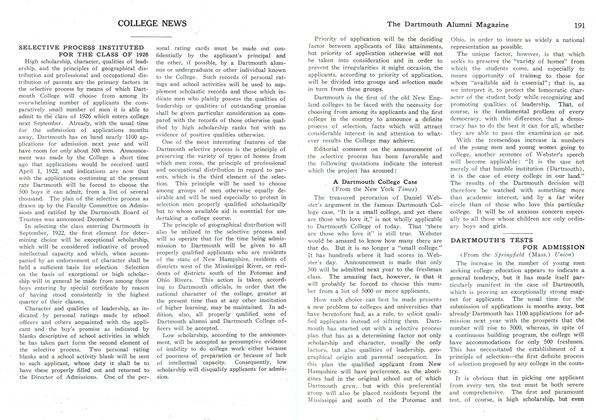
SELECTIVE PROCESS INSTITUTED FOR THE CLASS OF 1926
January 1922