LETTER TO THE EDITOR
Dear Sir:
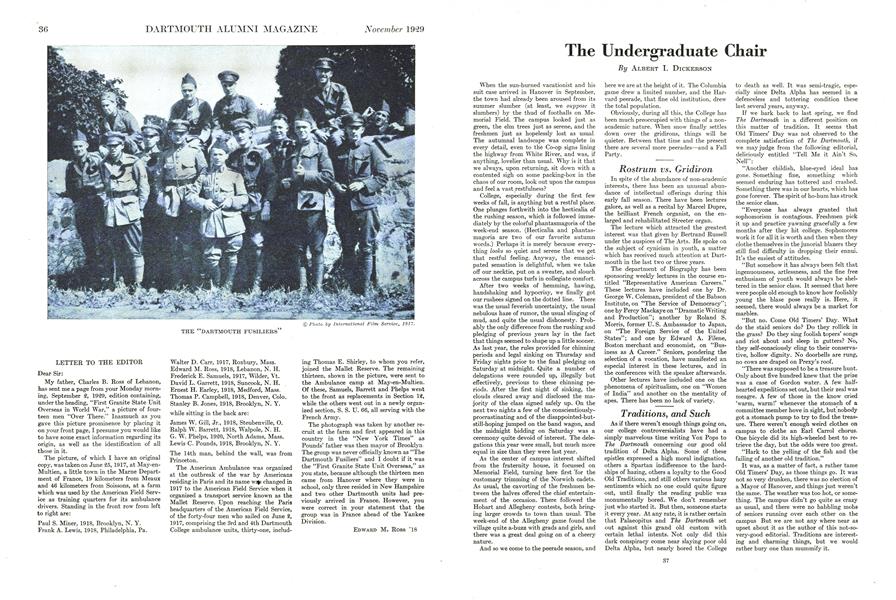
My father, Charles B. Ross of Lebanon, has sent me a page from your Monday morning September 2, 1929, edition containing, under the heading, "First Granite State Unit Overseas in World War," a picture of fourteen men "Over There." Inasmuch as you gave this picture prominence by placing it on your front page, I presume you would like to have some exact information regarding its origin, as well as the identification of all those in it.
The picture, of which I have an original copy, was taken on June 25,1917, at May-en- Multien, a little town in the Marne Department of France, 19 kilometers from Meaux and 46 kilometers from Soissons, at a farm which was used by the American Field Service as training quarters for its ambulance drivers. Standing in the front row from left to right are:
Paul S. Miner, 1918, Brooklyn, N. Y. Frank A. Lewis, 1918, Philadelphia, Pa,
Walter D. Carr, 1917, Roxbury, Mass. Edward M. Boss, 1918, Lebanon, N. H. Frederick E. Samuels, 1917, Wilder, Yt. David L. Garrett, 1918, Suneook, N. H. Ernest H. Earley, 1918, Medford, Mass. Thomas P. Campbell, 1918, Denver, Colo, Stanley B. Jones, 1918, Brooklyn, N. Y. while sitting in the back are: James W. Gill, Jr., 1918, Steubenville, O. Ralph W. Barrett, 1918, Walpole, N. H. G. W. Phelps, 1920, North Adams, Mass. Lewis C. Pounds, 1918, Brooklyn, N. Y. The 14th man, behind the wall, was from Princeton.
The American Ambulance was organized at the outbreak of the war by Americans residing in Paris and its name ws|s changed in 1917 to the American Field Service when it organized a transport service known as the Mallet Reserve. Upon reaching the Paris headquarters of the American Field Service, of the forty-four men who sailed on June 2, 1917, comprising the 3rd and 4th Dartmouth College ambulance units, thirty-one, including, ing Thomas E. Shirley, to whom you refer, joined the Mallet Reserve. The remaining thirteen, shown in the picture, were sent to the Ambulance camp at May-en-Multien. Of these, Samuels, Barrett and Phelps went to the front as replacements in Section 12, while the others went out in a newly organized section, S. S. U. 66, all serving with the French Army.
The photograph was taken by another recruit at the farm and first appeared in this country in the "New York Times' as Pounds' father was then mayor of Brooklyn. The group was never officially known as "The Dartmouth Fusiliers" and I doubt if it was the "First Granite State Unit Overseas," as you state, because although the thirteen men came from Hanover where they were in school, only three resided in New Hampshire and two other Dartmouth units had previously arrived in France. However, you were correct in your statement that the group was in France ahead of the Yankee Division.
THE "DARTMOUTH FUSILIEHS"
Letters to the Editor
-
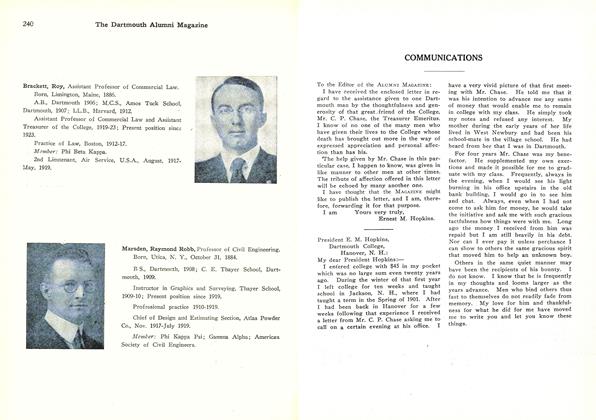 Letters to the Editor
COMMUNICATIONS
January 1924 -
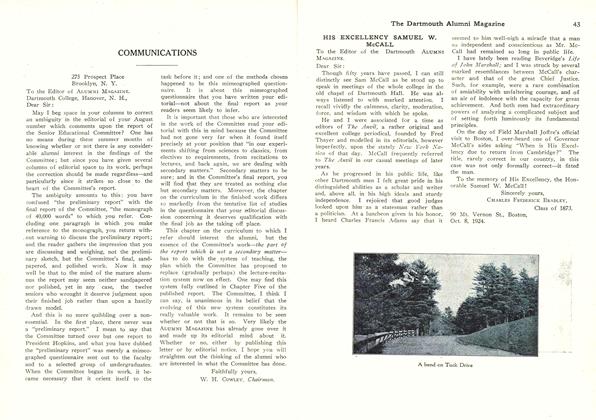 Letters to the Editor
COMMUNICATIONS
November, 1924 -
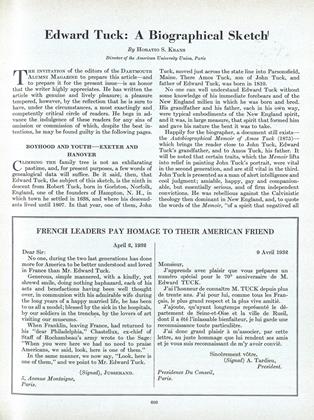 Letters to the Editor
FRENCH LEADERS PAY HOMAGE TO THEIR AMERICAN FRIEND
JUNE 1932 -
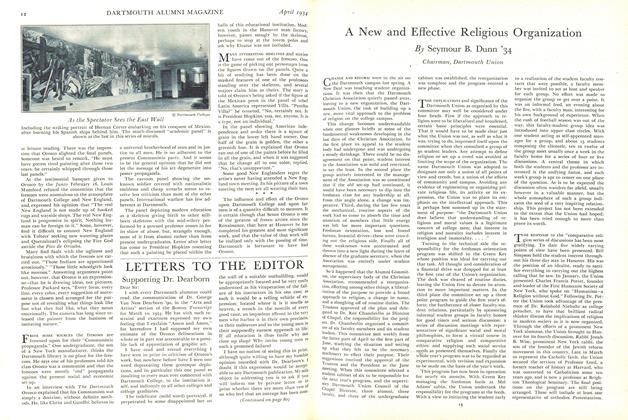 Letters to the Editor
LETTERS TO THE EDITOR
April 1934 -
 Letters to the Editor
LETTERS
APRIL 1959 -
 Letters to the Editor
Letters to the Editor
JANUARY 1973
