Modern Ski Technique
Part II—The Crouch—Turns
IV. THE CROUCH
A n outstanding characteristic of the new ski techer nique is the use of a crouch in down-hill running, instead of the erect style which has formerly been the accepted position.
Hannes Schneider, who is generally considered to be the greatest teacher of skiing in the world, was the originator of the new "Crouch" or "Arlberg Technique." So famous has Schneider become that thousands of skiers go every year to his ski school in Arlberg in the Austrian Alps.
Schneider first gained prominence because he was able to ski on slopes so steep that no one had been able to negotiate them before. He had perfect control at very high speed on the steepest slopes. Other skiers asked him how he was able to do it. They told him that the erect position had always been considered proper for descending steep slopes. He replied that he cared not what was considered correct, and that he skied in a crouch because he was more secure, due to the low center of gravity. Other things in Schneider's style of skiing were contrary to what had formerly been considered correct form. Skiers argued with Schneider, whose only answer was that he skied as he did because it was the only way that he was "able to negotiate the very steep Alpine slopes and always keep the skis under control.
Soon a group of expert skiers, who were keen students of the subject, worked with Schneider and analyzed his technique in accordance with scientific principles, with the result that a new "school" of skiing was originated which taught what is commonly known as the "Arlberg Technique."
A typical crouch position is shown in the accompanying picture. The knees are thrust forward and the body is bent so that the skier's shoulders are near his bent knees. He is so low that he could touch the snow with his hands. One foot is slightly advanced. Heels are firmly on the skis, although they might sometimes be raised for a moment. Hands are in front of the knees, with poles pointed toward the rear. The two common errors made by beginners are that they bend the body but do not thrust the knees way forward, and that they too often lift the heels from the skis.
The skier changes from a deep crouch to a more erect position and back again as the conditions of snow, slope, and speed vary. The steeper the slope, the greater the speed, and the more icy and slippery the snow the deeper the crouch; On slippery or icy snow the feet may be separated to give a better sideward balance. The advantage of a lowered center of gravity under certain conditions is as great to the skier as to a charging football player.
Another advantage of the crouch is that on rough bumpy snow the bent knees act as shock-absorbers. For example, when a trail is filled with drifts that resem- ble waves the knees are bent sharply as the skis glide over the crests of the waves, and then the legs are straightened or partially straightened as the skis drop into the troughs.
FALLING
If the skis get out of control so that the skier is apt to fall, it is better to pick the place and method of falling, and then deliberately fall, than take too many chances and get going so fast that it is impossible to fall with safety. If you must fall, assume a low crouch position and then fall to the rear and to the side. Forward falls are more dangerous.
GETTING UP
Nothing takes a skier's energy more than falling and getting up. To get up with a minimum amount of energy first un-scramble the skis and poles. Then, lying on your side, get the skis down-hill from you. Get them parallel and at right angles to the slope, that is, in a horizontal position. The illustration shows the proper position of skis, legs and body as the skier is about to get up with the assistance of the poles.
V. THE TURNS
LEARN" CONTROL FIRST
A FEW years ago the beginner started by seeing how fast he could go without falling. In this way he did not acquire confidence quickly. Nor was the method conducive to safety. The modern ski .technique teaches control first. With control comes confidence. Then speed comes gradually, but there is always control. The skier rides his skis, is not run away with by his skis. With control there is safety, and a thrill of accomplishment, instead of merely the thrill of being run away with. The secret of control is mastery of the turns. The turns herein described should not be regarded as ends in themselves, but as means of giving control under varying conditions of snow, slope and speed. Every turn, every "stunt" in skiing has its use sometime, somewhere.
After showing the fundamentals and the various turns in detail we will tell of the application of these in practice, using the three-mile down-mountain race on Mt. Moosilauke as an example.
DOUBLE STEMMING
Double stemming is a most useful method of lessening speed and stopping on gentle slopes, and is especially useful in trail running. Proficiency in double stemming may well be called the foundation on which the different methods of ski-control characteristic of the modern ski technique are built. In many leading European ski schools pupils are drilled on this until they can do it perfectly before they are allowed to try any of the turns. We cannot over-emphasize the importance of the constant practising of this fundamental.
The illustration shows the skier in double stem position. Points of skis are nearly together and ends of skis are wide apart. Note angle of legs. The skier's weight is evenly divided between both skis. The arms are relaxed in front of the body with poles pointing out and to the rear. Upper part of body is bent slightly forward. At the start of the double stemming skis are kept as flat as possible. To lessen the speed or stop, widen the position of the skis by straightening the legs, and also simultaneously edge the skis. This is the position shown in the picture. To again go forward, flatten the skis.
DOUBLE STEM TURN
The double stemming described above where both skis were equally weighted was for a straight descent. TTTI 1 • 1 1 . _
When a skier has learned to do this with both skis flat and with feet well separated he will easily learn the double stem turn. The position of the skis is the same as in double stemming, but the weight is shifted to the outside ski. For example, to turn to the left swing your weight over the right ski by bending the right knee and straightening the left knee. Swing the right shoulder forward. Keep both skis as flat as possible. The more the outside ski is weighted, the stronger the swing of the outside shoulder, the shorter will be the turn. When the turn to the left has been completed the skis are still in the stemming position and you can turn to the right by weighting the left ski as you weighted the right ski when turning to the left.
The double stem turn is not especially adapted for fast running.
FLAT SKI GUIDANCE
Another very important difference between the new technique and the old is in ski guidance. The older technique started most of its turns with the skis edged. The curved point of the ski tends to turn it to the side which is edged. But if the edged ski is weighted it cuts a rut in light or soft snow from which it is often very difficult to turn the ski. If the ski continues in this rut a turn is impossible, and a fall usually results.
A ski held flat can be turned easily, and the modern ski technique starts all its turns, with the exception of the open Christiania, with both skis flat. In the latter part of many turns the skis may be edged. It is natural to edge the skis when they are at right angles to the slope, and by edging the skis it is possible to stop more quickly after the turn is started. If the snow is hard, there is not so great a disadvantage if the skis are edged at the beginning of a turn. But when the snow is light or soft it is better to start the turn with the flat ski guidance. The skier who remembers this and gets this habit so that it becomes automatic to keep the skis flat will save himself many a fall:
Flat ski guidance is one of the reasons why the mastery of the turns is so much easier to learn now than it was under the old technique.
SINGLE STEM BRAKE
In traversing steep slopes and in narrow trails a useful means of lessening speed is the single stem brake, or "stemm fahren." The skier crouches on his uphill ski, which carries most of his weight. The illustration shows how the skier stems with his edged downhill ski to slacken his speed.
SINGLE STEM TURN
The single stem turn is a much used and very important feature of the modern ski technique. It can be used in deep and in heavy snow as well as in light snow. It is not as useful on frozen snow and at very high speeds as turns to be described later. Proficiency in this turn means that other turns will be learned easily.
To turn to the left, put all the weight on the left ski for a moment as the flat right ski is skidded into a stemming position. Now shift the weight to the outside (right) ski as the right knee is bent and the left leg is straightened. At the same time swing the right shoulder forward. Hold both skis as flat as possible. Keep most of the weight on the right ski until it has turned as far as desired. Then slide the flat unweighted inside ski beside and parallel to the outside ski, weighting both skis equally.
You can now start a turn to the right, by putting the weight on the right ski while the left ski is skidded into stemming position. Then shift the weight to the left ski and make the turn similarly to the one to the left.
In the double stem turn previously described both skis are kept in the stemming position all the time, and are not brought to a parallel position at all. After each single stem turn the skis are brought parallel.
LIFTED STEM TURN
On extremely steep slopes and in deep heavy snow one of the most useful of turns is the lifted stem turn. This is one of the quickest methods of turning or stopping.
This is very similar to the single stem turn, except that the weight is shifted to the outside ski more quickly than in the single stem turn, and the inside ski is lifted out of the snow and is placed beside and parallel to the outside ski after the turn is completed, or nearly completed. The turn can be made even sharper if the inside pole is inserted in the snow just as the turn is started.
JUMP TURNS
The jump turn is the quickest way to change direction or to stop. It may be made with or without the use of poles, on the level, on gentle or steep slopes, and in light or heavy snow. It is the only practical turn in very heavy breakable crust. Because of the strain on the ankles at landing this turn should never be used where there is little snow on the ground or where the-landing is hard.
The first jump turn a skier should practice is from a standstill on the level, and without inserting poles. From a low crouch position, with knees and ankles touching, quickly and energetically straighten knees and body as you twist the body around. With knees and ankles touching lift the knees as near your chest as possible. The skis, which have left the snow, quickly follow the turning body. The legs are straightened and knees and ankles are slightly separated as the skis are again put into the snow. One foot may be lightly advanced on landing. As soon as the skis strike the snow the knees are bent for a moment to absorb the shock of landing. Both poles swing with the body. The more degrees through which the skier wishes to jump the more energetically must he make the spring and the higher must he lift his knees.
The same principles of crouch, spring, and landing are used in making a jump on gentle or steep slopes. It is a comparatively easy turn to learn.
Most jump turns made when in motion are made with the help of one or both poles. The manner of using one pole is shown in the picture series. As the skier lands from the jump he should lean in somewhat to prevent being thrown out by his momentum. The place where the feet land is also important. The pictures show the skier making a turn to his left. If his feet had landed too far to the left he would have fallen backward; while if his feet had landed too far to the right he would have fallen forward. When landing the ankles are bent so that the skis are sharply edged to the inside.
As the landing may be a great strain on the ankles, inexperienced skiers should not attempt this turn at too high speeds.
When two poles are used they are brought forward together and inserted near the point of the ski on the side to which the turn will be made.
OPEN CHRISTIANIA
The open Christiania is a turn which has been used by skiers for a great many years. This turn is often used to stop at the end of a run. It is a typical turn "toward the slope." That is, if a skier is going down a hill obliquely to the right this turn might well be used to turn toward the right, or up-hill; but some other turn which gives a better sideward balance would be a much better turn to use in going to the left, or downhill. The open Christiania can be used at any speed.
This turn is sometimes called the "steered" Christiania because the turning is steered by the inside ski which is advanced, turned inward, edged, and weighted. The unweighted outside ski is held flat and follows the inside ski around. Both knees are slightly bent. When the skis start to turn the skier presses on the inside heel and leans inward. If he bends his knees and lowers his center of gravity he is less apt to fall. After the skis are again nearly parallel the outside ski may also be edged inward.
THE TELEMARK
Another turn which has been used a great many years and which has a beautiful swing is the telemark. This is primarily a turn for soft snow. Due to the position of the skis the forward and back balance is good, but the sideward balance is correspondingly poor.
Here are a few suggestions in regard to the telemark to supplement the explanation with the picture series. Most of the weight is on the left ski as the right ski is advanced and turned toward the left. As the right ski is then edged inward and weighted, the skier turns to the left. The sharper the turn, the more the skier must lean inward to prevent being thrown outward by his momentum. All movements in figures one to three are continuous and smooth.
(To be continued)
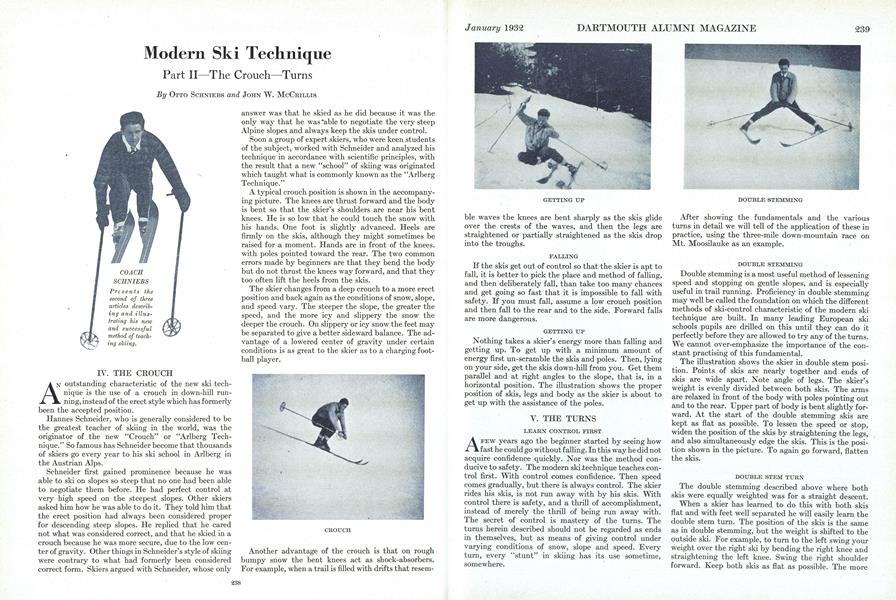
COACHSCHNIEBSPresents thesecond of threearticles describing and illustrating his newand successfulmethod of teaching skiing.
CROUCH
GETTING UP
DOUBLE STEMMING
DOUBLE-STEM TURN
1 Having just completed a double stem turn to the right, the skier has his weight mostly on his left ski.
2 Right shoulder and right pole start to swing forward as skier weights right ski.
3 Outside ski weighted more as outside knee is bent and inside knee is straightened.
4 Outside ski carries the weight. Outside shoulder and pole swing farther around.
4 Outside ski is still weighted as the turn is continued. Outside shoulder and pole are swung farther around.
6 Turn is completed, and skier is ready to turn to right. Both skis are held as flat as possible throughout the turn. Note that heels are firmly on the skis at all times.
SINGLE-STEM TURN
1 Skier is in medium crouch position. Skis parallel.
2 All weight is on left ski as right ski is held as flat as possible and skidded into stemming position.
3 Right ski is stemmed more, making greater angle with left ski. All weight still on flat left ski.
4 Weight is shifted from left to right ski.
5 Right knee sharply bent, left knee straightened. The right ski is slightlyadvanced. Left ski as flat as possible. Right shoulder swung forward.
6 Flat left ski has been brought parallel to right ski. When turn is completed weight is evenly distributed between both skis.
SINGLE STEM BRAKE
THE "JUMP TURN"
1 The skier is in a medium crouch with feet and knees close together. One ski is a very little ahead of the other. Both hands are near the knees.
2 Left pole is brought forward. Both feet still flat on skis. Feet and knees are close together.
3 Shows moment of inserting left pole, preparing to straighten both knees as shown in Fig. 4.
4 Straighten knees suddenly, together with a turn of body toward left. Turning starts with the head, shoulders follow, then body, legs, and at last, skis.
5 The body is already straightened more and turned to the left. Right shoulder and arm swing sharply with left hand resting on pole to support body. Skis still running straight.
6 Skis now leaving the snow and follow very fast the turning body. Both feet and knees close together.
7 Skis at highest point with knees near the chest. The skier leans wholly on his left pole. Preparing for the landing he slightly opens skis.
8 A moment before this picture knees were slightly straight Bened and now they bend again to break the shock of landing. Like a spring the skier goes down
9 And up again. On landing the skier leaned inward to prevent being thrown outward by his momentum.
1 Skier is running straight in a medium crouch. Knees close together. One ski slightly advanced.
2 Left ski is advanced, turned out, edged on left side, and weighted. Right ski is still running straight, absolutely flat.
3 Inside heel is weighted heavily, pushing rear of inside ski down-hill, making the turn sharper.
4 Left ski is still leading and turning with right ski following.
5 Right ski is brought nearer left and is now also edged. Note how poles are held throughout the turn.
6 This shows the track of an open Christiania.
1 Skier in medium crouch. Both skis flat.
2 Right ski advanced and turned left. The next instant right ski will be somewhat edged and pushed forward till right foot touches tip of left ski.
3 Right ski weighted and edged inward, kneesbent. Left ski is guided around by its tip which touches right foot. Whole trunk is turned left and leans inward.
4 Shows how center of gravity may be lowered by bending knees and bending body forward. Note position of flat left ski which is guided by right foot.
5 Left foot brought for-ward. Body raised. Note bending of knees as well as position of poles throughout turn.
6 Track of the beautifully curved Telemark.
More From This Issue
-
 Article
Progress and Prosperity: A Suggested Program
January 1932 -
Article
Progress and Prosperity: A Suggested Program
January 1932 -
 Article
Commentary: Cabot on Ames
January 1932 -
Article
Commentary: Cabot on Ames
January 1932 -
 Class Notes
CLASS OF 1926
January 1932 -
 Class Notes
CLASS OF 1905
January 1932