Class of 1895
A. J. Crosby has sent me the following clipping from the Boston Globe:—"Everybody's grateful to New Hampshire,which is to restore the old covered bridgeat Hooksett instead of building a modemone." "A. J." regrets the elimination of the old covered bridge across the Connecticut at the foot of the Hanover hill. His comment on the clipping is, "This illustratesmy point of view on old bridges. I am gladto see that others feel as I do."
I saw John Hayes at his office in Boston not long ago. He suspended all office activity while we chatted about the College and different men of the class. John is still writing and publishing scientific
* Thomas Maule, The Salem Quaker, and Free Speech in Massachusetts Bay, with biographical notes. matter concerning patents. He and Ernest Gile lunch together frequently, and both are planning on a fishing trip in the near future on Gile's Lebanon estate.
While motoring through Derry, N. H., I had the pleasure of a short visit with Harlan Cochran at his office there. He is in the insurance business. He reports that he sees "Willie" Wight now and then driving into town from his farm near Derry.
Arthur Bugbee's brother, Edmund ]., Dartmouth 1891, spent the winter in California. He recently motored from California to White River Junction. He states that "Bug" is a very busy man, although retired. "Bug" himself writes me that he is "doing nothing -with all my might andmain. Was reelected senior warden of St.Mark's (P. E.) church. During past year wecleaned up a floating debt of about Jt/000, paid off final mortgage on church, $2500,and start the year with money in the bank.Quite an achievement in these days. I hadmy daughter Catherine and family downover Thanksgiving Day. Her husband,Dartmouth '23, is minister of Cong, churchin Ogden, Utah. Also had my sister (Dr.Marion) on for a couple of weeks' visit."
Austin is the most advertised man in the class. The well-known magazine NewYorker issued a large brochure some time ago profusely illustrated, describing the ant palaces manufactured by Austin at Hanover. Here are a few excerpts from this brochure:
"A fascinating story—true, too!—about ants and a man in New Hampshire who built them an ANT PALACE and what it all means to Big Business—told by Eustace Tilley of The New Yorker, 25 West 45th St.
"This story has a lot of different names in it, so please follow carefully. "It starts way up in New Hampshire with a man named Austin.
"Austin is a retired citizen who has spent an abnormal amount of time watching ants. A few years ago he started building little houses for them. Two sheets of glass with dirt in between. "Ant Palaces," he called them, which is a ritzy title and has a certain amount of allure.
"In the Palaces he had queen rooms, banquet halls, watch towers, tunnels, and other necessary conveniences.
"And now, a few words about these ants of Mr. Austin's. We can't resist telling you something about them. It's part of the story anyway.
"The more Austin watched his ants, the more he got to know their private habitslike eating and mating, birth, death, and their pursuit of happiness. He became astonishingly familiar with queen ants, nurse ants, and worker ants. He found them to be skilful and unselfish and ingenious.
"He found that he could put food in the banquet hall and all the ants would troop in to eat regularly—just like boys at Hotchkiss or St. Mark's or Nutley High
"During the ten days following the appearance of the Ant Palace item only two were sold as a direct result of it.
"And then .... then .... Things began to pop.
"On December 10 twelve New Yorker readers wrote, phoned, or trudged up four steep flights to the Lawder apartment to purchase Ant Palaces. They said they had read an item in The New Yorker.
"On December n ten more New Yorker readers succumbed to the desire—trudged up. bought Ant Palaces.
"It was just the beginning, folks.
"During the week of December 11-18, the House of Russell-Lawder got telegrams, letters, air mail messages, from all over thecountry! From Santa Fe and Los Angeles and Aiken, S. C., and Toronto.
"People even phoned from Hartford, Conn., Boston, and Philadephia."
The swankey magazine Fortune, March number, had an article on Austin and his ants, from which the following is extracted:—
"The Austin Ant Palace is a cross section of a working ant colony. It consists of two pieces of glass, about a foot and a half, set parallel, an inch apart, in a wooden frame. Between the pieces of glass is dirt in which ants live and work. They tunnel, build, mate, eat, wash (twenty times or more a day), bury their dead in special burial grounds, carry the eggs and larvae around, feed each other. In short they work, and when their work is done they make more work. It is all completely fascinating, especially if you like nothing better than hanging around building excavations watching other men work. You feed the ants a few grains of sugar or a bit of honey or a dead cockroach and have to do nothing else for them. The ant palaces cost $5 each, complete with ants.
"They are built by Mr. F. E. Austin of New Hampshire, a beetle-browed, plainspoken gentleman of sixty or seventy, who used to teach engineering and mechanics at the Thayer School of Civil Engineering, which is affiliated with Dartmouth. He retired a few years ago on his savings, which the depression soon wiped out. He took to teaching manual training, and one day a student showed him a half-exposed ant colony. Next day Mr. Austin made his first ant palace, and soon was selling them to friends, schools, museums, and curious people."
The March number of Judge also bursts out about our famous classmate. It says in part:—.
"Send a check to the Austin Workshops, Hanover, N. H. (We often wondered when we clung to the popping radiators up there so many decades ago, while real Dartmouth men were taking nasty falls on skis, just what the old place would come to, twenty years hence.) Now we know—an Ant Factory: (Shades of Tucker, Webster, and Choate!). Anyway, your $3.50 will bring you a neat wood frame, attractively carpentered and painted, which holds two sheets of window glass about a half inch apart. Between the glass is a miniature coal mine effect, with a main shaft, galleries, earth, sand, etc., and ants—about a hundred.
"For sheer entertainment, they've got the 'Wizard of Oz,' 'Why Not Try God?' 'What Price Glory,' and 'The Five Little Peppers' fanning the air. Here is Life in the raw. Here is Birth, and Romance (clean, though), and Toil, and Death, right under your nose. Here is your own life, my land, and an incredible duplication of your own yeasty, confused society. The ants are better organized, though—they have only one party, and just a few queens, for fun. They're smarter, too, we think, because they don't seem to be under any delusions that their future lot is going to make them any happier, wealthier, or wiser. Not those babies—they just shoot the chips today and let the next generation worry about the ant soldiers' bonus."
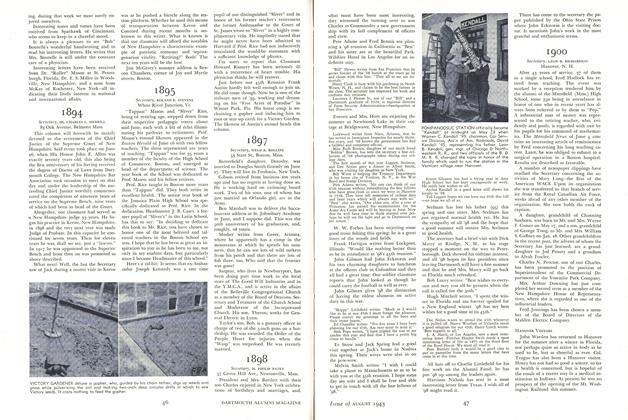
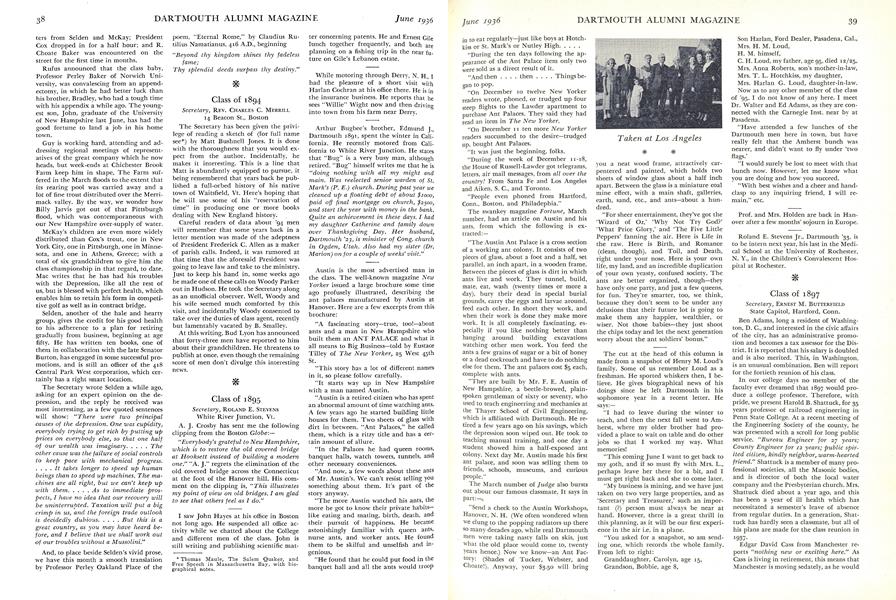
The cut at the head of this column is made from a snapshot of Henry M. Loud's family. Some of us remember Loud as a freshman. He sported whiskers then, I believe. He gives biographical news of his doings since he left Dartmouth in his sophomore year in a recent letter. He says:—
"I had to leave during the winter to teach, and then the next fall went to Amherst, where my older brother had provided a place to wait on table and do other jobs so that I worked my way. What memories!
"This coming June I want to get back to my 40th, and if so must fly with Mrs. L., perhaps leave her there for a bit, and I must get right back and she to come later.
"My business is mining, and we have just taken on two very large properties, and as 'Secretary and Treasurer,' such an important (?) person must always be near at hand. However, there is a great thrill in this planning, as it will be our first experience in the air i.e. in a plane.
"You asked for a snapshot, so am sending one, which records the whole family. From left to right: Granddaughter, Carolyn, age 15, Grandson, Bobbie, age 8,
Son Harlan, Ford Dealer, Pasadena, Cal., Mrs. H. M. Loud, H. M. himself, C. H. Loud, my father, age 95, died 13/25, Mrs. Anna Roberts, son's mother-in-law, Mrs. T. L. Hotchkiss, my daughter, Mrs. Harlan G. Loud, daughter-in-law. Now as to any other member of the class of '95, I do not know of any here. I meet Dr. Walter and Ed Adams, as they are connected with the Carnegie Inst, near by at Pasadena.
"Have attended a few lunches of the Dartmouth men here in town, but have really felt that the Amherst bunch was nearer, and didn't want to fly under 'two flags.'
"I would surely be lost to meet with that bunch now. However, let me know what you are doing and how you succeed.
"With best wishes and a cheer and handclasp to any inquiring friend, I will remain," etc.
Prof, and Mrs. Holden are back in Hanover after a few months' sojourn in Europe.
Roland E. Stevens Jr., Dartmouth '33, is to be intern next year, his last in the Medical School at the University of Rochester, N. Y., in the Children's Convalescent Hospital at Rochester.
Taken at Los Angeles
Secretary, White River Junction, Vt.