In Memoriam: Raymond Pearl
Distinguished Member of Class of 1899 Eulogized By H. L. Mencken For Qualities of Mind and Spirit
fThrough the courtesy of author andpublisher the following tribute by H. L.Mencken is reprinted from, the November24 issue of the Baltimore Sun. RaymondPearl '99, professor of biology at JohnsHopkins University, died November 17. ED.]
PEARL WAS one of those enormously diligent and enterprising men who really need two lives to do their work in—one for the plowing and planting and another for the harvest. I have never heard of any other student of mankind, save maybe William Graham Sumner, who undertook a more formidable collection of materials on the subject; and Pearl's was more orderly and significant than Sumner's, though perhaps of narrower scope. The thing that interested him was not man the poet and prophet but simply man the mammal—man as a living creature like any other, man the unstable aggregation of more unstable man in process of borning, living and dying, man in health and disease, man developing and man decaying.
Virtually all his work since he came to Baltimore in 1918 was in that field, and he had enough pertinent matter in hand, to say nothing of the additions he was making to it every day, to keep him busy for years to come. Out of it had issued a long series of highly original and valuable books, beginning with "Studies in Human Biology" in 1924 and ending with "The Natural History of Population" last year, but he had hardly begun to mine it, and the best was plainly ahead.
At the time of his death he was in the midst of a sort of summary to date—a formal and full-length report on man the animal, aimed mainly at other special students of the subject, but also offering plenty of interest to the more intelligent general reader. Its outlines, I suspect, were suggested by the classical work on ants by his old friend, the late William Morton Wheeler, and maybe its germ came from Huxley on the crayfish; but beyond those elements it was all Pearl, and, to judge from his accounts of what he had in mind, it was Pearl at his best.
Like both the famous biologists I have just mentioned, he was the master of an extraordinarily fluent and charming expository style. Though he dealt habitually with figures, and they are traditionally dull, he never wrote a dull paragraph in his life. Even in his textbooks he managed to write beautifully, and when the scientific harness was loosened a bit he showed an almost mischievous delight in putting words together. His book notices in the Quarterly Review of Biology were miles from the stodgy stuff that fills so many scientific journals. When he encountered a quack, he performed upon that quack with hosannas for the pleasant opportunity, and the result was often a piece of satirical writing of the first caliber. The late Dr. Basil Gildersleeve had the same taste and the same skill, but both are rare in the faculty.
I am, of course, not competent to estimate Pearl's professional work, but I may perhaps testify, as a layman, that what I could take in of it greatly enlarged my own ideas, and set me upon inquiries that were certainly not unprofitable. As one convinced that what the world chiefly needs is not so much to learn more as to believe less, I was especially stimulated by his relentless and effective war upon bogus facts and false assumptions within his own field. He cleared off, in his time, an immense mass of rubbish, and he opened many an area of investigation that had been long resigned to darkness.
There was, of course, no touch of messianic passion in him, and he disliked messiahs as he disliked all other varieties of romantics. Even when, as in the case of the birth-control movement, he found himself in collaboration with persons of a generally constabulary cast of mind, he was always careful to distinguish clearly between the facts in hand and their moral and transcendental implications. On the question of the facts he had plenty to say, and he said it with great clarity, but he had serious doubts about the possibility of perfecting the human race, and he let them be known just as clearly.
His general information was immense, and he was the complete antithesis of the specialist of fable, grubbing forever in a single groove. His reading appeared to cover the whole range from the Greeks to the New Republic, with incidental excursions into all sorts of strange byways. I well recall the winter when he wallowed in Lucian, and only a little while back he discovered the "Lacon" of C. C. Colton, and pressed it on me as a pungent book by an extremely original man—a clergyman who shed the cloth to become a professional gambler. In "To Begin With," his one venture into homiletics, he opened with this from Lucretius, "I love to approach the untasted springs," and summed up with the following tribute to Sumner's "Folkways": This great book. .. .offers no advice. But it exposes in complete nudity and objectivity the bases of hum an behavior. It is an interesting commentary on the state of civilization that it is still regarded somewhat dubiously in our colleges. Ideas certainly are dangerous.
"To Begin With" was addressed to young scientificoes, and its aim was to fit them for life in a Good Society devoted not only to the drudgery of the laboratory but also to sound eating and drinking, the chase and scotching of gamey quacks, and playing the French horn. Pearl's counsel was mainly very wise, as it was always very amusing, but there is no evidence that it had any substantial effect upon the thought stream of the nascent Ph.D.'s, and in his later days he talked darkly of revising it and trying again.
The books it listed ranged from Charles S. Peirce's "Theory of Probable Inference" to James Branch Cabell's "Straws and Prayer-Books," and from F. C. C. Schiller's "Formal Logic" to H. Warner Allen's "The Wines of France." It was, if nothing else, a testimony to Pearl's incredibly wide range of reading and speculation, and it also bore evidence of the sentiment that lurked in him, for among the seventy books listed were several that had little other claim to place save the fact that they were the compositions of men he knew and liked.
His delight in music was lifelong and profound, and showed none of the affection that is unhappily only too prevalent among music lovers. As a man of science, it might have been assumed that he'd be especially interested in the rigid mathematical discipline known as harmony, but as a matter of fact he had little curiosity about it, and seldom expressed any opinion about it. He had an instinctive preference for good music, just as he had an instinctive preference for good victuals and good wine, and he let it go at that. He was not concerned about the way the thing was written, but only about its effects, and un- der the influence of those effects he let himself go, and got all the innocent joy that a cat gets out of catnip.
,When he came to Baltimore in 1918 he was but little known here, and no news of his musical tendencies had reached the local amateurs. He was introduced to the Davidsbund by his colleague, Max Broedel, and straightway became a salient figure in it. He knew all the wind instruments more or less, and his favorite at the time was the basset-horn, or tenor clarinet, a somewhat somber pipe that is little played, though both Mozart and Mendelssohn loved it and wrote for it.
Why he abandoned it I do not know, but I have always suspected that there may have been an answer in the disparity between a performer of his heroic bulk and an instrument hardly larger than a riding whip. Whatever the cause, he switched suddenly to the large and more florid French horn, and to it he devoted thereafter many hours of his meager leisure. It would be an exaggeration to say that he became a virtuoso, but he nevertheless learned to play competently, and no one on this earth ever got more joy out of playing. Whenever he was in especially good spirits he would seize his horn and blow the famous solo in Richard Strauss's "Don Juan," with an extra loud blast at the thrilling leap of the octave.
Few more charming fellows ever lived, and few will be more bitterly missed. His death was entirely unexpected, and app eared irrational, for he came of a longlived family (his father died less than a year ago), and he was, despite the hypochondria that always accompanies association with medical men, apparently in excellent health. But now he is gone, and there ends a pleasant and unforgettable chapter in more than one other life.
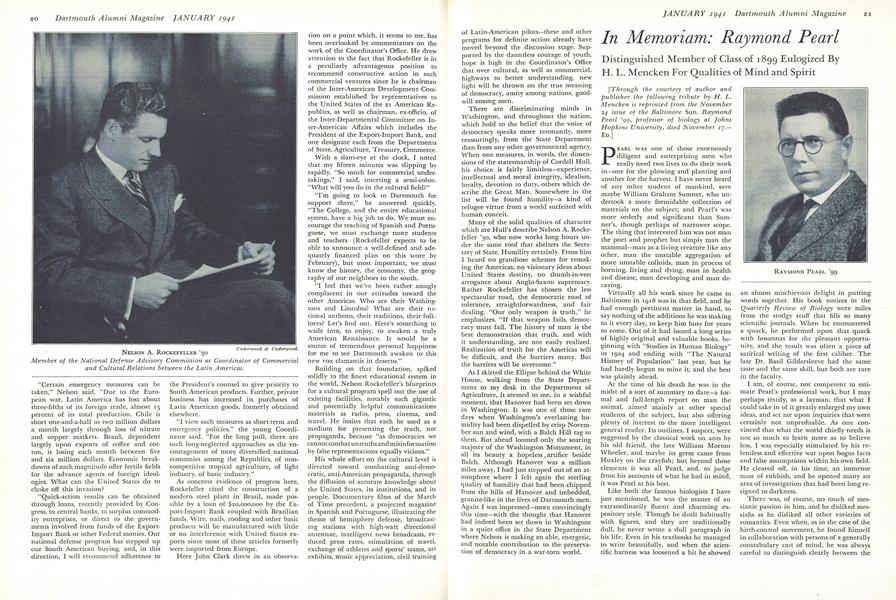
RAYMOND PEARL '99