Forgotten Dartmouth Men
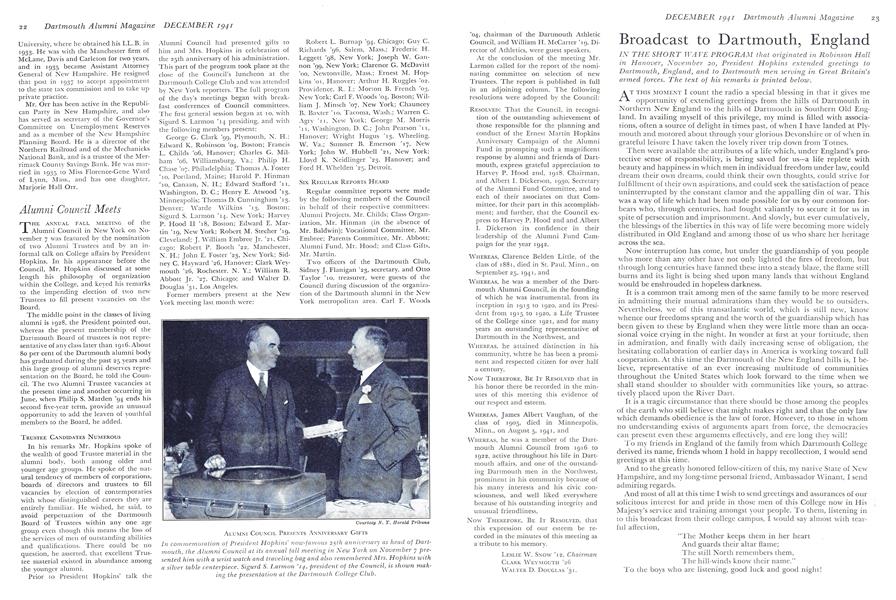
As A DARTMOUTH GRADUATE, I have always been interested in the Professorship that Oliver Wendell Holmes held at Dartmouth from 1838-1841. The material concerning his Hanover residence is indeed limited: before his death, Mr. Associate Justice Holmes, son of the poet-doctor-professor, wrote me that he had no knowledge of his esteemed father's professorship in Anatomy and Physiology other than that which might be found in his collected works.
In consulting the History of DartmouthCollege dealing with 1838, I find that in that year the professors' salaries were raised to $900; that of President Nathan Lord to $l2OO. Through a rearrangement of subjects in the Medical School, Oliver Wendell Holmes became one of the four new professors. In a letter to Professor Mussey, one of the displaced Faculty members, Dr. Holmes wrote as follows: Boston, July 12th 1837Dear Sir,
I have received your polite letter and reflected as much as the time has allowed upon the subject to which it relates. I am now prepared to answer your proposition in the affirmative, Should the Professorship in ques- tion be offered to me, I should be willing to accept, and feel myself honoured in sustaining its duties and responsibilities, and I would devote my best efforts to maintain the char- acter of a chair from which so much will be demanded. Of my desire to be adept in the work of medical instruction, to single out a special object of intellectual pursuit, to re- pay in some measure the sacrifices demanded by a protracted education, I need not speak to one who has passed through the same ordeal. And certainly no office in any of our colleges would be more in accordance with my present tastes and feelings than the one you have done me the honour to mention. I must leave entirely to yourself the task of ascertaining and of representing the circum- stance which recommend or disqualify me for those important duties which to be well discharged require the union of high natural qualities and thorough intellectual training. Yours very respectfully O. W. Holmes." Professor Mussey"
Dr. Mussey, the displaced Medical Faculty member to whom Dr. Holmes wrote had marked and stubborn ideas about the subject of diet, avoiding in his own case all alcoholic beverages, tobacco, and meat, even going so far as to believe that a vegetable diet would bring consumptives back to normal health. Dr. Mussey had been a member of the Bowdoin College Faculty from 1831-1835, as a visiting lecturer. From Dartmouth he went on in 1852 to found the Miami (Ohio) Medical College.
Now in the possession of Dartmouth College, a lecture ticket admitting a student to one of Dr. Holmes' lectures reads as follows:
DARTMOUTH COLLEGE Lectures on ANATOMY & PHYSIOLOGY Admit Mr. Charles D. Cleavland Oliver W. Holmes Professor
August 8, 1839 The credentials of Dr. Holmes proved highly satisfactory. He writes from Boston on August 7, 1837 to Arthur Partens, M.D. of Providence, Rhode Island
"I have just had official notice of my ap- pointment as Professor of Anatomy in Dart- mouth College. Mussey and Oliver quit after this course. Mussey's office is divided—l have anatomy—a N Hampshire man—Crosby1 I believe, has surgery, and Bartlett of Lowell has Physiology &c in Oliver's place—Of course I am not obliged to abide there except dur- ing lectures. I think this is a very excellent appointment and as I do not lecture until next August I shall have plenty of time to get ready. Yours affecty OWH"
Kate Sanborn, the authoress, tells us that the poet looked so young at the time of his arrival in Hanover that he was asked by a somewhat facetious person if he had come to join the Freshman Class, (on account of his youth and small stature)! He is further described as being charming company, witty, and bubbling over with fun and laughter. He arrived at Hanover on July 25, 1838 in company with Ralph Waldo Emerson who gave an oration that evening before the literary societies of Dartmouth.
Holmes appears to have been greatly pleased with his Dartmouth Professorship. During that period he described the Connecticut River loitering down from its mountain fastnesses "like a great lord swallowing up the small proprietary rivulets very quietly as it goes." He refers to the small country hotel where he lived in Hanover as "That caravansary on the banks of the stream where Ledyard launched his log canoe, and the jovial old Colonel used to lead the Commencement processions"; and he refers to the Norwich Hills just across the Connecticut as "the hills of Beulah," and to his Sunday walks under "my elms" which took him by the peaceful common to a certain beech tree, the goal of his pleasant purposeless stroll, in view of Mount Ascutney, "that mountain filling the south-west."
The later-practicing doctor who offended his aristocratic Boston Clientele by hanging out a sign—"All fevers gratefully received," made his lectures very attractive to his students, spiced up as they were by his own native humor. In one case he gave an examination by placing in one bag all of the bones of the hands and feet. Then each student drew one out in turn, locating and describing the bone in particular. Thereupon Holmes would state— .
"They can't do this at Harvard."
One day when he was riding near Williams College, a group of students greeted him and called for a speech. He rose in the wagon and inappropriately began"Gentlemen of Dartmouth." At another time while coming into Hanover to deliver a poem he met on the stage a lady wearing a string of gold beads; and in the evening he brought out in the poem both the lady and the beads when he says, "Wears unchanged her mother's golden beads."
Dartmouth College has a record of purchases which the Medical Professor made at that period, presumably just before entering upon his lecture duties: "O. W. Holmes in account with Dartmouth Dr. By cash received from Dixi Crosby, M.D $300 Cr. Osteological preparations procured from Paris, in 1839 102.00 Morbid specimens procured at the same time 20.00 Male skeleton 25.00 Female do 20.00 Anatomical syringe 28.00 Diseased bones procured from Paris in 1840 66.90 Two casts of adom. viscera 20.00 Incidental expenses and freight of first importation in 1839 5.75 Transportation of anatomical objects to Hanover 6.00 Freight of second importation .... 1.00 Transportation to Hanover, etc. ... .75 Printing numbers for museum .... 1.00 Separated cranium 3.00 $299.40 Set of bones for demonstration .... 25.00 $324-40 Subtract for Otto 4.20 ?320.00
I find no record of Holmes subsequent visits to Dartmouth until about twenty years later on Commencement Day, 1858, when he substituted—"pinch-hitting we should call it today"—for the illustrious Rufus Choate as orator on invitation of the Phi Beta Kappa Society with a most witty remark to the effect that he could hardly be expected to fill the place of the expected speaker (who was a very large man), but that he would try to rattle around in it, continuing further to say
"If a party of travellers, expecting to witness an eruption of Vesuvius, should be met by a deputation of magistrates and informed that, owing to unforeseen circumstances, the eruption would not take place, but that instead of it they would burn several Roman candles and a pinwheel, the reception of the gentlemen making such an arrangement might be respectful, but would hardly be enthusiastic."
From this statement, his address led into a masterly production of poets and poetry.
Thus endeth the pleasant and significant, yet brief, associations of Oliver Wendell Holmes with Dartmouth College.
Oliver Wendell Holmes—Dartmouth Professor
1 Dr. Dixi Crosby bought the house facing the Dartmouth Campus about 1838 and lived there until his death. In 1884, the family sold the mansion to the College; and in 1896 the College converted the residence into a dormi- tory, calling it Crosby Hall from the name of its last previous owner.