1919*
I have just learned of the death about a year ago of Emory Miller. He was employed as an accountant by Harris Trust & Savings Bank Chicago and since his death, his wife has been working for the bank. Emory had not been active in Class affairs in recent years and we have little information about his life as an alumnus. He attended Dartmouth 1915-18 and was a member of Kappa Kappa Kappa.
I acknowledge holiday greetings from Dr. -Lester M. (Snake) Felton, John (Stuffy) Carr, Adelaide and Paul Clements, Dot and Jim Pelletier, the Davises, Larry McCutcheon, Helen and Max Norton, Hal Parsons, Ken Huntington, Ed and Bea Martin, Doris and John Ross, Fred Blanpied, Dr. Denis T. (Denny) Sullivan, Stubby Stoughton and his family.
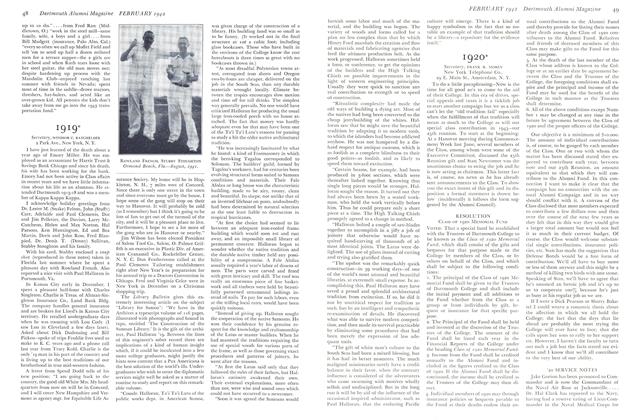
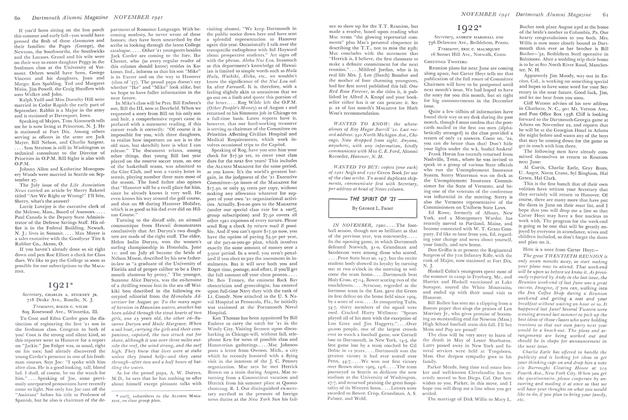
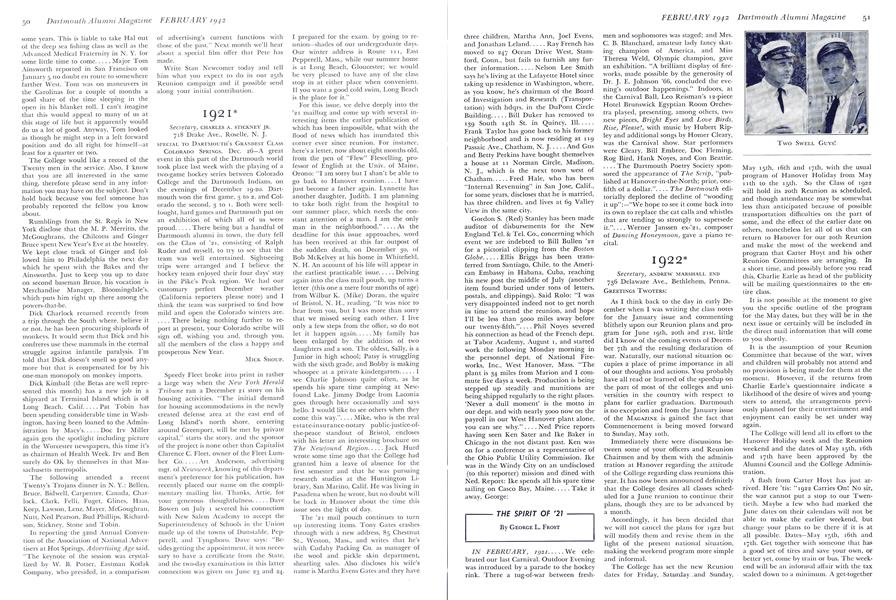
With his card, Stubby enclosed a snapshot (reproduced in these notes) taken in Florida last summer where he spent a pleasant day with Rowland French. Also reported a nice visit with Paul Halloran in Portsmouth, Va.
In Kansas City early in December, I spent a pleasant half-hour with Charles Singleton. Charlie is Treas. of Altman-Singleton Insurance Cos., Land Bank Bldg. The company handles general insurance and are brokers for Lloyd's in Kansas City territory. He recalled undergraduate days when he was rooming with Lou Cody (I saw Lou in Cleveland a few days later). Asked about Dick Dudensing and Bill Picken spoke of trips Freddie Ives used to make to K. C. years ago and a phone call last year from Tracy Kohl. Charlie is the only '19 man in his part of the country and is living up to the best traditions of our brotherhood in true mid-western fashion.
A letter from Spend Dodd tells of his new position: "I am going back to the country, the good old White Mts. My headquarters from now on will be in Concord, and I will cover New Hampshire and Vermont as agency mgr. for Equitable Life Assurance Society. My home will be in Hopkinton, N. H., 7 miles west of Concord. Since there is only one street in the town and since everyone must go by the house, I hope some of the gang will stop on their way to Hanover. It will probably be cold (as I remember) but I think it's going to be lots of fun to get out of the turmoil of the city, and it will be a pleasant place to live. Furthermore, I hope to see a lot more of the gang who are in Hanover or nearby."
Jim Wilson has been elected President of Salem Tool Cos., Salem, O. Palmer Griffith is an executive in Plastic Div. of American Cyanamid Cos., Rockefeller Center, N. Y. C. Dan Featherstone called at the Paul Clements Tailoring establishment right after New Year's in preparation for his annual trip to a Doctors Convention in Chicago. Fred and Virginia Celce were in New York in December on a Christmas shopping trip.
The Library Bulletin gives this extremely interesting article on the subject "Library for Samoa": "We have in the Archives a typescript volume of 116 pages, illustrated with photographs and bound in tapa, entitled 'The Construction of the Samoan Library.' It is the gift of the architect, Paul Halloran '19. Between the lines of this engineer's sober record there are implications of a kind of human insight which, if it could be inculcated into a few more college graduates, might justify the hints now current that a Pax Americana is the best solution of the world's ills. Undergraduates who wish to enter the diplomatic services might well be asked as a matter of routine to study and report on this remarkable volume.
"Comdr. Halloran, Ta'i Ta'i Latu of the public works dept. in American Samoa, was given charge of the construction of a library. His building fund was so small as to be funny. (It worked out in the final structure at io<f a cubic foot; including glass bookcases. Those who have built in the environs of the College know the cost hereabouts is three times as great with no bookcases thrown in.)
"As most dreadful Polynesian towns attest, corrugated iron sheets and Oregon two-by-fours are cheaper, delivered on the job in the South Seas, than any durable materials wrought locally. Climate between the tropics encourages slow motion and time off for tall drinks. The simplest way generally prevails. No one would have criticized Halloran for producing the usual large iron-roofed porch with no house attached. The fact that money was hardly adequate even for that may have been one of the Ta'i Ta'i Latu's reasons for pausing to study a bit the older native architectural tradition.
"He was increasingly fascinated by what he found: a kind of Freemasonry in which the hero-king Tagaloa corresponded to Solomon. The builders' guild, formed by Tagaloa's workmen, had for centuries been evolving structural forms suited to Samoan conditions and materials. Their Fale Afolau or long house was the characteristic building, made to be airy, roomy, clean and beautiful. Its shape, not unlike that of an inverted lifeboat on posts, undoubtedly had been determined by natural selection as the one least liable to destruction in tropical hurricanes.
"At first the choice had seemed to lie between an adequate iron-roofed frame building which would soon rot and rust away, and an impossibly small library of permanent concrete. Halloran began to wonder whether the native tradition and the durable native timber held any possibility of a compromise. A Fale Afolau usually required a year's labor of dozens of men. The parts were carved and fitted with great intricacy and skill. The roof was really an enormous piece of fine basketwork and all timbers were held by beautifully patterned ornamental lashings instead of nails. To pay for such labors, even at the trifling local rates, would have been quickly ruinous.
"Instead of giving up, Halloran sought the cooperation of the native Samoans. He won their confidence by his genuine respect for the knowledge and craftsmanship of the Latus or master builders. When he had mastered the traditions requiring the use of special woods for various parts of the frame, as well as those governing exact procedures and patterns of joinery, he went after the reasons.
"At first the Latus said only that they followed the rules of their fathers, but Halloran's curiosity awakened their own. Their eventual explanations, more often than not, were wise and sound ones which could not have occurred to a newcomer.
"Soon it was agreed the Samoans would furnish some labor and much of the material, and the building was begun. The variety of woods and forms called for a plan no less complex than that by which Henry Ford marshals the creation and flow of materials and fabricating agencies that feed the ultimate production belt. As the work progressed, Halloran sometimes held a fono, or conference, to get the opinions of the builders and the High Talking Chiefs on possible improvements in the light of western engineering principles. Usually they were quick to sanction any real contribution to strength or to speed of construction.
"Ritualistic complexity had made the old ways of building a dying art. Most of the natives had long been converted to the cheap jerrybuilding of the whites. Halloran saw that he might save the beautiful tradition by adapting it to modern tools, to which the islanders had become addicted anyhow. He was not hampered by a diehard respect for antique customs, which is as foolish as a complete blindness to their good points—as foolish, and as likely to speed them toward extinction.
"Certain beams, for example, had been produced in 3-foot sections, which were thereafter lashed together. Knowing that single long pieces would be stronger, Halloran sought the reason. It turned out they had always been hewn by a seated workman, who held the work vertically before him. Thus he could prepare only a short piece at a time. The High Talking Chiefs promptly agreed to a change in method.
L X J -o "Halloran bolted a couple of saw-blades together to accomplish in a jiffy a job of joinery that otherwise would have required hand-carving of thousands of almost identical joints. The Latus were delighted. The use of plans instead of cutting and trying also gratified them.
"The upshot was the remarkably quick construction—in 39 working days of one of the world's most unusual and beautiful libraries, at extremely small expense. In accomplishing this, Paul Halloran may have saved a proud and splendid architectural tradition from extinction. If so, he did it not by uncritical respect for tradition as such, but by an intelligent and sympathetic re-examination of details. He discovered what was able to survive modern competition, and then made its survival practicable by eliminating some procedures that had been merely the expression of less adequate tools.
"The gift of white man's culture to the South Seas had been a mixed blessing, but it has had its better moments. The much maligned missionaries surely have a credit balance in their favor, when the contrary influence is considered of the adventurers who came swarming with motives wholly selfish and undisciplined. But in the long run it will be by aid of the influence of the occasional inspired administrator, such as Paul Halloran, that the enduring Pacific culture will emerge. There is a kind of happy symbolism in the fact that so notable an example of that tradition should be a library—a repository for the evidence itself."
ROWLAND FRENCH, STUBBY STOUGHTON Ormond Beach, Fla.—August, 1941.
Secretary, 2 Park Ave., New York, N. Y.