'Round the Girdled Earth
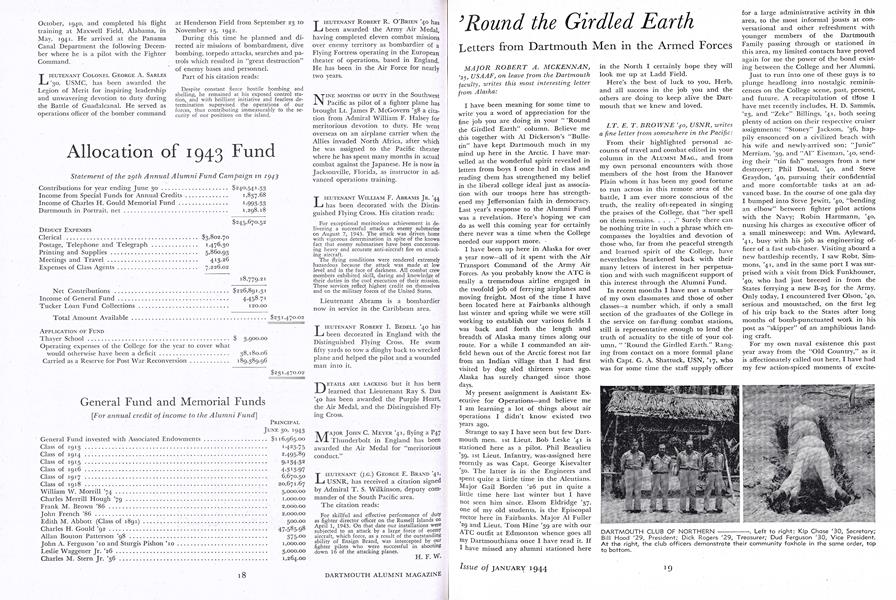
Letters from Dartmouth Men in the Armed Forces
MAJOR ROBERT A. MCKENNAN,'25, USAAF, on leave from the Dartmouthfaculty, writes this most interesting letterfrom Alaska:
I have been meaning for some time to write you a word of appreciation for the fine job you are doing in your " 'Round the Girdled Earth" column. Believe me this together with A 1 Dickerson's "Bulletin" have kept Dartmouth much in my mind up here in the Arctic. I have marvelled at the wonderful spirit revealed in letters from boys I once had in class and reading them has strengthened my belief in the liberal college ideal just as association with our troops here has strengthened my Jeffersonian faith in democracy. Last year's response to the Alumni Fund was a revelation. Here's hoping we can do as well this coming year for certainly there never was a time when the College needed our support more.
I have been up here in Alaska for over a year now—all of it spent with the Air Transport Command of the Army Air Forces. As you probably know the ATC is really a tremendous airline engaged in the twofold job of ferrying airplanes and moving freight. Most of the time I have been located here at Fairbanks although last winter and spring while we were still working to establish our various fields I was back and forth the length and breadth of Alaska many times along our route. For a while I commanded an airfield hewn out of the Arctic forest not far from an Indian village that I had first visited by dog sled thirteen years ago. Alaska has surely changed since those days.
My present assignment is Assistant Executive for Operations—and believe me I am learning a lot of things about air operations I didn't know existed two years ago.
Strange to say I have seen but few Dartmouth men. ist Lieut. Bob Leske '4l is stationed here as a pilot. Phil Beaulieu '39, ist Lieut. Infantry, was-assigned here recently as was Capt. George Kisevalter '3O. The latter is in the Engineers and spent quite a little time in the Aleutians. Major Gail Borden '26 put in quite a little time here last winter but I have not seen him since. Elsom Eldridge '37, one of my old students, is the Episcopal rector here in Fairbanks. Major A 1 Fuller 29 and Lieut. Tom Hine '39 are with our ATC outfit at Edmonton whence goes all my Dartmouthiana once I have read it. If I have missed any alumni stationed here in the North I certainly hope they will look me up at Ladd Field.
Here's the best of luck to you, Herb, and all success in the job you and the others are doing to keep alive the Dartmouth that we knew and loved.
LT. E. T. BROWNE '4O, USNR, writesa fine letter from somewhere in the Pacific: From their highlighted personal accounts of travel and combat edited in your column in the ALUMNI MAG., and from my own personal encounters with those members of the host from the Hanover Plain whom it has been my good fortune to run across in this remote area of the battle, I am ever more conscious of the truth, the reality oft-repeated in singing the praises of the College, that "her spell on them remains " Surely there can be nothing trite in such a phrase which encompasses the loyalties and devotion of those who, far from the peaceful strength and learned spirit of the College, have nevertheless hearkened back with their many letters of interest in her perpetuation and with such magnificent support of this interest through the Alumni Fund.
In recent months I have met a number of my own classmates and those of other classes—a number which, if only a small section of the graduates of the College in the service on far-flung combat stations, still is representative enough to lend the truth of actuality to the title of your column, " 'Round the Girdled Earth." Ranging from contact on a more formal plane with Capt. G. A. Shattuck, USN, 'l7, who was for some time the staff supply officer for a large administrative activity in this area, to the most informal jousts at conversational and other refreshment with younger members of the Dartmouth Family passing through or stationed in this area, my limited contacts have proved again for me the power of the bond existing between the College and her Alumni.
Just to run into one of these guys is to plunge headlong into nostalgic reminiscences on the College scene, past, present, and future. A recapitulation of those I have met recently includes, H. D. Sammis, '23, and "Zeke" Billings, '4l, both seeing plenty of action on their respective cruiser assignments: "Stoney" Jackson, '36, happily ensconced on a civilized beach with his wife and newly-arrived son; "Junie" Merriam, '39, and "Al" Eiseman, '4O, sending their "tin fish" messages from a new destroyer; Phil Dostal, '4O, and Steve Graydon, '4O, pursuing their confidential and more comfortable tasks at an advanced base. In the course of one gala day I bumped into Steve Jewitt, '4O, "bending an elbow" between fighter pilot actions with the Navy; Robin Hartmann, '4O, nursing his charges as executive officer of a small minesweep; and Wm. Ayleward, '4l, busy with his job as engineering officer of a fast sub-chaser. Visiting aboard a new battleship recently, I saw Robt. Simmons, '4l, and in the same port I was surprised with a visit from Dick Funkhouser, '4O, who had just breezed in from the States ferrying a new B-25 for the Army. Only today, I encountered Iver Olson, '4O, serious and moustached, on the first leg of his trip back to the States after long months of bomb-punctuated work in his post as "skipper" of an amphibious landing craft.
For my own naval existence this past year away from the "Old Country," as it is affectionately called out here, I have had my few action-spiced moments of excitement amid many quieter cruises—at present it's some more of the latter.
I presume that the alumni will soon again be campaigning for funds for the College, this time for a 1944 Alumni Fund drive to exceed the high mark of the 1943 campaign so recently concluded. That high mark will be a difficult but extremely worthwhile one to shoot at. The necessity of "giving till it hurts" in financial support of that institution which is a prime mover for that way of intellectual freedom and democratic community of constructive endeavor, which comprises a part of that life for which we fight today, is all the more essential in view of the lads who by giving their all in this fight have dropped from the ranks of contributors. To those of us who remain falls the added opportunity of kicking in now with not only a contribution for ourselves but a bit for those classmates and friends who did their utmost early in the race.
COMMANDER JOHN H. CHIPMAN'l9 writes me a heart warming letter fromthe "Levant States" which I reproduce infull.
The August issue of the DARTMOUTH ALUMNI MAGAZINE reached me here in the Levant States and after reading all the articles and most of the Class Notes and necrologies, it was with reluctance I put it down. Wonder when I shall receive the October number? But along comes your welcome letter of October 29th in right good time as an appreciated supplement.
You can't travel any where "Round the Girdled Earth" without finding a Dartmouth man. Sometimes it amazes me how soon one finds out his new acquaintance went to Dartmouth too. As you know I flew the Atlantic with Gene Markey 'lB and we roomed together at Shepheard's for about two and a half months until he went to India and I came north here. Frank E. Bailey around '24 joined us there and George Arnold 'lB was about 125 miles north of us. One night at dinner at Harvard Camp in candle and moonlight in the shadow of Khephren, the second largest of the Pyramids at Gizeh, our conversation naturally turned toward home and in no time I was talking Dartmouth with a young man of '4l.
Nowhere in the orient is the pioneer spirit of democracy more manifest than here in the American University. The indispensible assistant of Dr. Dodge, the renowned president of the University, is Leslie Leavitt who has been continuously building here since his graduation from Dartmouth in 1916. "It (too) is only a small college but there are those who love it." The yeast of Dartmouth doctrine placed in the whole here is working wonders. In fact it has been a potent factor in the present birth of a nation now taking place. I don't know how many of the present Lebanese leaders were educated at the University but I do know they are aware of the meaning "The American Way of Life" and they choose that way for Lebanon. The spirit of Dartmouth and the spirit of "The American Way" are of the same essence. Leslie Leavitt, year after year, has been going his even way, visualizing and interpreting Dartmouth and radiating the true Dartmouth spirit. No military, diplomatic nor academic honors are his, yet the worth of his contribution to the sum total of true values here is beyond measure.
Just now we are seeing here the founding of a new republic, a small but gallant little country which has been almost a perpetual battle ground for longer than 4500 years. The leaders of this people understand the significance of the Atlantic Charter and they believe the United Nations mean this to be a living document. They respect the United States for what she has achieved, starting likewise from a small country. They revere the United States because many tens of thousands of Lebanese live there and have brought peace, opportunity, health and prosperity to their loved ones. Now they want their reign here.
During the dark Middle Ages, the feeble flutterings of Culture and Knowledge found no haven except in the remote monasteries. For a thousand years there was no opportunity or freedom for the masses. During the present dislocation of reasoned, sane Civilization, the opportunity to think, to explore and extend research into the future and natural paths of Progress lies only in such institutions of America as our present colleges. The more liberal the college in its policies and scope of activity, the greater the opportunity to interpret and prove the true values resulting from the operation of the "American Way of Life." Dartmouth stands out among the few institutions of higher learning which have always maintained that the pursuit of culture for culture's sake brings its owr reward. Students enjoying this pursuit during their undergraduate days can investigate and enjoy the "American Way of Life" the rest of their days. This is Democracy in operation, the ideal we strive for but which requires eternity to reach.
Among the many valuable contributions to Dartmouth that Dr. Hopkins has made, none can surpass his "saving" the college. During the present war, the colleges of the United States proved their tangible value to the country as positive military assets. We had no West Point or Annapolis large enough to house and train officers in the great numbers necessary for the demands of our military forces. Dr. Hopkins was the first to recognize that the Dartmouth plant constituted a going concern and suitable supplement to those of West Point and Annapolis. His intuition and foresight suggested a plan. He brought Navy trainees to Dartmouth when other colleges were closing their class rooms. He kept the plant running full force. This accommodation to the Nation was not at a profit to the colleges. No price can equal the value to the country represented by Dartmouth's contribution. Dartmouth men are fighting on all fronts but in simi- lar manner, the very physical plant of Dartmouth has gone to war. She has gone through six wars and it is now sure that Dr. Hopkins is bringing her through the seventh.
It is cause for pride to see how, year after year, Dartmouth alumni respond to the Alumni Fund. This year particularly there are many Dartmouth men who are soldiers and sailors and who regret their service income necessarily limits the gift they are giving. Those gifts will flow to Hanover none the less. Never was the need greater than for the next few years, that extra consideration be given the situation of the college and its service to the armed forces of the United States. Its limited income on that account and the extra demand upon the physical plant are cause for concern. Never was the need greater for financial support. Every alumnus will see this opportunity and will make the best of it. Dartmouth will bear the scars of this war and carry on to greater service in years to come.
MAJOR JOHN W. HUBBELL '2lwrites from war time Washington: THOUGHTS STROLLING AROUND WASHINGTON— Wherever you find Main Street, you find Dartmouth men, and lots of them. That's Boston, or New York, or Chicago, and now it's the Nation's Capital. All men in uniform can't be at the fighting fronts, there's a job to be done at Headquarters, and that means that people in civvies and uniform are doing their stuff here in Washington. To mention only a handful that I've seen recently, there's Major Bill Marcy 'si, Major Rynie Rothschild 'si, who's headed overseas, Colonel Warren Ege 'si, Spike Hamilton, '23, Henry Morgenthau's able man Friday, John Sullivan 'si, John Foster '23, Lt. Col. John Wood '22, Colonel John O'Gara 'lB, Lt. Col. Ed Raisbeck '26, Lt. Col. F. J. McCarthy '26, an added starter in Washington.
The hurly burly of Washington doesn't provide much time for those peace-time sidewalk reunions so common on Main Street in normal times. Football doesn't seem important anymore, and doesn't rate a nod in a conversation, Fall 1943 style. The rah rah spirit is missing. In its place I find a healthier, more profound interest in the welfare of the College, an eagerness to do more and maybe say less, an earnestness that finds an outlet in doing a little extra for the Alumni Fund and the well-being of the College, with possibly a slightly decreased interest in participating to uphold the "glory of the Class." War isn't the best background for the conviviality that normally characterizes College reunions, but it seems to have a wholesome effect on the attitude of her sons for the Alma Mater. The stark realities of war are strengthening the ties and more of us want to do more things worthwhile for the College on the hill that we love so much. The sons will have a war record like the Mother College herself. I'm proud to be one of the Dartmouths who are trying to do their bit here in Boomtown.
I.T. HERBERT MATTLAGE '39,USNR writes from one of our fightingships in the Atlantic.
The other day the ALUMNI MAGAZINE for October caught up with me. Whenever it does—and it's not nearly often enough —I suspend all other activity and settle down for a couple of hours of the most enjoyable reading I know.
One of the best bits of news was that on the success of last year's Alumni Fund. It must be particularly gratifying to all the men who devoted so much of their time and effort to make it a success—but I also think all alumni get a great lift from having a part in this annual tribute.
Much has been said and written since the start of the war by profound thinkers and great educators justifying the continuation of liberal arts colleges in times such as these. It might have been well for anyone wanting to present a case for the liberal arts schools to strengthen his argument immeasurably by citing our college's Alumni Fund results for the year of 1943. To me it seems a vote of confidence from a large percentage of the alumni that Dartmouth supplied a something they believe to be of great value.
Why should this realization be evidenced in so much greater degree now than ever before, I believe that in these days of terrific strife when millions of men are in strange lands and death is an everpresent spectre—true, some of us haven't been in tough spots, and others have lived through all that men could endure—to all in spare moments comes a striving to find a reason or reasons for our fighting. What are we trying to protect? to gain? We think first of families, wives, and sweethearts and then our way of life—and to many of us Dartmouth is at its roots. From her we learned—in class and out, from studies and from that intangible something, the spirit of Dartmouth—to live a fuller life. Therefore, when we're given an opportunity to assure the continuation of an institution so deeply ingrained in us, its only natural for us to respond in this material way. True, there is a certain amount of inertia to be overcome, but the desire is there, and, with the fine job done by class agents and others, this inertia is overcome to a large degree. I believe and trust that the success of last year's drive will be repeated and improved upon in the '44 drive.
For myself and the rest of the '39ers, it's five years out this June and our plans for reunion have been shelved—we'll all be thinking of Hanover plain and vowing to get there as soon as possible when our big job is done. In the meantime our devotion to Dartmouth will be expressed by fighting the good fight where we are and by our contributions to the Fund.
My two and a half years in the. navy have brought me varied duties and carried me to many places. At present, I'm serving aboard the U.S.S. in the Construction and Repair Department. Besides, my duties in that department I'm in charge of the training of new men received aboard ship.
I've bumped into a few Dartmouth men lately but not nearly as many as I'd like. Dick Jackson and Andy Smith '39 had just received promotions when I saw themDick to Lt. (jg), and Andy to Lieutenant, both in the Navy. Also met Dick, Jr. who will be about '65. After a couple of years my path crossed that of my new brother-in-law, Lt. B. K. Ayers Jr. 'gg who has spent much of his time on the cold north Atlantic. Fred Mcßrien sends me a note now and then and when last heard from was a flying officer in the R.C.A.F.
I've rambled on at some length and may perhaps have sounded incoherent in places—but it does me good to sit down and talk Dartmouth. Whenever I've met Dartmouth men we talk of the "good old days" and also the good ones ahead which were, and are, and will be richer because of Dartmouth.
DARTMOUTH CLUB OF NORTHERN . Left to right: Kip Chase '3O, Secretary; Bill Hood '29, President; Dick Rogers '29, Treasurer; Dud Ferguson '3O, Vice President. At the right, the club officers demonstrate their community foxhole in the same order, top to bottom.
ON DUTY AT SEA after the recent graduation from Naval War College, Newport, R. I. Here shown with Capt. T. M. Shock, USN (third from left), are Lts. R. P. Fuller '37, W. W. Wotherspoon '4O, and H. S. Embree '3O, all USNR.
THANKSGIVING DAY IN THE SOUTH PACIFIC finds five Dartmouth men together on a new aircraft carrier. Left to right: Ens. R. Raffman '43, Lt. R. R. Frame '28, Ens. M. Paul Dickerman II '40, Ens. Benj. Farber '33, Lt. Don Hight (MC) '30.
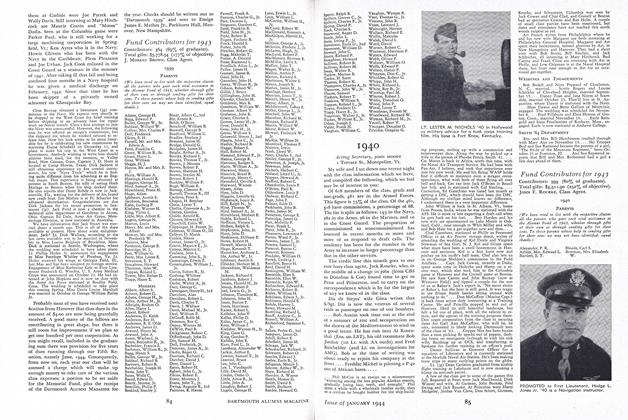
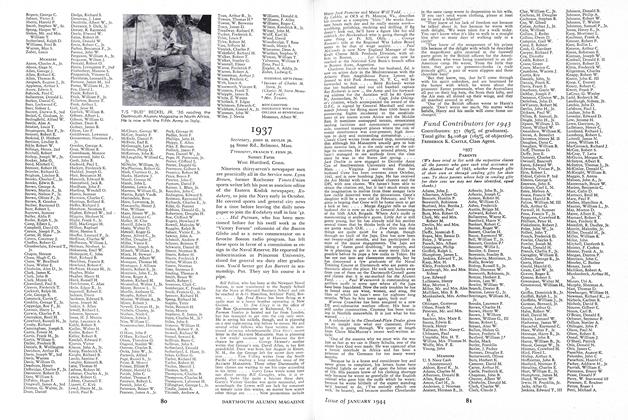
TOOK '23 OVER THE TOP. John E. Moore, '23 class agent, headed the largest class that got 100% of contributors and with fine all-round record was close second in Group II of the 1943 Green Derby sweepstakes.
Lettter from the Editor
-
 Lettter from the Editor
Editorial Comment
June 1929 -
 Lettter from the Editor
Letters to the Editor
November, 1930 -
 Lettter from the Editor
Memoirs of a Great Editor
October 1937 -
 Lettter from the Editor
Letters From Bolte
November 1941 -
 Lettter from the Editor
Dateline Hanover
MARCH • 1986 -
 Lettter from the Editor
"That time of year"
OCTOBER 1984


