1933
The stirring of new life in the hitherto comatose corpus of '33 that we noted with appropriate awe and delight last month continues, we are happy to report, with increasing signs of an early return to full health and vigor. As we move into the homestretch on the Alumni Fund we are still in the van of the classes around us. Fifty percent of our constituency has chipped in to date. The Fund closes on June 30 and we urge those of you who have not yet done so to put your checks in the mail pronto, and while you're at it drop Ripley or yrs. tr. a line about yourselves to help swell the rising tide of '33 news. We have a report from the Treasurer this month, and that too is encouraging. Lee says that we now have a fighting chance of balancing our books for the current fiscal year if you felers continue to send him your four bucks as you've been doing lately.
We're doing well, gang, and I'm going to tell you just one reason why by quoting a couple of sentences from Lee's letter. Lee tells of receiving a check for $4O from one man, and he says, "This gentleman (and I mean that) sent his check with the interesting inscription thereon of 'Back Class of '33 dues to date.' You can well believe that your Treasurer goes for that kind of classmate.' The next day Sam Black wrote to tell us that this same man had also made a very generous contribution to the Alumni Fund. Now perhaps we can't all do as well or as much, but we can do the best we can. Let's do it!
Now for the news. We have a swell letter from medico Phil Byers. Wish we could give you the whole thing but space limitations don't permit. Some of the best bits from it:
"I received an JM.D. from U. of Pa. School, then two years' hospital work and private practice in internal medicine until the trouble started. Have a home in Kansas City, with my wife and two children, Phil, eight, and Betty, three and a half—who are keeping the home fires burning. My Naval Reserve career started in 1939 •—my gosh, five years ago, as medical officer to the Bth Battalion, U. S. Naval Militia, then medical officer of the U.S.S. Wilmington, two and a half years as senior medical officer of a recruiting station, and senior medical officer for the past six months to the fast moving, hard working, tough fighting Seabees Let me tell you something about this World War II child of the Navy Dep't. I helped examine a lot of them as recruits, with prerequisite physical standards that were far below those of any other recruit They were relatively old men, but skilled, and representative of every phase of labor. In spite of their age .... they went through training similar to that of Marine landing forces. It was tough on them, and a few slipped by the wayside, but for the most part they were a hardy lot. .... When I arrived in the South Pacific area, and was informed of my assignment, my hopes for a fighting battle wagon were dashed, but it has turned out better than I thought. These outfits are the most self-sufficient independent organizations in this war. They have done everything, and can do anything. This outfit has spent twenty months out here all in a forward area, and a portion of it has just returned from a two-month stretch in the farthest advanced base in this area, being there when the beachhead was made. And believe me, bulldozers do make beach-heads —often in advance of the commandos. These outfits literally pave the way in this island hopping warfare out here. For their job up there they rated and well deserved a fegimental citation. I was there and I'll vouch for the show; it was a grand one. A fine bunch of officers and men, better than sixty percent married and with children. So don't ever kid yourselves that fathers can't fight wars—they are doing it As for medicine, I, like most military personnel, would probably have my difficulties with a 'Main Street' practice, but we have certainly seen a world of interesting things. I have had the opportunity to care for some natives and they were of tremendous interest with their yaws and leprosy and behold, even influenza, which they had never experienced before we acquainted them with the flora of our respiratory tracts Sorry I missed Lee the last time, but I got the word too late. Mine will be in this time."
Thanks, Lt. Comm. Byers, and best of luck. A card from Lt. (jg) H. "Hop" Hopkins: "After indoctrination at Dartmouth (a fine tenth reunion almost), went to Anacostia, D. C., then at NAS Jacksonville, a month and a half in Newfoundland, and finally six months in England. Have been trying to get to sea for lo these many months—so they finally sent me back to the States and I am now with an operating squadron, as administrative and personnel officer. Hugh Johnson is in the Flag Office Commander Air Forces Atlantic Fleet."
You will be deeply grieved to learn of the death, on April 22, of Molly Hoffman, in Chicago. When Bill was in the Physical Education Department here those of us in '33 who live in and around Hanover came to know Molly well. The announcement of her death came as a great shock to all of us. Bill and Molly went to Montclair from here, and in recent years have made their home in Evanston. Bill has been teaching and coaching at the Chicago Latin School. They have oneson, John. Our deep sorrow and sympathygoes to Bill and John.
From Capt. Ken Jacques-. "About a year ago I joined the Air Force at March Field, Calif, as a Ist Lt., M. C. and went to Carlisle Barracks for six weeks. In July '43 I arrived here at the Key Field Station Hospital where I have remained since as Chief of the Orthopedic Service. In January I acquired another duty as Area Orthopedic Consultant for the Air Force in this area with two other hospitals to visit, one fifty and the other 120 miles away. Last month my Captaincy arrived I've seen none of our classmates here and have been in few other places."
Tom Eastman writes from Tinker Field, Oklahoma: "My Army career so far has been eventful only in getting supplies to combat outfits. I am not a pilot, but have been in Air Corp transportation. I spent a couple of months in India in 1942, and then was with the 9th Air Force through the Egyptian, Libyan, Tripolitanian, Tunisian, and Sicilian campaigns. I was hospitalized in Africa in the fall of '43 and sent back to the States. After spending four months in the hospital I was returned to duty in December of 1943. I.am now assigned to the above tactical outfit Life in the Army is very interesting providing a man always keeps the ultimate reason in view "
Finally, fellows, thanks for all that you've done these past couple of months to make the jobs of Sam Black, Lee Eckels, Frank Ripley, and your secretary more pleasant. Keep up the good work.
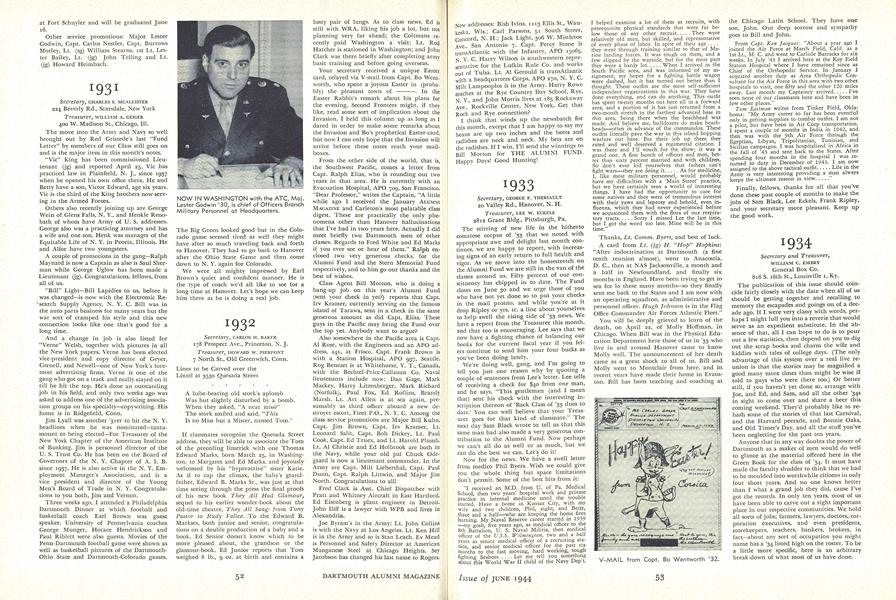
V-MAIL from Capt. Bo Wentworth '32.
Secretary, 20 Valley Rd., Hanover, N. H. Treasurer, 2812 Grant Bldg., Pittsburgh, Pa.