Energy and Man
THE SUCCESS OF the nuclear explosion at the test in Alamogordo and the dropping of the atom bomb on
Hiroshima and Nagasaki were the realization of careful thinking of many physicists and chemists. The fanciful and nebulous hopes of the Nineteen Twenties were gradually crystallized during the Thirties into a definite program of research carried out all over the world. When the key experiments of Hahn and Strassman at Berlin on the splitting of the Uranium nucleus were heard and checked in this country, their implications were immediately realized at the scientific research centers. It was obvious to those on borders of scientific knowledge that the problem of obtaining nuclear energy was solved in principle and it was only a matter of time before it would be attained in practice. The cloud of war and human misery darkened our eastern sky. We all realized that beyond the horizon and in an atmosphere oppressive with Nazi humidity, work was carried out to utilize the principles of nature not only for instantaneous death but also for eternal subjugation of what we best prize in man. The problem American science faced was not a considered exploitation of nuclear energy for the best interest of humanity, but a mad race to beat the enemy to the goal. American science backed by a resourceful technology and an unstinting military establishment, won. The test bomb exploded with expected violence at Alamogordo. The atom bomb flattened Hiroshima and Nagasaki. The war was soon over.
The purpose of this essay is to discuss the phenomenon of the atom bomb. In doing so it will be pointed out that the release of nuclear energy was inevitable. The history of science, as history of any creative achievement of man, is replete with accounts of great men, lofty ideas, clever techniques and interwoven with petty squabbles, sordid hopes and chicanery. It would serve to no purpose in the present discussion to cite all the historical factors which contributed to the tapping of the nuclear energy and the creation of the atom bomb. An attempt will be made, however, to delve into the history and delineate a unifying trend in the background of science that produced nuclear fission. One of the essential methods of the scientific method is analysis. The idea is to so take apart into components a system, that one appreciates the inter-relationships of the various parts of the whole. We learn that way as children. Savages learn that way also in an African jungle. The atom bomb is a result of the desire of man to find out what makes matter tick by taking it apart. To break things apart one needs to apply energy. One way of looking at the history of mankind is to consider it as a discovery of the methods of generation and control of greater and greater amounts of energy. People of the ancient world and the Middle Ages had at their disposal as a source of localized energy the heat of a fire. This energy could be localized and enhanced by means of forced draught and blow pipes. Great as the service of fire was to man, he was able to break up but few substances. Thus by heating the red mercuric oxide he was able to obtain mercury and oxygen. He could accelerate the tarnishing of metals by heating them. Small wonder, therefore that very few of the compounds could be broken up into their constituent elements. Small wonder that the alchemist bent on transmuting base metals into gold, failed. He had to have greater energy to turn that trick.
It is interesting that it was the beginning of the Nineteenth Century that introduced the electrical age. Volta invented the electrical battery and in 1800 Nicholson and Carlisle passed an electric current from such a Voltaic pile through water. The result was astounding. Water which could not be broken up by direct heat, in fact by the greatest heat available at that time, easily broke up at the two poles of the wire. Hydrogen and oxygen were produced. These two elements contained a tremendous amount of stored chemical energy. One only had to put them into a bottle and apply a spark. An explosion sufficient to shatter the flask would result. Soon after, Sir Humphrey Davy melted by direct heat some alkaline caustic and passed an electric current through the metal. Metallic sodium was the product. This again had locked in it large amounts of chemical energy. Sodium and metals produced in a similar way were used to unlock other elements from their union with oxygen. Thus the chemical energy concentrated in the sodium metal was used to break up most of the minerals into their constituent elements. The pioneering work of Nicholson, Carlisle, Sir Humphrey Davy and Michael Faraday inspired the work in physical science during the whole of the Nineteenth Century. It was the work of these men and others that resulted in new materials, new metals, and controllable sources of energy. Higher and higher sources of voltage and current were obtained by piling up more and more batteries and higher and higher energies were localized in matter by using arcs and resistance furnaces.
A new and significant type of experimentation attracted many scientists during the latter half of the Nineteenth Century. A glass tube was fitted at two opposite ends with lead-in wires which went through the glass and terminated just inside the tube. A potential of several thousand volts was impressed on these two lead-in wires. No current passed through the air gap in the tube between the two wires. The tube was gradually evacuated with crude vacuum pumps. As the air was pumped out of the tube it began to glow producing various colors depending on the type of gas with which the tube was originally filled. Everyone is familiar with that type of set-up for it finds its every-day application in the neon lamps and in an indirect way, in the fluorescent lamps. As one evacuated the tube further and further the glow broke into segments and then disappeared. There was still a flow of current through this vacuum and this flow of current was later found to be due to small negative particles, several thousand times smaller than the atom, called electrons. Just fifty years ago Roentgen in Germany discovered that if the voltage is high enough the electrons travel so rapidly through the vacuum between these two wires that when they hit the second wire they emit X-rays. Greater progress was attained in concentrating energy. Now the energy is not localized at the ends of wire from a two-volt battery, nor is it concentrated in a pound of sodium. The energy of an X-ray expresses itself in highly penetrating radiation, radiation which can traverse matter, radiation which can produce burns but which also can diagnose bone fractures and make tumors shrink. Let anyone who draws up an indictment of the men of science for producing the lethal weapons of modern warfare, just stop and add up the innumerable ways whereby science has made the life of every man on this earth less susceptible to ravages of disease and pain. The X-ray, great as its service is in analyzing the structure of matter, led unwittingly to still greater discoveries. Roentgen the discoverer of the X-rays noted that the X-rays cause a glow when they hit glass and they also darken photographic paper. Becquerel thought there was a connection between these two phenomena. To check this idea he used a compound of uranium which fluoresced. It turned out that uranium did blacken the photographic paper and further experimentation led to the discovery of radioactivity. Elements were uncovered which spontaneously broke up, giving off particles whose energy is measured not in thousand of volts as is the energy of X-rays, but close to a million volts. More and more energy concentrated by man's cunning. In 1919 Lord Rutherford in Cambridge first realized the dream of the alchemists: he transmuted matter. Using fast flying atomic projectiles from a radioactive material he changed nitrogen into oxygen and helium into hydrogen. The yield was so small that it required the most sensitive methods of science to detect the result. The atom had been smashed. The reason Lord Rutherford was successful and the alchemists were not was because he could command energies of millions of volts; they did not know what a volt was. Atomic transmutations, modern alchemy, resulted in the transformation of most every one of the ninety elements. Though the yields were low, there was an overall understanding of the energy requirements and energy production in such processes. New machines such as the cyclotron and the betatron were developed to create energy of several million electric volts. The most recent achievement in production of high energy is the ten million volt electron produced by the betatron.
The implications of this cursory historical sketch are clear, the delineated trend may be extended: future years are going to produce even greater concentrations of energy. These in proper hands will lead to greater understanding of the universe and its material contents. In sordid, selfish hands they will create misery beyond the prediction of the gloomiest man.
The equitable distribution of nuclear energy and those sources of energy unachieved as yet by man is the greatest problem of the present. Its solution demands vision of international cooperation unimaginable a year ago. Its realization demands from each of us the same patience, respect and good will toward men of foreign lands which we show toward our fellow-citizens.
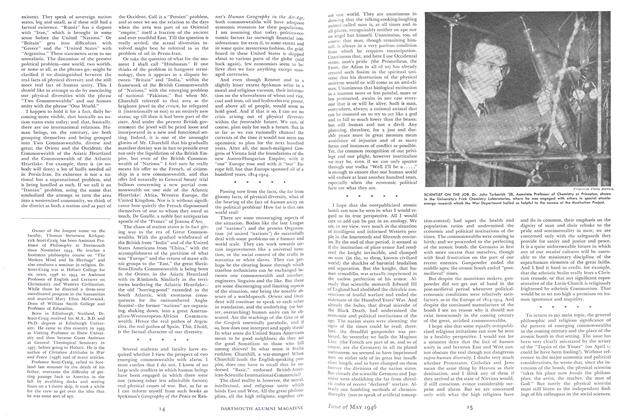
John Turkevich '28 is one of the most brilliant of Dartmouth graduates in the field of science. Combining natural resourcefulness with the capacity for uncalculating industry, his work has always produced tangible results. He received both undergraduate and graduate honors. In college he was elected to Phi Beta Kappa, and at Princeton, where he went to work for his Ph.D., he was named Plant Fellow (1933-34) and Proctor Fellow (1934-35) by that University. For the year 1935-36 he was awarded a Cramer Fellowship by Dartmouth College. He has studied at Cambridge University in England and at Leipzig in Germany. He took his M.A. at Dartmouth and was an Instructor here during 1928-31. At present a member of the Chemistry Department at Princeton, Dr. Turkevich has written for scientific publications and acted as President of the Princeton Chemical Society. Speaking of the life of a research chemist, he says, "It is a pleasure to see the research problems crack open, be solved, and the next one come up for the same process." Some of the toughest of these came up during his work of the past two years when he was working under Dr. S. Taylor in the Frick Chemical Laboratory at Princeton on the atomic bomb project.
ASSOCIATE PROFESSOR OF CHEMISTRY, PRINCETON UNIVERSITY