1946 Alumni Fund Rings Up $416,589
WITH A RECORD-SMASHING TOTAL of $416,589.41 from 13,217 contributors, the 1946 Alumni Fund has gone beyond the most optimistic predictions of Fund officials and has once again made it almost impossible to state in words the accomplishment of the Class Agents. This nearfinal total of July 18 is an all-time high by a margin of nearly $80,000 standing far ahead of last year's record figure of $337,451, and it also represents 119% of this year's objective of $350,000.
The 13,217 contributors for the 1946 campaign are 107 greater than the comparable figure for last year, even though the war classes of 1943 to 1946, now back as undergraduates, gave 293 less gifts. Although 13,348 was the published figure for 1945, that total included 248 memorial gifts from classmates, omitted from the total this year, and the comparable figure for 1945 therefore is 13,110. The participation index for the 1946 Fund is 75%, as compared with 78% for 1945, but since last year the scoring base has been enlarged and the calculation of the participation index refined, so that 75% represents increased participation on the part of all classes except the youngest war classes now back on the campus.
Praise for the work of the Class Agents in the 1946 campaign was expressed by President Dickey when the Fund Office released its July 18 figures. He said:
The workers in any cause know their own: reward; in truth they fashion it. The thanks and appreciation of others is simply a pleasant extra. Certainly that is all my thanks can; be to you who have made the 1946 Fund a landmark in the history of Dartmouth's progress. But I do want you to know that what you personally and your classmates through you have done for Dartmouth is the warmest encouragement any man could know who works in the same cause. I can only add what I told Josh Davis yesterday—the thanks of the College you will see in her men.
Although complete Fund details were lacking on July 18, the winners in the various Green Derby contests were definitely settled as follows:
GROUP I (1898-1907)—1900, Clarence G. McDavitt head agent, with 205% of objective and 194% participation.
GROUP II (1908-1917)—1914, John F. Conners head agent, with 135% of objective and 99% participation.
GROUP III (1918-1926)—1918, Richard A. Holton head agent, with 140% of objective and 95% participation.
GROUP IV (1927-1935) !927, George W. Provost Jr. head agent, with 164% of objective and 78% participation.
GROUP V (1936-1943)—1942, James L. Farley head agent, with 158% of objective and 71% participation.
LITTLE GREEN DERBY (1944-1948)—1947, Edward P. Scully head agent, with 207% of objective and 90% participation.
The classes of 1906 and 1947 divided Green Derby honors on percentage of objective with 207% each, closely followed by 1900 with 205%. The highest cash total contributed was 116,486 by 1927, with 1926 and 1918 virtually tied for second with 114,767 and $14,718 respectively. The fact that 13 classes went over the $10,000 mark this year, as compared with only three in 1945, indicates something of the tremendous gains registered by the classes.
This year's campaign was directed by the Alumni Council's Fund Committee headed by Joshua A. Davis '27 of New York, who for the second successive year steered the Fund to record-breaking achievement. Executive direction in Hanover was provided by Albert I. Dickerson '30 and George H. Colton '35. The new Fund chairman for 1947 will be Richard A. Holton '18 of Brooklyn, N. Y., for many years head agent of his class.
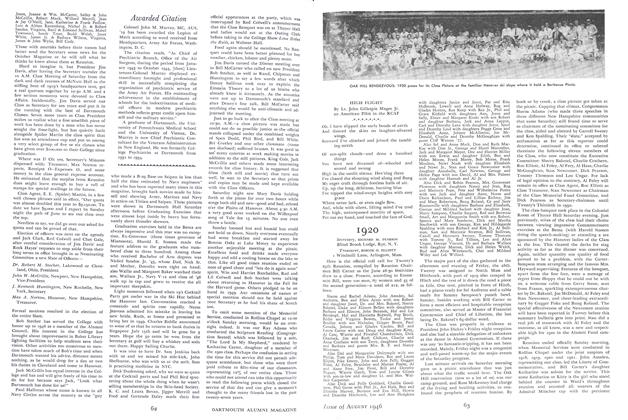
THE SUN IS THE SAME, the sun-bathers are a little different than the usual Hanover group. Ex-Gls and their wives bask behind Fayerweather Row, against a strange back-drop of washing and clothes lines.