1923
Last month we served up for you the first of a series—a long series, we hope—of personal reminiscences written by members of the Class. That one was turned out by PudgeNeidlinger. This month we have one for you by Joe Pick, and we think it will awaken many a memory in many an old breast.
VIGNETTE-1923
"Yes, and have it here no later than ten o'clock tomorrow morning, d'ya understand? See that it looks like something with class; refined, smart, sleek; worthy of the highest honors Judge Flanigan can bestow. And if it smells, buy a dimes worth of Allen's best perfume and pour it over the animal. Now, beat it, and don't come back without something on four feet."
Spring had arrived—and so had additional residents among the dog population. The great event, climaxed by the dog judging contest, had been announced. The event was the Senior Parade, each senior to lead a dog which some freshman had acquired for him, whether by begging, borrowing or stealing—but preferably the latter. Once having the animal, let each man do his best or worst to make the mongrel look worthy of a prize in the Easthampton Kennel Show; but, more important, to win the nod from that astute judge of dog-flesh, that upright (when sober), honest, incorruptible, The Irishman.
At about the appointed hour comes a knock on my door, and my freshman drags in something that looked like nothing I had ever seen before—pint sized, wet, bedraggled, cold and scared. "What's that?," says I. "That, Sir, is a dog."
Assuming that by this time a freshman should know the difference between a dog and a Missouri Mule, I let him get away with it, but with some misgivings.
"Where did you ever find it?" I asked. "I had a terrible time," he whimpered. "I looked all over town—even went to Norwich. When I came back I saw this dog, chased it, tripped over the leash, and that's why I'm all muddy."
The dog was muddy, too. That wasn't all. He, or she—sex uncertain—smelled, and smelled badly. .
With great insight I realized that I had no prize winner unless a magic transformation could be accomplished. Then I spied my roommate's comb, brush, and tonsil spray. Now, for sure, victory was within my grasp.
"Get to work, freshman," said I. "Whatever you brought in has to be combed and curried, and up there are the tools."
He got to work. Gradually, amid valid objections from the beast, the knots were combed out, the pelt smoothed down, and, with the aid of the roommate's vaseline, the hair acquired a lustre of such brilliance that whenever he looked at himself the dog was blinded by the illumination.
And that wasn't all. Ribbons and bows were hung fore and aft, and a tail light somehow affixed to one hind leg. We were ready for all comers.
The parade got under way behind the three-piece band. Proudly I walked with that hound in tow, confident that no other animal could possibly match it for appearance, style, or hair-do.
Along Wheelock Street were the envious onlookers, and each one seemed to have a particular interest in that mongrel of mine.
But suddenly, as if propelled from a gun, from among the crowd a figure of a man rushed at me, hand upraised as if to strike. No! — it couldn't be, but it was _ _ _ my English Prof.
"Where did you get that dog?" he shrieked, turning the Parade into a pandemonium. "That's my dog!" he yelled, at the top of his lungs. "You can have my liquor, you can have my children, yes, you can even have my wife! .... but my dog, never!"
As quickly as he appeared, just as quickly was he swallowed up by the surging crowd, as he dashed away, clutching the gleefully reunited dog tight in his arms.
And there I was, with nothing to show for my freshman's work, no prize, no nothing, only trouble. I passed the course, but my grade was nothing to brag about. JOE PICK
We have caught up with Sherrard Clemens, and can report on his activities since graduation. For four years after graduation he was in the cotton brokerage business. There followed a rather protracted period of illness, then five years of various enterprises including newspaper work and commercial fishing. Since 1935 he has been in glass manufacturing, and is now manager of the Vycor Plant of the Corning Glass works. He and Mrs. Clemens, who was Esther Wilcox, have two daughters and a grandson.
CALIFORNIA, HERE WE COME!
Thinking about population shifts the other day, we got to wondering about the changes which have taken place in the 28 years from 1920 to 1948, so far as the habitats of members of our Class are concerned. So, with the help of the ever-helpful Miss Ford of the Alumni Records office, we got the lists for both years, and worked them over to see what we could find. Our findings are presented below, and should make wonderful reading for people, like us, who love silly statistics. Well, anyhow (1) New England and the Midwest have lost ground to the South, the West, Foreign Countries, and the Eastern Seaboard, in that order. (2) Thirty-four '23 men now live in 10 states which nary a '23 freshman ever called home, and these 10 states and the number of men now living in each are Alabama 1, Arizona 2, Florida 9, Louisiana 2, Maryland 9, New Mexico 3, Oregon 3, S. Carolina 2, Tennessee 2, and Utah 1. (3) The eight men who, in 1920, lived in the six states of Idaho, Missouri, Montana, Oklahoma, South Dakota and Virginia, have all taken off from there, for better or worse, we suppose. (4) There are nine times as many classmates, 27 to be exact, in California now, as there were in 1920. (5) Ten of us are abroad now, compared to four in 1920. (6) Twenty-eight years ago there were three from the D. of C., and now there are fourteen from that locale. (7) Sectionally, the South has gained 389%, the West has gained 85%, foreign lands have gained 18%, and the East has gained 9%. Against these gains, the 15% loss for the Midwest and the 18% loss for New England do not look so rosy. (Massachusetts, by the way, lost 26% of its '23 citizens, who now number only 119). (8) The 582 of us now on deck are distributed this way: New England 218, East 193, Midwest 91, West 46, South 24 and Foreign 10.
We are indebted to Mrs. Philip De Berard for news of her husband and family, down in DeLand, Fla. Phil retired from the bank there last year, and subsequently became Commodore of the Lake Beresford Yacht Club. A married son lives close to the old folks there in DeLand, and a married daughter lives with spouse and youngster in Detroit. Another daughter lives with husband Lt. Cmdr. Karl Brown and their cute two year old in Seattle. Meanwhile Phil Sr. doesn't find it too tough barging around on Lake Beresford with his Commodore's cap at a rakish angle, we suspect.
Here's one from a member of that fine, upstanding group of stalwarts who lived in Thornton 'way back when, George Gibson. "It's a long time since I've seen your jovial countenance—'19 on the second floor of Thornton. I was in with J. Francis Smith, then, diagonally across from you and CharleyHoward. Well, Smith was just beginning to burn up his league then, and the pan was too hot for me. I moved on to Harvard Dental. I've been practicing here in Waterbury, Conn., for 18 years. I'm married, and have a daughter in the freshman class atVassar. Very best regards, Gibson." GRANDPA KIMBALL SPEAKS HIS PIECE "Dear Metz: "Here is the information about me and my family which you requested for the class records: 1. President, W. W. Kimball Company, Chicago. 2. President, Cliff Dwellers Club. 3. Member Board of Governors, Community Memorial General Hospital. 4. Member Village of Hinsdale Zoning Board. 5. Member Village of Hinsdale Board of Appeals. 6.Chairman Dupage County Zoning Appeals Board. 7 Member Union Church, Hinsdale. 8' Three children and three grand-children. 9. Two sons at Dartmouth. "I am happy to say that I have no complaints concerning the conduct of Class affairs, since it is obvious to any but the most prejudiced individuals outside of the Class that it is the best run outfit in the United States, and has always been! Sincerely yours, BUTCH KIMBALL"
FOREIGN DEPARTMENT—CANADIAN SECTION
"Dear Metz: "The subject upon which I am about to discourse is one with which I have been associated all my life and for this very reason I often find myself guilty of gross exaggeration when called upon for a few remarks. "I have also been associated with the A & P for the past twenty-two years or so, since 1929 in Montreal and now Toronto in charge of purchasing for the Canadian subsidiary. "My efforts at raising a family have been fairly successful, reasonably diversified, and unusually prolonged. I have a daughter Jocelyn, a junior at Duke University; a son Tom fourth year high school; and Pat, who is six and one half and who, considering the surroundings, is making fair progress. "My partner in this staggered production is the former Helen Nathan of Newton Centre, Mass., sister of Cushman Nathan, Dartmouth 'l9, who unfortunately lost his life with the RAF in World War One. "I see some of the gang occasionally but unfortunately my trips to the U.S. are limited and of short duration. If and when we get a little relaxation in U.S. funds the situation might improve. I wrote Irish some time back and asked him to remind any of the weary brethren passing through Toronto to give me a call. Sincerely,
GEORGE BIRD"
THE "BACK TO HANOVER THIS SUMMER"MOVEMENT
You and your family are going to enjoy that Rump Reunion you've been planning to take in this coming July, up there on the Hanover Plain. How about needling that old crony who's still undecided, into going along? Read The Skiddoo for complete details, and Be There!
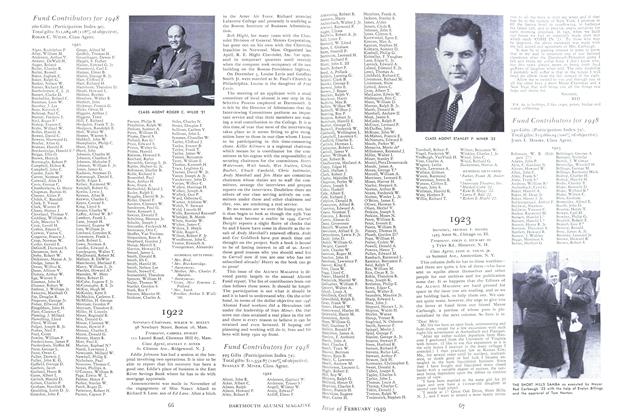
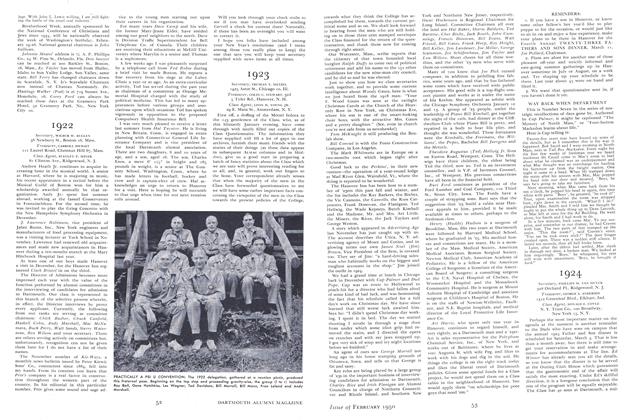
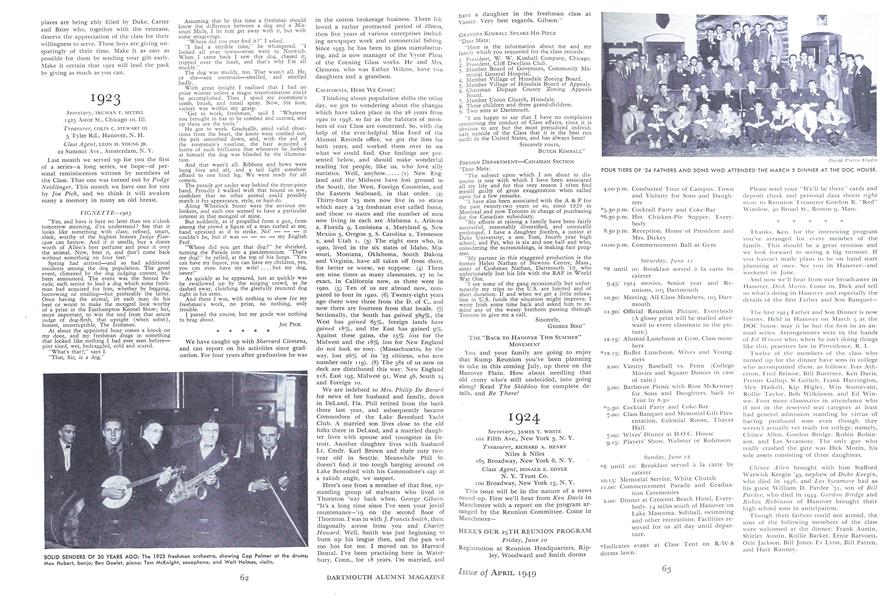
SOLID SENDERS OF 30 YEARS AGO: The 1923 freshman orchestra, showing Cap Palmer at the drums; Mox Hubert, banjo; Ben Goelet, piano; Tom McKnight, saxophone; and Walt Holmes, violin.
Secretary,1425 Astor St., Chicago 10, 111
Treasurer, 5 Tyler Rd., Hanover, N. H.
Class Agent, 22 Summit Ave., Amsterdam, N. Y.